



A version of this story appeared in the daily Threat Status newsletter from The Washington Times. Click here to receive Threat Status delivered directly to your inbox each weekday.
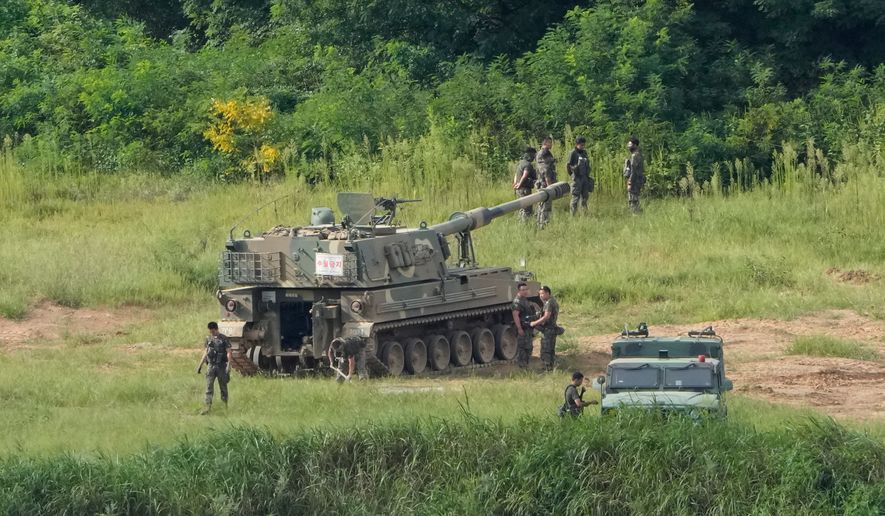
SEOUL, South Korea — A conflicted South Korea is weighing whether to deploy military forces to the Persian Gulf to aid the U.S. in its on-again, off-again war against Iran.
The issue is causing headaches in capitals that are traditional allies of the U.S. but have declined to join the American campaign against Iran.
On Monday, Seoul announced it was consulting with regional allies about a possible deployment, despite Iranian warnings the same day against any South Korean intervention.
People were interested in these podcasts
The presidential Blue House announced last week that no final decision had been reached on sending military forces to the Strait of Hormuz after multiple media reports suggested a deployment was planned. The Blue House said a review was underway.
Neighboring Japan has been adamant that it will not deploy assets to the combat zone. U.S. allies in NATO have taken the same position.
However, one expert says he believes Tokyo is acting evasively regarding its stated inability to commit.
South Korea and Japan, which wield powerful militaries, are not the only American allies agonizing over their decisions not to assist U.S. operations.
Britain was placed in an uncomfortable position after President Trump indicated that he may throw his weight behind Argentine President Javier Milei, who renewed his country’s claim to the Falkland Islands last week and threatened sanctions against companies drilling for oil near the islands.
London and Buenos Aires fought a short but intense land-sea-air war over the islands, which Argentina calls the Malvinas, in 1982.
South Korea’s choice
At a time when so many customary U.S. allies are refusing to join the war against Iran, a South Korean deployment could win diplomatic capital with Washington. However, Seoul appears gun-shy.
“We are closely communicating with the international community, including relevant countries, to help restore peace and stability in the Middle East as soon as possible and to ensure the free passage of all vessels, including those of our country, through the Strait of Hormuz,” the ministry announced Monday.
Despite the immense military superiority at their disposal, U.S. war planners have been confounded by Iran’s continued ability to threaten the strategic waterway, a key channel for the Gulf’s global energy exports.
That ability has dealt a blow to U.S. prestige and infuriated Mr. Trump, who has angrily asked allies to commit forces to reopening the strait.
Iran warned South Korea against any moves to assist the United States in the region.
“Any other country’s military presence or participation in operations in the Persian Gulf and the Strait of Hormuz can only be regarded as direct support for the party responsible for the aggression and will have serious consequences,” the Iranian Foreign Ministry stated in a Korean-language message monitored by South Korea’s Yonhap News Agency.
“Dangerous choices come with consequences,” the post warned. A South Korean tanker in the Gulf was damaged by an Iranian double-tap drone strike in May.
Seoul may nevertheless feel compelled to swallow risk and deploy some assets, given multiple frictions abrading current relations with Washington, its only major ally.
No apparent movement has been made on either a promised South Korean $350 billion investment pledge in America or on an American agreement to supply its Asian ally with nuclear submarine technologies.
Meanwhile, Washington is angered at the legal woes facing Coupang in Korea. The e-commerce giant does most of its business in Korea but is listed on U.S. stock markets and has taken to lobbying in Washington.
Seoul is concerned that American troops based in Korea could be used elsewhere in the region, potentially infuriating neighboring trade partner China.
Given all this, a deployment to the region, where the U.S. and Israel unleashed a joint offensive against Iran in late February, could feasibly earn Seoul some diplomatic points with the Trump administration.
Seoul maintains a base in the Gulf, with a special forces unit permanently based in the United Arab Emirates.
However, since the Vietnam War, when Seoul deployed the largest foreign troop contingent to assist the U.S.-allied Saigon regime, South Korea has largely taken noncombat roles alongside American troops.
In Iraq, it deployed a stabilization force to the country’s peaceful north. In Afghanistan, it dispatched medical and engineering units.
Last week, South Korean media, citing leaks, reported that the country may deploy noncombat assets to the Gulf. Under consideration, per the reports, are maritime reconnaissance aircraft, underwater clearance teams and a logistics vessel.
“I could imagine that President Trump put some pressure on us over the Strait of Hormuz,” said Lee Soonchun, a former chancellor of the Korea National Diplomatic Academy. “That was one reason he canceled the joint military exercises.”
Last month, Mr. Trump used Truth Social to announce that he was scaling back joint summer military drills with South Korea.
The unconventional communication method, and the short notice — mere hours before exercises were set to commence — caused consternation in Seoul.
One observer suggested that South Koreans needed to understand their ally’s shifting stance.
“American expectations are different now, and we need to change: It’s ‘No more free chicken,’” said Chun In-bum, a retired South Korean lieutenant general. “We have to do our part, and this thing in the Middle East is not just in U.S. interests: 70% of our oil comes through there, so it is in our interest to make it transitable.”
He added, “Though it’s too bad [Mr. Trump] did not consult us when the war started.”
Tokyo wriggles out
Japan, even as it continues a decade-long buildup of its Self-Defense Forces — its destroyers are being fitted out with U.S.-made Tomahawk cruise missiles — has kept its head below the parapets.
In March, Prime Minister Sanae Takaichi told Mr. Trump that Japan was unable to assist in the Gulf. Although Ms. Takaichi has been hawkish on defending Taiwan against China, she played a legal-political card — Article 9 of Japan’s pacifist constitution, which prevents Tokyo from using force to settle international disputes.
Although some conservative Japanese politicians have seen the mechanism as a constraint on Tokyo’s freedom of action, it is also a handy tool for turning down U.S. requests to join military adventures.
Mr. Lee noted that Seoul lacks any such exit clause. “We don’t have that kind of thing,” he said.
Still, Tokyo’s turn to Article 9 rests on dubious legal and legislative grounds.
Japanese Prime Minister Shinzo Abe secured a Cabinet reinterpretation of the constitution in July 2014, and the Diet passed enabling legislation in September 2015. Under that legislative effort, “collective self-defense,” including the defense of allies under attack, was enabled.
At the time, the importance of the Strait of Hormuz to Japan was specifically recognized as one potential area where future collective self-defense efforts might be required.
“A closure of the Strait of Hormuz was specified in Diet deliberations over this legislation as one of the prime cases where CSD would be invoked,” said Paul Midford, an American political scientist who teaches at Meiji Gakuin University. “Given that Takaichi is considered an ideological follower of Abe … it came as a real surprise that she invoked Article 9 to claim that Japan was unable to send its military to ensure the safety of ships in the Strait of Hormuz.”
Mr. Midford guessed that Mr. Trump’s aides were insufficiently briefed to push back.
“For some reason, Trump accepted her argument, apparently because he or his aides were unaware of the reinterpretation of Japan’s constitution a decade earlier,” he said.
Britain gets boxed in
Although Japan, which fields a highly capable minesweeping flotilla, has managed to avoid a commitment without consequences, another U.S. ally has had less luck.
London has permitted U.S. aerial assets to use British bases and has deployed ground and air units to the Gulf to help defend against Iranian strikes. However, Mr. Trump has made his disappointment with Britain’s response clear.
Speaking Thursday, Mr. Milei — a conservative who has amicable relations with Mr. Trump — used a national broadcast to restate Argentina’s claims to the Falkland Islands and announced he would seek legislation to impose sanctions on companies operating near the islands without approval from Buenos Aires.
Though geographically proximate to Argentina, Falkland residents, who are British citizens, have overwhelmingly voted to remain under London’s administration.
Mr. Milei also suggested that America may be moving away from its pro-London stance.
“The United States is considering this change in position because it knows that Argentina is a reliable partner, aligned with Western values, in a strategically important position that can be a valuable ally in the decades to come,” he said.
Asked about America’s position on the Falklands by British media outlet GB News before Mr. Milei’s statements, Mr. Trump did not respond directly but said Britain was “not there to help” in the Gulf.
Earlier, Mr. Trump, who is pressing London to increase its defense spending, said Washington’s position on the Falklands could “come under review.”
Britons like to think they have a “special relationship” with the U.S. because of their shared language and legal systems and their alliances on the battlefields of World War I, World War II, Korea and the global war on terrorism.
Mr. Milei is opposed to joint British-Israeli oil drilling off the Falklands, set to start within months. Some British critics say he needs to position himself strongly on the Falklands, a highly emotive issue for Argentines, ahead of a general election in 2027.
Contact the author

Please read our comment policy before commenting.