



OPINION:
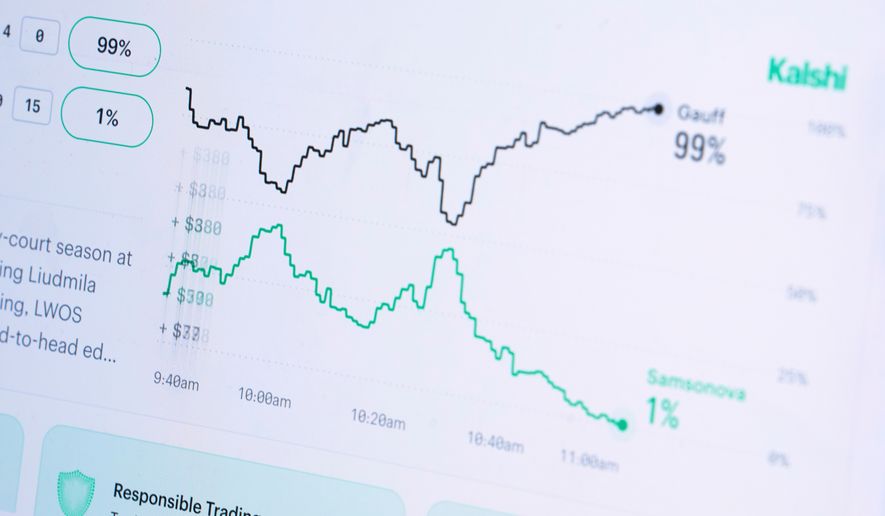
An issue that has flared up almost as fast as the public’s revolt against data centers is the rapid growth of prediction markets. These are online marketplaces where participants buy and sell contracts tied to the outcomes of future events.
If you are unfamiliar with Kalshi or Polymarket, you can make a bet or prediction on nearly any future event happening — such as who will be the next president, what the consumer price index will be next year, whether space aliens exist and whether a peace treaty with Iran is likely.
This has become a massive overnight market with more than $40 billion in annual contracts and billions more on predictions for this year’s midterm election outcomes.
People were interested in these podcasts
Naturally, Congress and many states want to regulate these markets as gambling casinos. These markets are currently regulated by the Commodity Futures Trading Commission.
Yet this is not gambling. Prediction markets play a valuable role in a free market economy by helping to hedge against risks. The classic example is the betting market on where last month’s hurricane off the coast of Florida would make landfall and how much damage it would cause. This highly influenced how Floridians prepared for the storm.
What are the odds that President Trump will repeal his steel and aluminum tariffs? Every manufacturer in America wants to know that.
Independent academic studies, supported by data from Kalshi’s internal research across more than 2.2 million resolved markets, confirm that prediction markets are more accurate than listening to so-called experts. That is because the collective wisdom of prediction markets takes expert analysis into account when setting the odds.
Here is what the data shows, based on Kalshi’s odds of an event occurring versus the actual outcome, across more than 2.2 million observations.
At any given time, the prediction markets are accurate to within less than 1%. For example, when Kalshi sets a line one month out at a 30% chance of an outcome, the estimate is accurate to within about a 1% margin of error.
In other words, that event happened 29% to 31% of the time. That is one month out from the event. Within a day or a week of the event, the predictions are even closer to bull’s-eye accuracy.

Capital markets and insurance markets thrive on accurate information. Prediction markets make the entire economy work better.
There should be CFTC regulations on issues such as a minimum age requirement. There should be laws restricting individuals from participating in a market when they can control the outcome. The U.S. trade representative, for example, should not be allowed to bet on whether tariffs will be lifted.
Still, more information is always better than less in a market-based economy. We do not need gaggles of university professors making wild forecasts about what is going to happen to the planet. If they are so smart and can see into the future, they can now put their money where their mouths are and get rich.
Yet prediction markets are teaching us that there are a lot of blowhards out there.
In markets, you are punished for making wrong and wild predictions. In academia, you get famous for it.
The government should keep its hands off this booming market that is making our economy even more efficient every day.
• Stephen Moore is a senior fellow at the America First Policy Institute and a co-founder of Unleash Prosperity.
Follow the author
Please read our comment policy before commenting.