



A version of this story appeared in the daily Threat Status newsletter from The Washington Times. Click here to receive Threat Status delivered directly to your inbox each weekday.
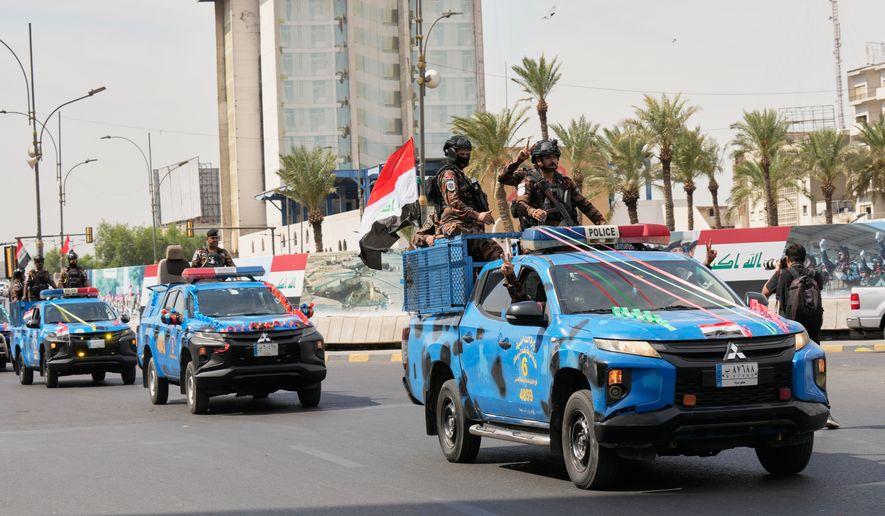
The last remaining American troops in Iraq pulled out of Irbil Air Base in the country’s Kurdistan region on Wednesday, more than two decades after the 2003 invasion toppled the regime of Saddam Hussein, which later morphed into a U.S.-led campaign against the Islamic State terrorist group.
President Trump hailed the withdrawal as a victory for both the U.S. and Iraq.
“This day is a victory for the United States. It’s a victory for Iraq and a decisive victory over ISIS, which has been completely decimated, which is the reason we went in there in the first place,” Mr. Trump said at a White House event.
People were interested in these podcasts
“We came to fight a caliphate, and there is no longer a caliphate, so we are going home,” he said.
More than 4,500 American military personnel died in Iraq across Operation Iraqi Freedom and subsequent counter-ISIS missions since the 2003 invasion, according to Department of Defense casualty records.
“The United States supports a strong sovereign Iraq that secures its borders, protects its people and serves as the foundation for deeper commercial, diplomatic and security cooperation between our two countries,” chief Pentagon spokesman Sean Parnell said in a statement.
Washington and Baghdad announced a formal understanding to wind down the mission during the Biden administration. Wednesday’s deadlinew was reaffirmed in July during Iraqi Prime Minister Ali al-Zaidi’s meeting at the White House.
Mr. Trump said the Iraqi leader “is outstanding” and fully capable of running the country without U.S. intervention.
Still, analysts say that even without the presence of U.S. troops, Mr. al-Zaidi faces significant challenges bringing Iran-backed Iraqi militias under government control. Hard-line armed groups such as Kataib Hezbollah and Harakat Hezbollah al-Nujaba are not surrendering their weapons and integrating into Iraq’s armed forces.
“The real test for al-Zaidi will be whether he can convince the United States to stay the course in building a bilateral defense relationship and encouraging strong American investment while he buys more time to establish control over the militias that continue to resist disarmament,” said Alina Romanowski, a distinguished fellow at the Scowcroft Middle East Security Initiative at the Atlantic Council think tank.
She warned that the departure of U.S. forces from Iraq is seen by many across the Middle East as an example of America abandoning its regional partners.
Mr. Trump compared the relatively straightforward U.S. pullout from Iraq with the chaotic evacuation from Afghanistan during the Biden administration, including the August 2021 suicide bombing at Hamid Karzai International Airport that killed 13 U.S. service members and at least 170 Afghan civilians.
According to oversight reports from the Department of Defense and the Special Inspector General for Afghanistan Reconstruction, the U.S. military also left behind about $7 billion in government-funded arms, vehicles and equipment originally provided to Afghan forces that ultimately fell into the hands of the Taliban.
“I said, ‘I want every screw taken. If there’s a screw lying on the ground, take it. If we have a canvas tent, take it.’ We took everything,” Mr. Trump said about the Iraq withdrawal.
Sabah al-Numan, an Iraqi military spokesman, took a more optimistic tone Monday regarding the foreign military pullout. Baghdad is formally marking the withdrawal as Iraqi Sovereignty Day.
“Our security situation is good, and we maintain control over all Iraqi territory. There are no concerns regarding the country’s security, and our forces are deployed throughout Iraq,” Mr. al-Numan told the Iraqi News Agency. “Furthermore, our relationship with the international coalition will transition into a different form of bilateral partnership.”
Majid Al-Qaysi, a retired Iraqi general and former director of intelligence analysis for the Ministry of Defense, said the most pressing concern is not what happens in the immediate aftermath of the U.S. withdrawal, but rather the long-term future of Iraq.
“The most important question, in my opinion, is whether Iraq will be able to manage the new balance of power internally while simultaneously dealing with external regional pressures,” Gen. Al-Qaysi told The Washington Times. “The real test may be the Iraqi state’s ability to unify security and defense decision-making, coordinate its military institutions and prevent the post-withdrawal phase from degenerating into a competition for influence.”
After overthrowing the Saddam Hussein regime and fighting violent insurgencies across much of Iraq, U.S. forces were withdrawn in 2011 but returned in 2014 to help Baghdad because of an ISIS offensive that nearly brought down the government.
Eyup Kerem, president of the Iraqi Turks Association, told The Washington Times that the U.S. withdrawal caps a long process.
“This should be understood not simply as an American withdrawal, but as part of a wider Iraqi effort to reassert full state sovereignty and reduce the presence of foreign military forces on Iraqi territory,” he said from the city of Kirkuk.
A U.S.-led task force aimed at countering ISIS is relocating its headquarters to Jordan, and operations will continue in Syria. Roughly 4,000 troops will remain in Jordan.
Mr. Kerem said Iraqi and Turkish officials are discussing Iraq’s relationship with its NATO member neighbor. Turkey agreed to gradually transfer control of the strategic Bashiqa-Zilkan military base in northern Iraq to the Iraqi government.
“This is significant because it demonstrates that the issue is not being framed exclusively around the United States. There is a broader Iraqi objective of restoring the state’s authority over its territory,” Mr. Kerem said.
Meanwhile, the U.S. relationship with the Kurds in Iraq has evolved over decades into a vital strategic partnership. Kurdish forces fought alongside U.S. troops to overthrow Saddam in 2003.
More recently, American troops and Kurdish Peshmerga forces worked closely in the military campaign to defeat ISIS, with Washington providing extensive support.
As for the American withdrawal, Ruwayda Mustafah, a writer and analyst specializing in Kurdish affairs, said it has caused consternation in the region.
“There’s a growing sentiment of uncertainty and not knowing where things are headed. The Kurdish people throughout history have suffered immensely and have been a casualty of wars they didn’t start or want to take part in,” Ms. Mustafah said.
The U.S. established a no-fly zone over the Kurdish region in the 1990s, which provided the Kurds with a corridor of safety that they have always relied on, she said.
“There’s a growing sentiment of not knowing what’s to come, whether this region is going to destabilize,” she said.
External backing, particularly from Washington, has long underpinned the semiautonomy of the Kurdistan Regional Government, according to an analysis by the Soufan Center think tank.
Since the start of the Iran war, U.S.-led coalition air defense forces have intercepted about 95% of the drones and missiles fired by Iran and its military allies at targets inside the KRG, analysts said.
“The departure of the U.S.-led coalition leaves the KRG bereft of an independent capability to counter such attacks and more dependent for its security on what have been unreliable — and sometimes openly hostile — governing partners in the Iraqi federal government,” Soufan Center analysts said.
Mr. al-Zaidi addressed the U.N. General Assembly on Friday, setting out his country’s vision for regional security and economic development. He said the West can still play an important role in securing Iraq’s future by providing its expertise in economics, finance and business.
“Our ambition is for Iraq to become a global hub for energy production and to make use of its capabilities to sustainably strengthen regional and international security and stability,” he said. “Iraq has never been on the margins. It is the heart of history and the pulse of the present, and it is worthy of partnership for the future.”
• Jeff Mordock contributed to this story.
Correction: Analyst Ruwayda Mustafah’s name was misspelled in an earlier version of this story.
Contact the author

Please read our comment policy before commenting.