


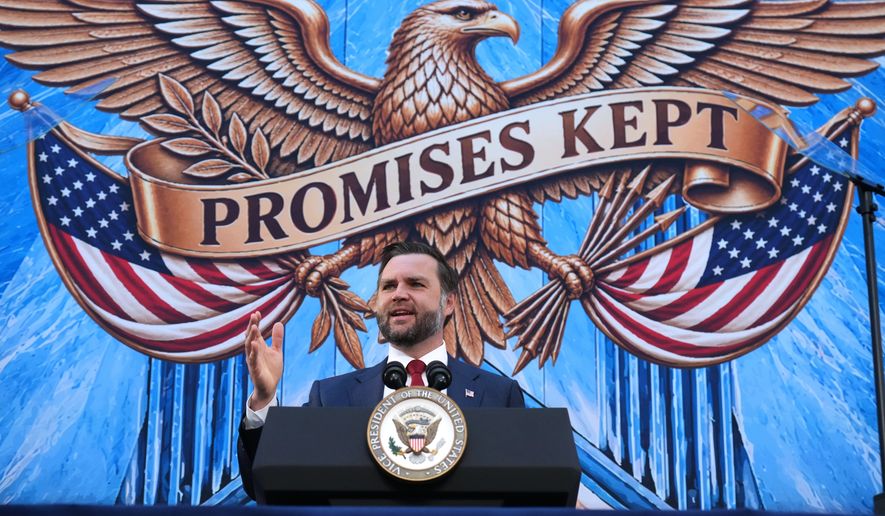

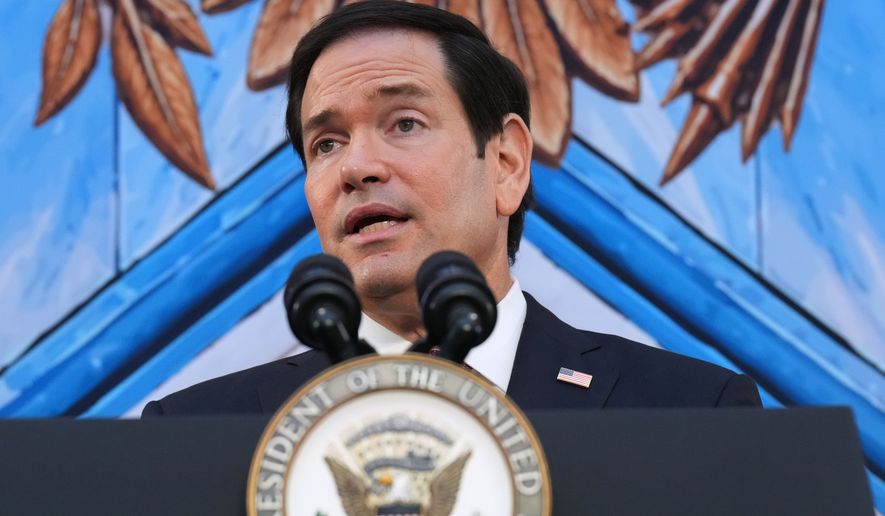
Vice President J.D. Vance and Secretary of State Marco Rubio tied the Trump administration’s aim to revitalize U.S. manufacturing to national security on Thursday at the launch of Foundry School, a State Department partnership with American universities.
Both officials echoed President Trump’s claim that the U.S. has for years acted as the world’s customer, not its builder, leaving America dependent on rival nations such as China for essential goods.
“We are suddenly, as a nation, dangerously dependent … not simply for our economic vibrancy, but, in many cases, for our national security and our very survival as a prosperous nation-state,” Mr. Rubio told a crowd of tech leaders, lawmakers and education officials at the Donald Trump Institute of Peace in Washington.
People were interested in these podcasts
Mr. Vance cited supply chain shocks during the COVID pandemic that made it harder for Americans to obtain lifesaving health equipment as one example of how relying on foreign manufacturing can weaken the country.
“You cannot run an economy entirely on services and finance. You have to have a foundation. And that foundation is always going to be making stuff,” Mr. Vance said.
Foundry School is a workforce-training program aimed at rebuilding America’s domestic manufacturing base, according to a State Department readout. First announced by Undersecretary Jacob Helberg this year, the project brings together eight universities to host 17 sessions with manufacturing officials and executives from the U.S. and partner countries.
Participating universities include Arizona State, Georgia Tech, Ohio State, Penn State, the University of Cincinnati, the University of Kansas, Stanford and Vanderbilt.
In opening remarks, Mr. Helberg said manufacturers will need 3.8 million skilled workers by 2033 to fill jobs in the defense, energy and semiconductor industries. That figure comes from a 2024 joint report by Deloitte and the Manufacturing Institute, which found that 1.9 million of those jobs could go unfilled if nothing is done.
Foundry School is the flagship project of Pax Silica, the Trump administration’s effort, led by Mr. Helberg, to strengthen international economic partnerships and “critical supply chains and industrial capabilities that underpin the AI economy.”
The initiative is the latest in the administration’s push to boost domestic manufacturing employment, which has generally declined since Mr. Trump took office last year.
Federal employment figures show the sector has shed 75,000 jobs since the start of the year alongside a sharp drop in capital investment for new production plants.
Still, the White House has pointed to manufacturing job openings, which hit 529,000 in May, as evidence its policies are working.
Some economists counter that open-job figures are a poor indicator of industry health, since they don’t reflect turnover or growth.
Foundry School, which aims to expand an educated industrial workforce, could help fill some of those jobs.
Contact the author

Please read our comment policy before commenting.