



OPINION:
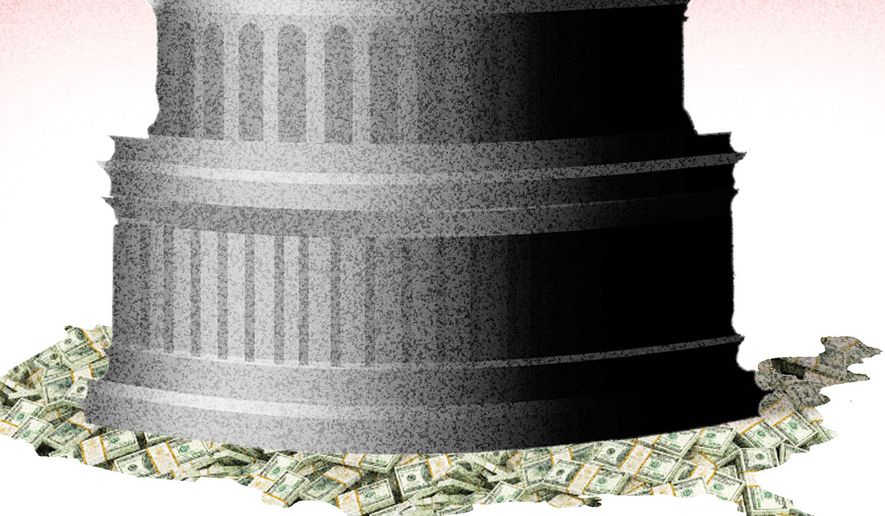
With President Trump offering $5,000 to every American adult if Republicans win the upcoming midterm elections, both major political parties appear to have reached the looting-the-Treasury stage of our republic’s history.
Can federal spending still be cut, or are we trapped in a doom loop toward national bankruptcy?
A few weeks ago, Mr. Trump pledged to give a $5,000 “dividend” to all adults if Republicans retain Congress. That comes to more than $1 trillion, and it is on top of a roughly $2 trillion annual deficit.
People were interested in these podcasts
Mr. Trump’s argument is that a growing economy can carry it and the economy will grow sufficiently only if Republicans remain in charge.
Job growth recently rebounded to 162,000 per month, temporarily calming fears of a no-hire-no-fire economy squeezed among wartime oil prices, slowing growth and, of course, artificial intelligence eating all the jobs.
Even happier was the federal workforce number: down roughly 336,000 since Mr. Trump returned to office. The level of government bureaucrats is now at its lowest level since the 1960s. Unfortunately, slashing the federal workforce apparently had little effect on Leviathan itself.
Washington accumulated a deficit of nearly $2 trillion during the first 11 months of fiscal year 2026.
Meanwhile, in August, the national debt passed $40 trillion. This is particularly depressing because we just ran the closest thing America may ever get to a controlled experiment in shrinking government.
Republicans held the White House and both houses of Congress. Mr. Trump came in swinging an ax at the administrative state. Elon Musk, a force of nature fresh off firing most of what was Twitter, was turned loose inside Washington with a mandate to cut trillions of dollars.
Though federal payrolls plunged, the fiscal trajectory barely budged.
That is because personnel and administrative costs are not what drive trillion-dollar deficits. Social Security, Medicare, Medicaid, defense and interest on the debt dominate federal spending. The Department of Government Efficiency could fire employees, cancel contracts and target agencies, but it could not reach the machinery actually producing the red ink.
When DOGE identified hundreds of billions of dollars in potential savings, Congress ignored them. If unified Republican control and Messrs. Trump and Musk could not bend the curve, what combination could?
Here is the problem: The forces expanding government are structural. Industrialization created taxable prosperity, allowing the government to take a rising share of national income without an automatic response of torches and pitchforks.
As voting expanded beyond property owners and substantial taxpayers, political participation became less directly tied to government financing. Public choice theory predicts the result: programs with concentrated benefits and widely dispersed costs.
Women’s suffrage shifted the median voter further toward health, education and social insurance. One prominent study estimated that enfranchisement increased state spending fourfold.
Then came the financial machinery. The income tax and the Federal Reserve both arrived in 1913, when Washington was dramatically smaller. Payroll withholding, introduced during World War II, made taxation nearly invisible by taking the money before workers ever saw it.
Corporate taxes disguise additional government financing paid by shareholders, workers and consumers. Deficits dump the bill on future taxpayers who cannot vote today. Inflation siphons purchasing power without requiring Congress to announce a tax increase. Each mechanism weakens the connection between receiving government benefits and paying their cost.
Finally comes the crisis. Wars, depressions and pandemics lead to borrowing, taxation and controls that voters might reject in ordinary times. Some emergency measures disappear, but most of the revenue capacity, bureaucracy and beneficiaries remain. Thus, the government ratchets upward.
President Reagan showed the limits. He cut the top marginal income tax rate from 70% to 28% and pursued sweeping deregulation. Yet federal spending barely budged, falling only from 22.1% to 20.5% over his eight years in office.
Reversal is not impossible. Tax transparency could reconnect benefits with costs, while federalism could return responsibilities to states. Enforceable spending limits — ideally, a balanced budget amendment — could impose fiscal discipline.
Yet ordinary elections face a structural obstacle: Voters receive visible benefits while seeing only a fraction of the bill.
Indeed, Mr. Trump’s proposed $5,000 dividend perfectly illustrates the doom loop. Even the party that promised to drain the swamp now proposes borrowing more than $1 trillion to reward voters for keeping it in power.
Washington’s workforce can shrink and its offices can close, but until voters see the full cost of what politicians promise them, Leviathan will keep growing.
• Peter St. Onge, Ph.D., is senior economist, and E.J. Antoni, Ph.D., is chief economist at The Heritage Foundation.
Please read our comment policy before commenting.