



A version of this story appeared in the daily Threat Status newsletter from The Washington Times. Click here to receive Threat Status delivered directly to your inbox each weekday.
OPINION:
Does the name Dmitry Medvedev ring a bell? If not, let me remind you. He was president of Russia from 2008 to 2012.
Perhaps you recall that, in 2012, President Obama told him that their disagreement over American missile defense in Europe could be resolved.
On a hot mic, Mr. Obama added, “This is my last election.” Then: “After my election I have more flexibility.”
People were interested in these podcasts
Mr. Medvedev replied, “I will transmit this information to Vladimir.”
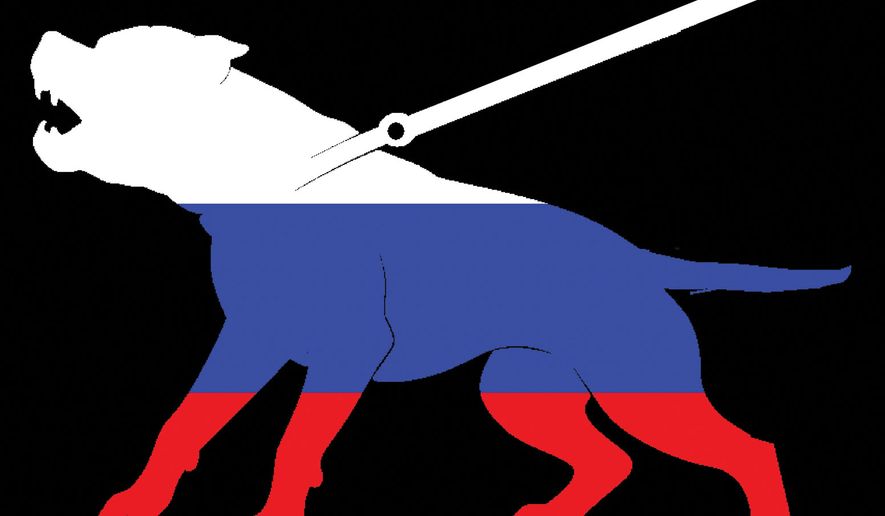
Vladimir Putin was then Russia’s prime minister, so constitutionally, Mr. Medvedev was his boss. Mr. Putin had preceded him as president and would succeed him as president. There was never any question about who was the top dog and who the lap dog.
Today, Mr. Medvedev holds two positions: deputy chairman of the Security Council of the Russian Federation and chairman of the United Russia party.
Those sinecures give him a platform to serve, and also to serve as Mr. Putin’s attack dog. For example, in an interview this month with the Russian-language daily Vedomosti, he accused Western leaders of a “Neanderthal mindset and abysmal ignorance.”
By supporting Ukraine, he added, they were “trying to push the world to the brink of nuclear apocalypse,” adding that Moscow “reserves the right” to use nuclear weapons “if its security is threatened.”
A few days later, Mr. Medvedev addressed United Russia regional secretaries in preparation for the Sept. 18-20 elections for the State Duma, the lower house of parliament.
The results of that neither free nor fair election were announced Friday: United Russia won 349 of 450 seats, a party record now cited as proof of Mr. Putin’s popular support, as is his war against Ukraine.
That conflict is estimated to have resulted in more than 1.4 million Russian military casualties, including as many as 500,000 killed since 2022 — some 30 times the Soviet death toll during the decade of war in Afghanistan.
In exchange for those losses, Russia’s net gain this year, Ukrainian and Western sources say, is about 39 square miles, or roughly the size of the Disney World Resort in Florida.
What I found most revealing were Mr. Medvedev’s two sentences defining the purpose of the conflict. “Our country can either be a great power, or it will not exist at all. Such are the laws of history.”
In other words, ambition and the domination of Ukrainians are the primary motives.
As for the “laws of history,” he is wrong about extinction but onto something else. Britain and France, former empires, still exist. Yet despite their nuclear weapons and large economies, are they still great powers? Or are they declining powers?
He has reason to think Russia’s descent would be steeper. Britain and France shed empires that lay overseas. What he considers Russia’s “empire” sits inside its own borders: 11 time zones, an ethnic Russian majority ruling nearly 200 distinct people, among them Chechens, Tatars and Tuvans.
Why is that not enough?
Mr. Putin’s claim to Ukraine rests on history he distorts — most notably in his 2021 essay on the “historical unity” of Russians and Ukrainians.
From the late ninth century to the mid-13th century, Scandinavian Norsemen settled among and assimilated with the indigenous East Slavic and Finnic tribes, forging a powerful medieval state centered on Kyiv and extending across lands now in Ukraine, Belarus and Russia.
On that basis, all three states can claim aspects of the inheritance of Kyivan Rus’, but none can claim that inheritance gives it title to the others.
The Russian Empire emerged centuries later. In 1721, after defeating Sweden in the Great Northern War, Peter the Great adopted the title “Emperor of All the Russias” — the plural meaning Great, Little and White Russia, which is to say Russia, Ukraine and Belarus.
The empire fell in 1917. Five years later, the Soviet Union rose across much of its former territory. Mr. Putin has called the collapse in 1991 “a major geopolitical disaster” of the 20th century.
His mission now: Restore an empire and become Vladimir the Great (ironically, an epithet borne by a prince of Kyiv who died in 1015).
President Trump said outside the United Nations on Sept. 22 that his message for Mr. Putin was “Settle the war!” Yet what I have recounted above should make clear why proposals for “peace and reconciliation” hold no appeal for the man in the Kremlin.
That said, if the price Russia is paying in blood and treasure continues to rise — as it will if Ukrainians, on the front line against a common enemy, receive the support they deserve from the U.S. and Europe — it is not impossible to imagine Mr. Putin agreeing to a ceasefire.
He could call such a pause temporary and prepare for future hostilities against what he will never stop regarding as a rogue province.
Ukrainians could use the truce to bolster their defenses, making the country harder to conquer — a steel porcupine. Thereafter, Mr. Putin might wake up every morning to decide that today is not a good day to resume his “special military operation.”
Whoever comes to power in the Kremlin next might find himself another mission. I would bet a ruble — now worth only about a penny — that it will not be Mr. Medvedev.
So, my advice to Mr. Trump: Do not try to “solve” the “underlying conflict” between Moscow and Kyiv with some grand bargain. Pursue a halt to the carnage instead, an armistice with continuing weapons flows and security guarantees for Kyiv.
That may not win you a Nobel Peace Prize from the leftist globalists who give out those awards, but serious historians of the future will recognize your work as a major strategic and humanitarian achievement.
• Clifford D. May is founder and president of the Foundation for Defense of Democracies, a columnist for The Washington Times and host of the “Foreign Podicy” podcast.
Follow the author
Please read our comment policy before commenting.