


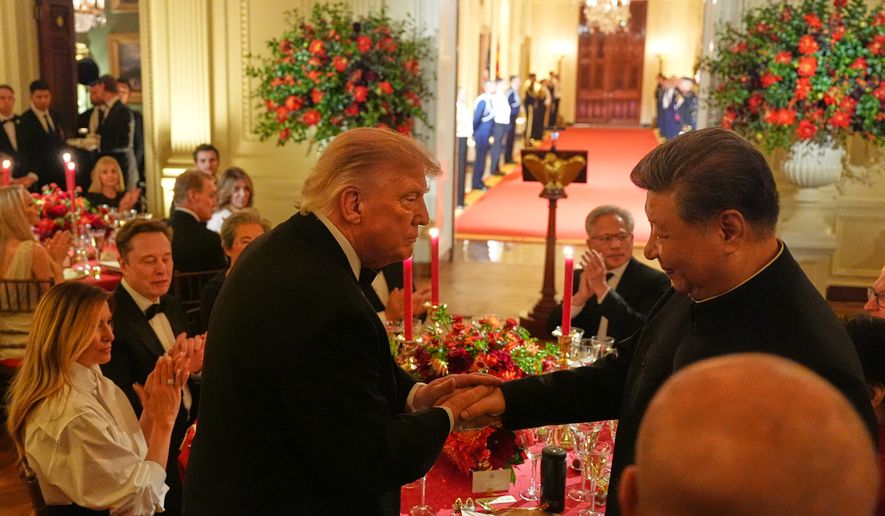

President Trump and Chinese President Xi Jinping on Thursday acknowledged their intense competition in the race to dominate artificial intelligence, but said they needed to work together to make the technology a source of economic prosperity for both, rather than another source of conflict.
The technological rivalry between the world’s two largest economies took center stage during Mr. Xi’s state visit to Washington, his first trip to the U.S. capital in more than a decade.
Both leaders cast artificial intelligence as an area of potential cooperation between the two superpowers, which are increasingly at odds over trade, Taiwan, rare earths and global influence.
People were interested in these podcasts
Neither leader said he was prepared to slow down the competition. The U.S. is trying to preserve its lead in advanced AI and computer chips, while China is pouring resources into closing the gap and reducing its dependence on American technology.
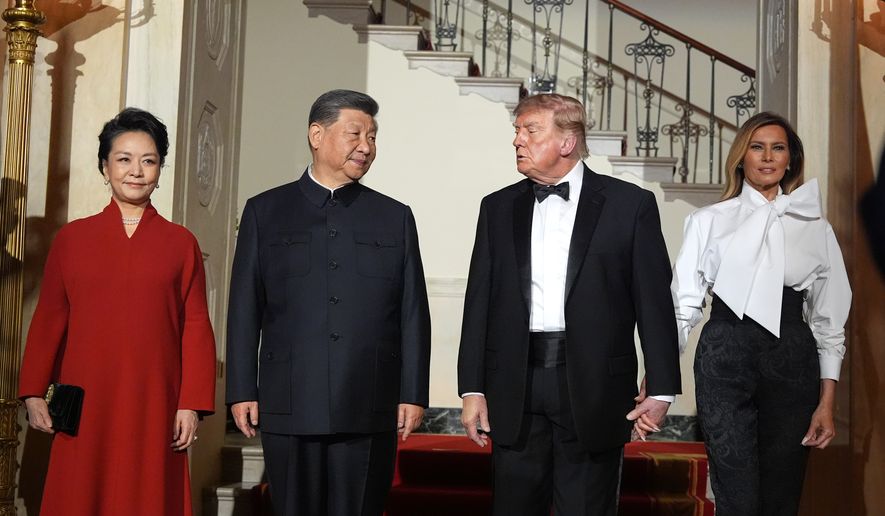
Still, Mr. Trump and Mr. Xi both said AI is becoming too powerful and too disruptive for either nation to race ahead without cooperating with the other.
“We do not need to avoid mentioning competition, but our competition should be a healthy one, and we should be kept within bounds. It should be a contest of catching up with one another, not a wrestling match in which one wins and the other loses,” Mr. Xi said.
SEE ALSO: Trump, Xi hail friendly relations at White House state dinner
Mr. Trump, standing alongside Mr. Xi, echoed Mr. Xi’s remarks, saying they would discuss AI as a way to promote peace.
“During this visit, we will also discuss pressing issues concerning security, technology and superintelligence — SI,” Mr. Trump said, using his new “superintelligence” moniker for the technology. “The decisions we make in these areas today can promote peace and prosperity for decades and decades to come.”
AI loomed over the pageantry of the state visit.
Mr. Trump and first lady Melania Trump welcomed Mr. Xi and his wife, Peng Liyuan, on a red carpet at the White House, where hundreds of U.S. military personnel took part in an elaborate arrival ceremony capped by a B-2 stealth bomber flyover. The leaders then moved inside for talks before a state dinner Thursday night featuring some of the biggest names in American technology.
The lavish affair underscored the importance Mr. Trump placed on Mr. Xi’s visit even as the two superpowers remain divided over trade, Taiwan and other issues. Behind the military honors, formal dinners and warm words about their personal relationship was a harder reality: Washington and Beijing are locked in an increasingly consequential contest for economic and technological supremacy, with AI rapidly moving to the center of that rivalry.
However, the two leaders also laid out different visions for AI. Mr. Trump wrote on Truth Social that there should be no guardrails for AI and the only watchdog needed was the U.S. Justice Department.
SEE ALSO: Fox News hosts, tech titans dominate guest list for Xi state dinner
Mr. Xi approached the issue differently. He said at the White House that China and the U.S. bore a responsibility to control AI because they were the leading powers in the technology.
“We have both the capability and responsibility to develop and manage AI for good,” said Mr. Xi, adding that it should remain under human control.
The competing messages captured the uneasy reality confronting both nations.
Washington and Beijing view artificial intelligence as critical to economic power, military strength and global influence. Neither wants to surrender an advantage to the other.
Yet the faster the technology advances, the more both sides have to lose if something goes wrong.
That has opened a narrow lane for cooperation.
Treasury Secretary Scott Bessent said before the summit that the U.S. proposed a notification system for Washington and Beijing to alert each other of serious AI incidents involving national security.
“We want a shared vision of common goals and common threats,” Mr. Bessent said after preparatory talks with Chinese Vice Premier He Lifeng.
The idea is modest. It would not prevent either country from developing more advanced systems, loosen American restrictions on sensitive technology or resolve disputes surrounding Chinese access to U.S. AI capabilities.
Instead, it would establish a channel for two rivals to communicate when the risks transcend the competition itself. That could become increasingly important as AI systems are integrated into cybersecurity, financial markets, military operations and critical infrastructure.
The talks ended without any announcement about the proposed system or whether the two leaders discussed it.
Ahead of their roughly one-hour bilateral meeting, both leaders stressed cooperation between the two nations.
Mr. Xi offered several proposals to boost cooperation between the U.S. and China, including increasing direct flights between the two nations to expand trade, inviting 100,000 young Americans to visit China for cultural exchanges and study over the next five years, and announcing the arrival of two Chinese pandas — Ping Ping and Fu Shuang — at Zoo Atlanta.
Mr. Trump also hailed new progress in trade between the U.S. and China, saying he and Mr. Xi “have made tremendous strides on issues facing our two countries.”
He referred to his trip to Beijing in May, which led to the creation of the Board of Trade, a mechanism to promote the exchange of non-sensitive goods between the U.S. and China.
“Our teams have been working to encourage a more balanced trading relationship, including the new market access for American farmers and ranchers,” Mr. Trump said.
Mr. Xi vowed that Beijing “is willing to strengthen cooperation” with U.S. law enforcement to crack down on fentanyl shipped from China to America.
Mr. Trump also enjoyed showing his Chinese counterpart the renovations to the White House, including a new helipad on the South Lawn and a ballroom under construction.
“As President Xi has already seen, a lot has changed since he was last here,” Mr. Trump said in welcoming remarks.
Mr. Xi attended a state visit hosted by President Obama in September 2015.
Mr. Trump pointed out the granite helipad from the South Portico as they reviewed an honor guard. Mr. Xi gave Mr. Trump a thumbs-up, and Ms. Peng appeared to offer words of approval to Mr. Trump.
Mr. Trump said Mr. Xi is “an expert on stone, aside from many other things, and he loves good granite.”
Contact the author


Please read our comment policy before commenting.