



NEWS AND ANALYSIS:
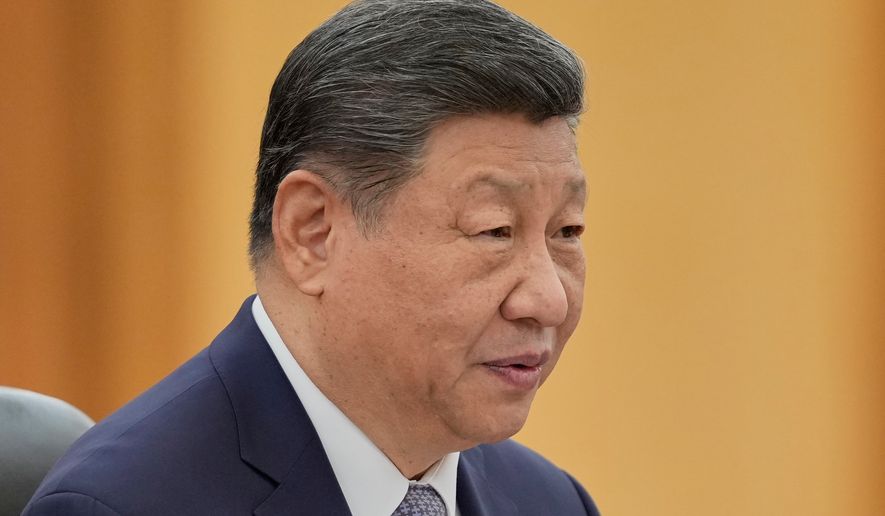
The chairman of the Senate Armed Services Committee does not share President Trump’s enthusiasm for Chinese President Xi Jinping’s state visit this week.
Sen. Roger F. Wicker took to the Senate floor to announce that if he had been asked, Mr. Xi would not have been invited or given the planned, grandiose state visit culminating in a White House banquet set for Thursday.
The chairman then outlined a number of issues he wants Mr. Trump to raise with the Chinese Communist Party leader at the dinner, including a response to reports that China supplied Iran with intelligence that led to the deaths of Americans in the Middle East, and about Beijing’s “massive” military buildup.
People were interested in these podcasts
“This summer, it was all over the press that China gave Iran satellite imagery intelligence, and that intelligence led to the death of American troops,” the Mississippi Republican said.
“So I would certainly suggest that the president try to get an answer to that.”
Mr. Wicker said Mr. Trump will correctly discuss trade and artificial intelligence with Mr. Xi and “perhaps some progress will be made.”
“But, Mr. President, during every minute of dialogue, our commander in chief should keep in mind that his guest is a brutal, unelected and oppressive dictator who seeks to dominate his neighbors, and whose massive military arsenal is aimed directly at the United States of America,” Mr. Wicker said in the floor remarks referring to the presiding Senate officer as Mr. President.
Mr. Trump has been relatively quiet about the summit and dinner but in the past has praised his close relationship with Mr. Xi.
“We’re going to talk about a lot. It’s going to be a great meeting. And we’re going to have a look — we have a very good relationship,” he said Tuesday in New York. “Look, he likes China. I like the U.S. He loves China. I love the U.S. That’s the way it is.”
Mr. Wicker urged the president to raise the issue of the repression of millions of the predominantly Muslim Uyghurs languishing in concentration camps in western Xinjiang.
“I hope our president will take this visit as an opportunity to advocate for the Uyghur people. The fact that they remain in prison by the millions is a grave injustice and a reminder of Xi Jinping’s many human rights abuses,” he said, adding that continued repression of all unofficial Christian and other religious groups in China also should be raised.
On Japan, Mr. Wicker said Mr. Xi should be confronted by what he said is open coercion against key U.S. allies Japan, the Philippines and Taiwan.
“The Chinese dictator works hard to intimidate America’s allies in the East China Sea, the Taiwan Straits, and the Second Thomas Shoal,” he said. The shoal is a disputed island in the South China Sea. Both China and the Philippines claim the shoal.
During the May summit in Beijing, Mr. Trump advocated in support of imprisoned Hong Kong media mogul Jimmy Lai, who he said has been locked in solitary confinement for the crime of “speaking freely in Hong Kong,” Mr. Wicker said, adding that the president should again demand Mr. Lai’s release.
Chinese navy and coast guard harassment of Philippine fishermen and sailors and other abuses of neighboring states also should be a topic of dinner discussion, along with Beijing’s interference in the internal affairs of other nations.
Another issue that needs to be addressed is China’s exploitation of nations in Africa and Latin America using “debt trap diplomacy” and election meddling, he said.
“And while the service is switching from chardonnay to Cabernet at the fancy state dinner, perhaps the president could turn to Xi’s so-called reunification of China with Taiwan,” he said.
Mr. Wicker said Mr. Trump should press the Chinese leader on whether he plans to turn the freely elected government in Taiwan into Hong Kong that lost its freedom after mainland communist controls were imposed.
Asked about the senator’s comments, Secretary of State Marco Rubio said the idea that the U.S. should not interact with Chinese leaders is irresponsible and “outrageous.”
“We have to,” he said in New York on Wednesday. “I think it’s just responsible statecraft for our leaders to speak and meet with one another, and that’s the way we view it, and that’s the way we view this visit.”
Separately, the House Select Committee on the Chinese Communist Party released a video for the summit noting China’s support for Iran.
The video quotes Committee Chairman Rep. John Moolenaar saying China buys 90% of Iran’s oil and is helping Tehran evade sanctions and help its struggling economy.
Beijing is keeping the economies of both Iran and Russia “afloat” while fueling its “authoritarian agenda,” the video states.
“China’s dark fleet is Iran’s economic lifeline, shipping illegal oil to bypass sanctions,” the video said.
“China also helps Iran with satellite imagery and targeting data for attacks on U.S. military assets in the Middle East.”
Report: China ready to attack Pacific undersea cables
China’s military has built weapons for cutting strategic undersea communications cables in the Pacific as part of “gray zone” or low-level warfare, according to a new congressional commission report.
The Chinese are rapidly preparing the capabilities to attack underwater cables using dual-use military-civil fusion technology that will allow its forces to access and target the lines in potential offensive military attacks during a future conflict, the report published by the U.S. China Economic and Security Review Commission warns.
The tools range from submersibles capable of diving 6,200 feet underwater to swarming underwater drones.
The report states that China regards undersea cables as vulnerable to offensive action both above and below the level of kinetic military action.
Pacific cable connections among the U.S. and allies Taiwan, Japan and the Philippines are often located in shallow or contested waters and in busy shipping lanes and are among the most vulnerable in the Pacific networks, the report said.
Attacks on cables near Taiwan by China could impact U.S. efforts to defend the island from an attack, the report said.
“The ability to conduct sabotage attacks on undersea cables gives China the ability to effectively hold an adversary’s infrastructure hostage as a tool of ’asymmetric leverage’ in both times of conflict and gray zone coercion,” the report said.
Military writings identify attacks on seabed infrastructure as asymmetric warfare tools against technologically superior adversaries like the U.S. and allow strikes that will not trigger political and legal thresholds of overt military attacks.
One Chinese military official quoted in the report states that in a war, “cutting undersea cables is the most effective way to strike at the opponent’s vital points” at low cost and with high impact on disrupting enemy command and intelligence systems.
China operates a range of specialized deep-sea robot vehicles equipped with cable-cutting capabilities that could be used to covertly sabotage the communications of enemies in a conflict.
The robots include those with arresting and catching tools that carry “shark tooth” style cable cutters, specifically for fiber optic lines in ways that mimic biological damage and disguise the attacks, the report said.
Another method for cable attacks includes “hibernating” pre-positioned undersea cable weapons located near strategic cable infrastructure.
China’s People’s Liberation Army is pursuing what the report called “command of the deep sea” that differs from traditional notions of surface-dominance sea control.
Command of the deep sea is defined as the ability to enter freely, remain undetected, and shape the deep sea military domain with high-tech capabilities and sensing.
“PLA-affiliated analyses describe the deep sea as a sixth operational dimension, characterized by concealment, endurance, and high barriers to attribution, and therefore particularly suited to asymmetric competition,” the report said.
Commission Chairman Randy Schriver said the Chinese are pursuing “command of the deep” to disrupt the networks.
“Undersea cables, carrying the vast majority of international data traffic, are the backbone of the global digital economy and are increasingly a matter of national security,” he said in announcing the release of the report Tuesday.
The report, prepared for the commission by the contractor China Strategic Risks Institute, offers several recommendations for Congress to bolster defenses against undersea cable attacks.
General: Air Force think tank closure a warning sign
The Air Force’s decision to close a think tank at the Air University in Alabama is a warning sign of deeper problems within the aerospace service, according to a retired three-star Air Force general.
The Air Force confirmed Tuesday that the university’s highly touted China Aerospace Studies Institute is being defunded starting Oct. 1 in what civilian researchers there say will end the institute’s work of educating warfighters on Chinese military aerospace developments over the coming months.
Retired Lt. Gen. David Deptula, a former deputy chief of staff for intelligence, surveillance and reconnaissance, said the closing of CASI is “exactly the wrong move at exactly the wrong time.”
“CASI gives the Air Force deep, sustained insight into the PLA’s strategy, doctrine, modernization, and operational concepts. That kind of expertise takes years to build and cannot be casually replaced,” he said.
The defunding also is a flashing warning sign of chronic Air Force funding shortages, he said.
“When the service cannot afford key professional forums and starts cutting critical intellectual capacity, the problem is no longer abstract,” Gen. Deptula said.
“It is already experiencing fewer flying hours, grounded aircraft, declining pilot proficiency, munitions shortfalls, and degraded readiness. If this continues, the Air Force will reach a point where it simply cannot execute the National Defense Strategy it has been assigned,” he said.
No reason was given for the closure that an Air Force spokeswoman attributed to “ongoing civilian restructure.”
The closing of the institute set in motion widespread commentary on social media.
Defense expert Tom Shugart said on X the shutting of CASI is “a terrible decision” by the Air Force that is “penny-wise and pound foolish.”
“@CASI_Research is a vital source of information on Chinese military doctrine, aerospace forces, and more.
Its elimination makes no sense if China really is a top defense priority,” he stated.
China expert Grant Newsham also said on X: “Effectively closing down China Aerospace Studies Institute is stupid. Beijing will be delighted. One hopes USAF Chief of Staff will reverse this decision, and perhaps find another career path for the person(s) who thought it was a good idea.”
• Contact Bill Gertz on X @BillGertz.
Contact the author

Please read our comment policy before commenting.