



President Trump told the United Nations on Tuesday that he is confronting global challenges while others dither and would not let the midterm elections dictate whether he strikes a deal with Iran or moves to “annihilate” the Middle Eastern country.
Mr. Trump threatened to drive Iran “into hell” if the regime refuses to drop its nuclear ambitions, an eyebrow-raising threat during a whirlwind day that featured his address to the General Assembly, a Greenland security pact and meetings with the leaders of Britain, Japan and Ukraine.
“I have a big decision to make,” Mr. Trump told gathered leaders. “Will a deal be made with Iran that lets them rebuild and create a far greater country than it ever was before, maybe one of the greatest in the Middle East or even the world? Or do I annihilate the Islamic republic and do it quickly, never giving them a chance to kill and destroy people and countries again?”
People were interested in these podcasts
Later in the day, Mr. Trump said the U.S. and Iranian delegations had a “very good meeting,” though he reissued his threat.
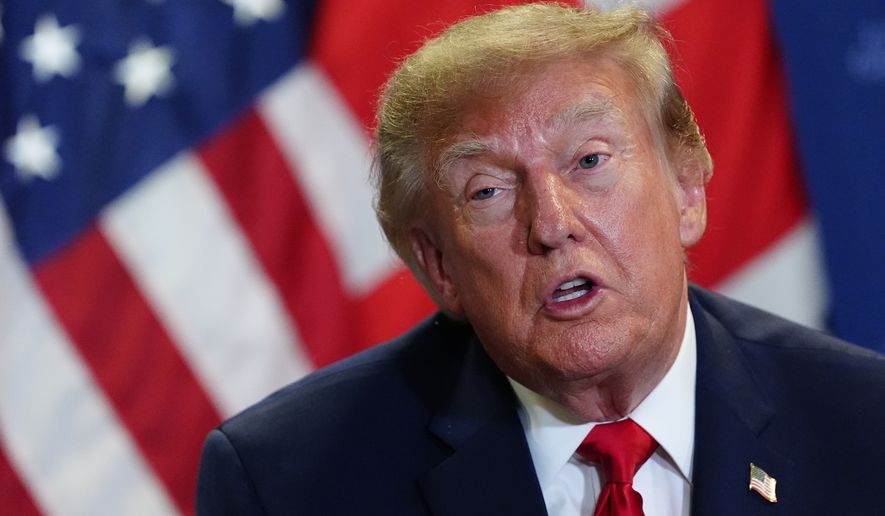
“I can’t imagine why they wouldn’t want to. It’s greatness, potential greatness, or obliteration,” Mr. Trump said during a series of bilateral meetings.
Mr. Trump used Iran as an example of his do-it-now approach to leadership, which served as the theme of his annual address to the United Nations General Assembly.
He said great leaders must use the little time they have to shape the world, so he refuses to let problems such as Iran fester.
“While others have talked, I have acted. While others have spoken of peace, I have made it. While others have ignored threats, I have confronted them,” Mr. Trump said. “While others have talked of courage, America has shown it.”
Mr. Trump said Iran is the “No. 1 sponsor of terror” whose “mad dash” toward a nuclear weapon left him no choice but to launch airstrikes with Israel on Feb. 28.
Tehran retaliated by hindering oil traffic in the Strait of Hormuz and striking America’s allies in the Persian Gulf region, sparking nearly seven months of military bombing, ceasefires and attempts at diplomacy.
Mr. Trump said Iran is waiting to see how Republicans fare in the November elections, given the war’s unpopularity at home. The president told Tehran not to bother.
“It doesn’t even enter my mind. The only thing that does is that Iran will never have a nuclear weapon,” Mr. Trump said.
Michael Rubin, director of policy analysis at the Middle East Forum, said he is critical of Mr. Trump, “but it is a breath of fresh air for a president to lead irrespective of polls.”
“There is a fundamental breakdown of logic among those Republicans who demand an end to the war for the sake of the economy,” Mr. Rubin said. “Iran gets a vote, and if the U.S. turns around and leaves Iran in charge of the world’s most vital waterways, the pain we feel will be just the tip of the iceberg.”
The U.N. General Assembly is an annual gathering in New York that brings together all 193 members of the peace and security organization.
Leaders address the large hall, debate hot issues, make budget decisions and pass nonbinding resolutions.
Mr. Trump is skeptical of global alliances such as the United Nations. He says they are often ineffective and seek outsized funding from the U.S. while delivering little in return.
Last year, Mr. Trump used his speech to criticize other Western nations for allowing unchecked migration and promote his “America First” agenda in place of “destructive globalism.”
Also in 2025, the president’s teleprompter malfunctioned, and the U.N. escalator stopped working just as Mr. Trump and first lady Melania Trump stepped onto it.
Mr. Trump formed a Board of Peace to resolve global conflicts and serve as an alternative to the United Nations. More than two dozen countries agreed to join, according to White House diplomatic logs.
Despite his recurring criticism, Mr. Trump thanked the U.N. Security Council on Tuesday for voting overwhelmingly to pass a resolution condemning Iran’s attacks on commercial shipping in the Strait of Hormuz.
He also thanked the United Nations for supporting his plan to rebuild the Gaza Strip after Israeli strikes on Hamas terrorist leaders.
Mr. Trump told gathered leaders that his aggressive approach to leadership includes America’s backyard, pointing to his January raid to capture Venezuelan “outlaw dictator” Nicolas Maduro and extradite him to the U.S. on drug charges.
“The United States will no longer permit threats to America to gain a foothold anywhere in the Western Hemisphere,” he said. “And if necessary, we will use our unmatched military might to secure the vital national interests of the United States.”
He defended his lethal strikes on cartel drug boats in the Caribbean Sea and Pacific Ocean, dubbing traffickers the “ISIS of the Western Hemisphere.”
Mr. Trump said Cuba is a “failed state” that will fall — which prompted Cuba’s delegation to walk out — though he promised to allow space for negotiations with the communist regime. He hailed an agreement with Denmark to allow the U.S. to control security in Greenland, a pivotal Arctic region coveted by the U.S., China and Russia.
He said the U.S. plans to build two major military bases on the massive island, in addition to the one already there.
More generally, Mr. Trump defended U.S. sovereignty by saying his administration would not accept “global taxes,” including a levy on carbon emissions.
Mr. Trump’s speech was the marquee event in a busy day at the U.N. headquarters in Manhattan.
The president praised British Prime Minister Andy Burnham as a “natural business person” who “gets it” during their bilateral meeting on the sidelines of the assembly.
“He’s going to be, I think, a great prime minister,” Mr. Trump said. “I think he’s got a lot of assets on his side. We talked about everything from the Rolls-Royce to energy to immigration. We’ve covered a lot and we’re with him.”
Mr. Trump told Mr. Burnham and gathered reporters that he remains optimistic about striking a deal with Iran.
“They want to talk to us. They have been talking to us even today,” Mr. Trump said. “They’ve been talking to us, and the relationship is developing.”
Mr. Trump also praised Japanese Prime Minister Sanae Takaichi, saying her country’s industries are “doing very well.”
“She’s going to go down as one of the great prime ministers,” Mr. Trump said in their meeting. “It’s an honor to be with you.”
The president put his stamp on the U.N. gathering while his Republican Party, which controls the House and Senate, tries to stave off a Democratic wave in the November midterm elections.
Mr. Trump’s address resembled a campaign speech at times. He boasted about Republican tax cuts, a string of foreign investments in American factories and his efforts to seal the southern border.
Voters, however, remain worried about the cost of living and high energy prices from the Iran war.
The average U.S. price of gas is nearly $4.50 per gallon, up from $3.18 at this time last year, according to AAA.
Mr. Trump says costs will nosedive once the Iran war ends, possibly after the midterms, but it is unclear how the conflict will wind down.
The president is also pressing to end the Russian invasion of Ukraine. Recent Ukrainian strikes on Russian refineries, combined with the conflict in Iran, are driving diesel prices to record highs above $6.50 per gallon.
Mr. Trump, meeting with Ukrainian President Volodymyr Zelenskyy, said he is considering a ban on diesel exports while he works with Kyiv and Moscow to settle the war.
“We will get that one done,” Mr. Trump said of the war in Ukraine. “It’s going to happen more quickly than people understand. They’ve had it.”
Mr. Trump visited the United Nations ahead of Chinese President Xi Jinping’s three-day state visit to Washington.
The U.S. and China are the world’s foremost economic superpowers, and Mr. Trump is looking to defeat Beijing in the race to develop artificial intelligence.
At the same time, U.S. voters are leery of AI’s potential impact on jobs and society, as well as the massive data centers needed to power the industry.
Mr. Trump said the U.S. has to “be careful” and use the Justice Department to monitor the technology, but he would not “stifle growth of something that will be bigger than the Industrial Revolution.”
“We will only encourage ’super intelligence,’” Mr. Trump said. “We’re going to encourage it, not rein it in.”
Contact the author

Please read our comment policy before commenting.