


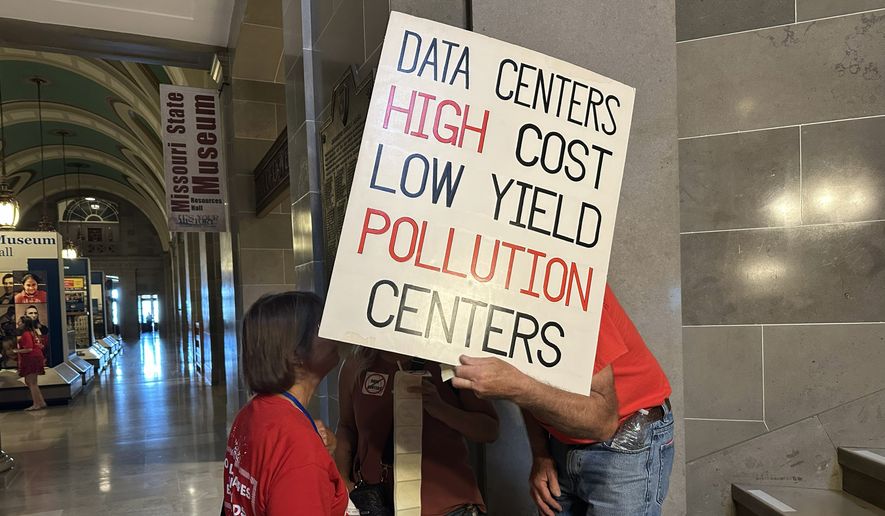

House Republicans on Wednesday used one of their final legislative votes before the midterm elections to address a top concern of voters: data centers.
Poll after poll shows that most Americans do not want data centers built in their communities, in part because they fear the energy the tech hubs consume will drive up everyone’s utility bills.
In an overwhelming 417-3 bipartisan vote Wednesday, the House tried to allay those fears by passing the Ratepayer Protection Act.
People were interested in these podcasts
“This bill answers that question very clearly,” said Colorado GOP Rep. Gabe Evans, the bill’s lead sponsor. “Large load data centers must cover the full costs of any system upgrades they require, not families or small businesses.”
The measure, however, does not mandate anything, and lawmakers in both parties say it is a “modest” effort.
The bill creates a federal standard for electric utilities to recover “the full, incremental cost of any generation, transmission, or distribution upgrade necessary” to serve data centers that would create an aggregate, peak electric demand of 100 megawatts or more.
It leaves the final decision on whether to adopt the federal standard up to state utility regulators and nonregulated utilities, only requiring them to “consider” it and decide within two years.
“This bill strikes the right balance of providing a modest, but important level of accountability,” said Energy and Commerce Chairman Brett Guthrie.
The Kentucky Republican said the measure also protects existing state authorities and supports continued AI development.
“Data center growth can be a catalyst for investment in an aging grid, strengthening the tax base to fund essential public services and anchor tenants for utilities at lower rates for everyone else,” Mr. Guthrie said.
Senate action on the bill is possible, but Majority Leader John Thune said taking it up before the midterm election would require unanimous consent from all 100 senators to hold a quick vote, as there is not enough time to run through all the normal Senate procedural hurdles.
Most House Democrats supported the bill, despite believing Congress could have gone further to address the issue.
“It only addresses one small part of the puzzle,” said Rep. Frank Pallone of New Jersey, the top Democrat on the Energy and Commerce Committee. “It does not change how wholesale generation or transmission costs are allocated at the federal level. And it doesn’t push for the transparency and data transfer mechanisms that state regulators need to ensure that data centers actually are paying their fair share.”
Mr. Pallone said he would prefer a moratorium on construction of new data centers until stronger guardrails are enacted.
“Just in the mid-Atlantic, over the past few years data centers have increased electric bills by over $30 billion,” he said.
It was Republicans, however, who appear to be feeling the most pressure to act on the issue.
New York GOP Rep. Mike Lawler said the average residential electricity price in his state rose 58% over the last six years and in February, before the start of the Iran war, was 70% higher than the national average.
He attributed those increases in large part to outrageous energy policies in the Democrat-run state but said data centers that are collectively requesting more than 9,000 megawatts from New York’s electric grid would make the problem worse.
Most of the lawmakers who came to the floor to speak in support of the bill were Republicans facing tough reelection races, such as Mr. Evans, Mr. Lawler and Pennsylvania Rep. Ryan Mackenzie.
“While the grid capacity will catch up eventually, the short-term costs of those investments must not be passed onto families, seniors and small businesses — many of whom don’t want data centers in their communities in the first place,” Mr. Mackenzie said.
A national poll from the University of Massachusetts Amherst released this week found that only 11% of Americans support the construction of a data center in their local community, while 65% were opposed.
Of the 1,000 respondents surveyed, MAGA supporters were the most receptive to data centers, but just 25% support them being built in their communities, compared with 42% who oppose them.
President Trump recently said that only communities that “want to end up being backwards and poor” would oppose data centers and that China is cheering on the anti-data center movement.
“If we kill the golden goose, you will only have yourselves to blame,” he said.
House Majority Leader Steve Scalise, Louisiana Republican, came to Mr. Trump’s defense during the floor debate.
He credited the president with getting commitments from the big technology companies that build data centers that communities would not get stuck with higher electricity rates.
The companies have adhered to that pledge, Mr. Scalise said, citing a study from the Institute for Energy Research that looked at energy prices in all 50 states and found no disparity in costs per kilowatt hour in states with data centers compared to states without them.
Mr. Scalise said data centers can actually provide a financial benefit to communities, pointing to Meta working with Little Richland Parish, a rural community in his state, as it built a data center there.
Meta is building its own natural gas facilities to support its energy load.
“Anything extra they have is going to be offloaded to the grid, so the neighbors in that community will actually get lower utility rates,” Mr. Scalise said.
The $50 billion in private funding Meta is funneling into the project has also increased sales tax collections in Little Richard, so much so that the parish provided a $50,000 bonus to every public school teacher.
Democrats are less keen to trust “the wealthiest big tech corporations on the planet” — as Florida Rep. Kathy Castor put it — to do the right thing without regulatory enforcement.
Ms. Castor said AI data centers are “energy hogs.”
Most data centers, she said, continuously consume over 100 megawatts — the threshold for the federal standard in the bill — and the largest facilities consume over 650 megawatts.
“That’s comparable to the energy use of tens of hundred of thousands of homes,” Ms. Castor said. “Right now, data centers consume about 4.4% of all electricity in America, but they predict that will go up to 12% … by just 2028.”
Contact the author

Please read our comment policy before commenting.