


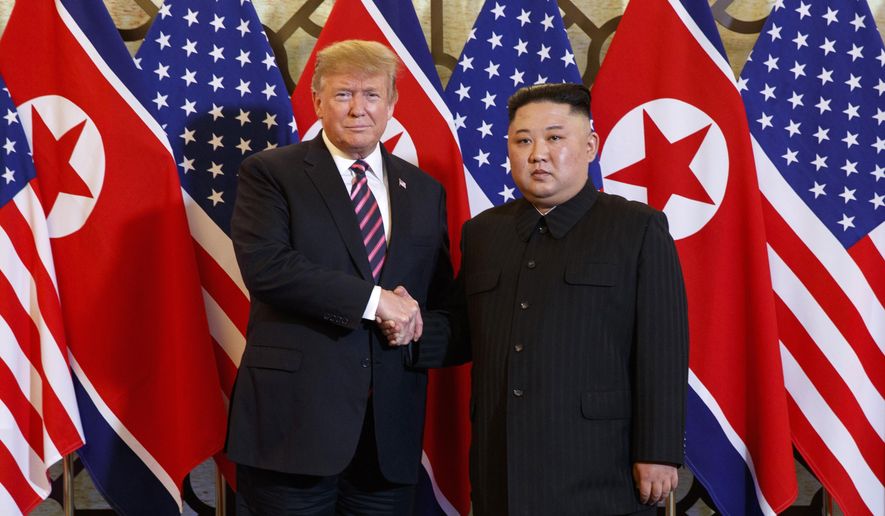

SEOUL, South Korea — A high-profile summit reuniting President Trump and Kim Jong-un would check a lot of boxes for Mr. Trump, who has openly pined for a Nobel Peace Prize. But don’t expect any substantive breakthroughs or concessions, experts say: The North Korean leader doesn’t need Mr. Trump this time around.
It is unclear whether Mr. Kim will agree to the sit-down requested by Mr. Trump, but the mere possibility of renewed Pyongyang-Washington engagement raises questions.
Given North Korea’s ironclad resistance to denuclearization, what shared grounds for discussion exist? What are the quid pro quos? And how would talks play out in the U.S. and among American allies?
For weeks, Mr. Trump has hinted at a summit with Mr. Kim and admitted that communications are underway. He even cut joint military drills with South Korea — in a surprise, last-minute intervention — as an apparent offering to Pyongyang.
One problem for Mr. Trump: Mr. Kim needs his support far less than he did in 2018-2019, when the two men met in Singapore and in Hanoi.
In 2024, to widespread surprise, North Korea signed a mutual defense treaty with Russia — a deal that Russian President Vladimir Putin signed to repay Mr. Kim for his support for Moscow’s war with Ukraine.
Now, Russia is boosting North Korea’s economy, upgrading its military with new technologies and tactics, while enabling the bypass of global sanctions.
Indications are that Beijing-Pyongyang ties are equally solid.
Mr. Kim may today be in the strongest position he has enjoyed since inheriting power in 2011.
By contrast, Mr. Trump is trapped in an unpopular war with Iran, while his Republican Party faces a potential clobbering in the November midterms.
Moreover, Pyongyang has repeatedly stated that America’s foremost priority toward North Korea — denuclearization — is off the table.
Denuclearization means no talks
Pyongyang has offered no official response to Mr. Trump’s outreach, but some expect a green light.
“Trump has said he wants to meet with Kim,” said Ambassador Joe DeTrani, a former U.S. envoy for North Korean negotiations. “That should start it.”
“I don’t think there is any reason for Kim to refuse,” said Lee Sung-chul, former chancellor of South Korea’s Diplomatic Academy. “Trump is in a corner and is desperate to meet Kim to boost his own status. That boosts Kim’s status as well.”
The bigger issue is the agenda.
On Wednesday, the U.S. State Department told Seoul’s Yonhap News that denuclearization remains U.S. policy. That is problematic.
“If denuclearization is on the table, no talks will take place. Period,” said Andrei Lankov, a North Korea expert at Seoul’s Kookmin University.
Many politicians, diplomats and wonks prefer to resist that reality. Mr. Trump’s actions suggest he has other ideas.
“That indicates that Trump cares about realities,” Mr. Lankov said. “Denuclearization will never be on the table: North Korea is a nuclear state.”
North Korea’s “sacred sword” — its nuclear deterrent — is central to regime prestige. Development has cost it dearly in terms of resource allocation and international isolation.
The national leadership has made clear, repeatedly, that they will never give up a program comprised of as many as four nuclear enrichment facilities; a vast armory of missiles, including models capable of hitting the mainland U.S.; and an expanding maritime delivery system — destroyers, underwater drones and an under-construction nuclear submarine.
The suffering of nonnuclear Iran is almost certainly offering North Korea’s elite proof of their wisdom in attack-proofing their nation.
It’s a dilemma for American negotiators.
“I’ve negotiated with North Korea for 13 years and understand why they want/need nuclear weapons,” conceded Mr. DeTrani, a frequent columnist for this newspaper. “However, for counter-proliferation reasons, we should not accept North Korea as a nuclear weapons state.”
Pyongyang’s sensitivities mean communications will have to be carefully couched.
“I think nobody can admit that denuclearization is off the table,” said Chun In-bum, a retired South Korean general. “They’ll have to color code the agenda.”
Mr. Trump “can put complete and verifiable denuclearization on the back burner, but that doesn’t mean complete denuclearization isn’t our ultimate goal,” added Mr. DeTrani. “Halting their nuclear and missile programs is an interim goal.”
Agenda issues
Some reckon Pyongyang and Washington are so far apart, engagement is doomed — citing Russian and U.S. positions on the Ukraine war as an example.
“Look at Trump and Putin,” said Fyodor Tertitskiy, a North Korean expert at Seoul’s Korea University. “There are lots of talks and lots of circling each other, then nothing.”
Others warn against optical summitry.
“The fact that Trump is so eager for this meeting raises questions about what he is willing to do to broker it,” said Jenny Town, director of specialist North Korea website 38 North. “Flashy summits have not had much substance or brought about results.”
If talks focus on arms control rather than denuclearization, it could undermine Washington’s own long-held stance on anti-proliferation.
“Arms control means, de facto, accepting nuclear status, and that could set a dangerous precedent,” said Mr. Lee. “It could facilitate a mindset in South Korea, and in other countries, that they should try to nuclearize themselves.”
Other experts see some value propositions.
“Trump needs an opportunity to brag about on Truth Social, and Kim needs sanctions to be partially or completely lifted,” said Mr. Lankov. “If Trump agrees to make moves on sanctions, North Korea has reason to talk.”
North Korea could “get security assurances and international legitimacy once they move closer to normalizing relations with the U.S.,” said Mr. DeTrani. “This in turn will give North Korea access to international financial institutions.”
Risk hovers over both failure and success.
Given Mr. Kim’s actions after his Hanoi summit with Mr. Trump imploded, another failure could push him toward even harder stances.
“After Hanoi, I think Kim felt a profound sense of betrayal,” said Mr. Tertitskiy. “North Korea’s isolation was amplified after Hanoi; it was ‘Lock the whole thing down, roll back reforms, go even harder line.’”
And a successful summit hardly means continued progress.
“Both sides have credible commitment problems,” said Daniel Pinkston, a Seoul-based international relations expert. “Dictators like Kim have that problem, but so does Trump. Any agreement can be overturned the next day with a mean tweet.”
How will Americans and U.S. allies see it?
If denuclearization is off the table, then Americans would be forced to accept the permanency of a nuclear North Korea.
That would offer Mr. Trump’s critics plentiful ammunition. However, his indifference to criticism was displayed during his last dalliance with Mr. Kim, when he told supporters he “fell in love” with the dictator.
“In the U.S., Trump is not really afraid of criticism — we saw this on North Korea during his first term,” said Ms. Town. “In terms of U.S. allies, it’s a riskier proposition … but both Seoul and Tokyo, along with other U.S. allies, have already seen greater disconnects between U.S. interests and the interests of allies.”
South Korea more pro than Japan
Seoul’s liberal Lee Jae-myung government is keen to start its own negotiations with Pyongyang. For Tokyo’s conservative Sanae Takaichi administration, that is not a priority.
While South Koreans tend to be blase about the threat next door, Japanese — citizens of the only nation ever to suffer nuclear attack — are jumpier.
But Tokyo cannot push back.
“Japan would be in an awkward position, for sure,” said a Japanese academic, speaking on condition of anonymity as he consults the government. “But there is very little leverage.”
“What can Japan or South Korea expect from Trump regarding North Korea anyway?” asked Haruko Satoh, who teaches regional relations at Osaka University. “I don’t think Tokyo is expecting much from the U.S. except the [nuclear] umbrella.”
Might Trumpian recognition of North Korean nuclear status encourage South Korea and Japan to initiate their own moves toward breakout?
“The majority of South Koreans have consistently supported the idea of going nuclear, influenced by Donald Trump and MAGA isolationism,” said Mr. Lankov. “But the Japanese public is overwhelmingly hostile to the idea of nuclear weapons.”
Contact the author

Please read our comment policy before commenting.