


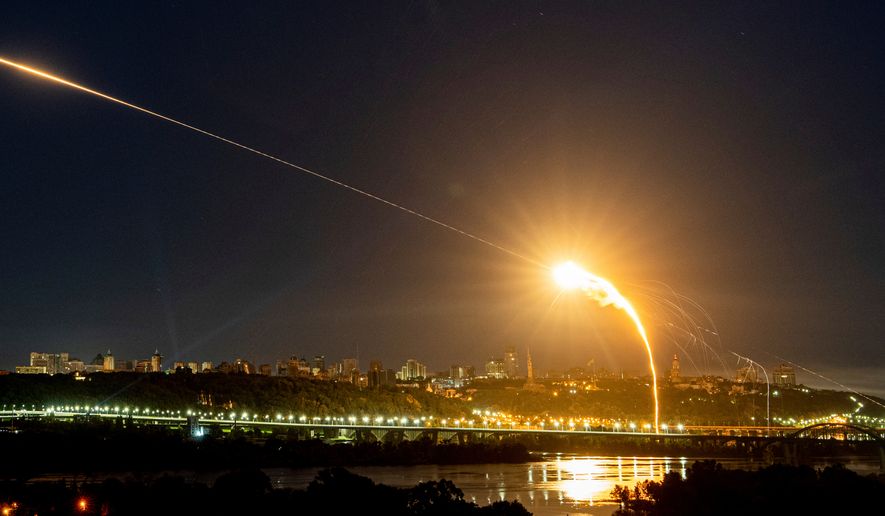

What do “air superiority” and “air dominance” really mean in the age of drones?
The Iran war has supercharged a doctrinal and rhetorical debate among foreign policy analysts, military scholars and defense industry leaders, many of whom believe that those terms must be reimagined for a world in which attack drones outnumber traditional military aircraft by orders of magnitude.
People were interested in these podcasts
By the most traditional definition, the U.S. achieved air dominance over Iran mere days after the conflict began on Feb. 28.
Iran’s air force and air defenses were no match for America’s second-to-none aerial warfare capabilities, and U.S. forces were quickly conducting bombing, reconnaissance and other operations at will over Iran.
But that hasn’t stopped Iran from successfully targeting U.S. military bases across the Mideast by using drones and ballistic missiles.
Nor did it prevent Iran from shooting down an American F-35 fighter jet in April or taking down dozens of MQ-9 Reaper drones.
Other sections of Mideast skies are also not fully dominated by the U.S. and its allies.
The Iran-backed Houthi rebels, armed with their own arsenal of missiles and drones, have bombed U.S. regional partners, such as Saudi Arabia, which had its King Khalid International Airport in Riyadh targeted this month.
U.S.-made Patriot and Terminal High Altitude Area Defense (THAAD) missile defense systems, which Saudi Arabia and other allied nations possess, have failed to stop all of those attacks by Iran and its proxies.
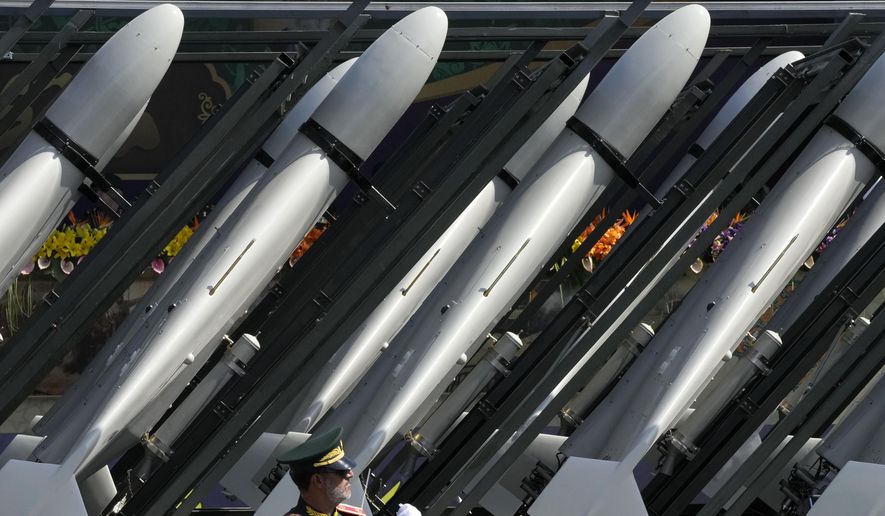
With drones crowding the airspace between the ground and the higher-altitude domains of traditional aircraft, national security insiders say the decades-old understanding of air superiority and air dominance in wartime theaters such as the Mideast no longer applies.
“We can no longer claim air dominance. No country, I think, in the world can claim air superiority, air dominance,” said Andy Lowery, CEO of the California-based company Epirus, which builds high-power microwave platforms to counter autonomous drones.
“When you consider traditional air defense, there’s still no other country greater than the U.S. at building … Patriot missile systems, THAAD missile systems, in these large geographical cylinders. But those large geographical cylinders were designed to go after elephants,” Mr. Lowery said in a recent exclusive interview on The Washington Times’ Threat Status podcast.
“It’s like bringing an elephant cage and an elephant gun. And we’re being overrun by mice.”
The terms “air superiority” and “air dominance” are sometimes used interchangeably, but they refer to distinct levels of airspace control.
Air superiority generally refers to one force holding a clear advantage in conducting aerial operations, though an enemy can still pose a threat.
Air dominance is when a force has overwhelming, virtually unchallenged control of the air.
Understanding air dominance
To get a sense of how long those ideas have been central to U.S. military thinking, consider this famous quote from Gen. Dwight D. Eisenhower in the summer of 1944, after the Allied landing at Normandy, France.
“If I didn’t have air supremacy, I wouldn’t be here,” he said at the time, according to numerous historical accounts.
Other accounts attribute phrases such as “aerial supremacy” and “control of the air” to U.S. military leaders as far back as the 1920s, just years after aircraft were introduced to combat.
Analysts say those terms have mostly lost their meaning.
“In reality, these terms are so last century,” Peter Layton, an associate fellow at London’s Royal United Services Institute, wrote in a June analysis published on the website of the Military Academy at West Point’s Modern War Institute.
“The fundamental reason the terms now confuse rather than bring clarity is that the air is now filled by more than only the manned aircraft that were present when these definitions were established,” he wrote. “The airspace of modern wars is now routinely also used by large numbers of remarkably diverse types of rockets, cruise missiles, ballistic missiles, and drone systems. Compounding this, such unmanned systems are now used by everybody: states, nonstate actors, and all the military services, whether land, sea, or air. It’s a busy sky, open to all, used by all, and at all times.
“These terms all suggest a certain ownership of the sky that’s no longer possible, even in limited ways.”
The Russia-Ukraine war offers more modern examples. Many military observers expected the Russian military, one of the largest and most well-funded in the world, to achieve air dominance over Ukraine in a matter of weeks after launching its invasion in early 2022. But Ukraine’s remarkably successful use of small attack drones and other tactics has prevented the Russians from achieving that goal.
Military analysts and strategists refer to the crucial new battlespace as the “air littoral,” or the airspace from the ground to a few thousand feet in the air. They argue that the proliferation of drones, missiles and other aerial assets operating in that space represents a massive change to warfare.
“Just as the emergence of the submarine, the self-propelled torpedo, and mines during the early 20th century added subsurface threats in the contest for sea control, small autonomous drones, low-flying missiles, and loitering munitions increasingly present a threat to air control from below the altitudes of conventional air superiority,” reads a 2021 analysis published by the U.S. Army War College.
Data behind the drones
No reliable figure exists for the number of attack drones in the world today. But key pieces of data show just how dramatically the dynamic has shifted.
The world’s top 10 militaries boast at least 30,510 military aircraft in service today, according to GlobalFirepower.com, an online clearinghouse for military data.
The U.S. accounts for nearly half of those, just over 13,000, including fighter jets, transport planes, refueling tankers and helicopters.
Russia and China are next, with 4,237 and 3,529 aircraft, respectively.
Those numbers don’t include small attack drones, which now dwarf the number of traditional military aircraft by a staggering margin.
Leaders of the Ukrainian military recently said the country has the capacity to produce more than 8 million first-person-view drones this year alone. In its attacks on Ukraine, Russia is believed to have launched nearly 60,000 attack drones.
The Pentagon’s Drone Dominance program aims to field hundreds of thousands of small attack drones by next year, eventually reaching the millions.
Tehran is believed to have thousands of drones in its arsenal, though U.S. and Israeli bombing campaigns have greatly compromised its domestic production capacity. Still, Iran can inflict significant damage.
Last month, the Pentagon’s inspector general reported that Iranian missile and drone attacks on U.S. outposts in the Middle East have damaged or destroyed hundreds of buildings and dozens of American combat aircraft since the war began.
The Pentagon IG investigators also detailed the U.S. military aircraft destroyed or heavily damaged in the conflict, including F-15E and F-35 fighters, KC-135 refueling aircraft, combat helicopters like the AH-64 and the MH-60, along with drones like the MQ-4C Triton and the MQ-9 Reaper.
The Pentagon IG said as many as 30 Reapers have been destroyed in the fighting.
At least 21 American troops have been killed in the war, though six of those deaths occurred when two U.S. aircraft collided over Iraq in March.
Contact the author

Please read our comment policy before commenting.