


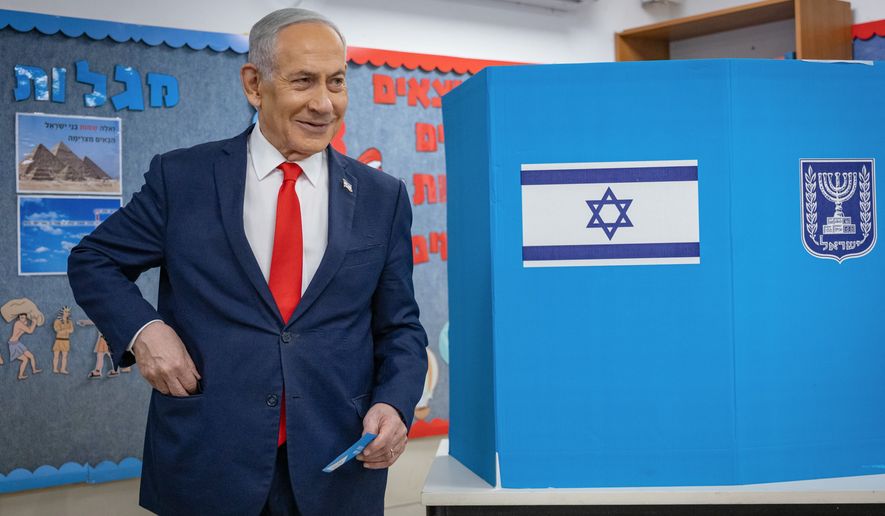

A loss by Prime Minister Benjamin Netanyahu in Israeli elections Tuesday could mean a cooling of domestic political polarization in Washington, but the U.S. security relationship with Israel is unlikely to change whether Mr. Netanyahu remains in office or not.
Mr. Netanyahu has closely aligned himself with U.S. conservatives during his decades in power. For many Democrats, criticizing Israel’s policy had become intertwined with the prime minister himself. An exit by Mr. Netanyahu would give mainstream Democrats sufficient room to support Israel without the partisan backlash.
Former Rep. Madeline Dean, a Pennsylvania Democrat who describes herself as “very pro-Israel,” said criticizing Mr. Netanyahu’s policies or actions in office does not mean you are against the country.
People were interested in these podcasts
“I think it reveals that I’m even more pro-Israel, and I compare it to this country,” she told the Jewish News Service last month. “I am very critical of [President Donald] Trump. That doesn’t mean I don’t love my country. It actually means I love my country more.”
Still, the anti-Netanyahu opposition is not a liberal movement. It is a broad coalition united primarily by the prime minister’s governance, personal legal problems and alliances with far-right religious nationalists.
Former Israel Defense Forces Chief of Staff Gadi Eisenkot, now a Knesset member representing the National Unity party and a key figure in the opposition bloc seeking to deny Mr. Netanyahu a majority, has explicitly opposed a fully sovereign Palestinian state and has argued that Israel cannot take “existential security risks” on its border.
Former Israeli Prime Minister Naftali Bennett is considered a wildcard in the elections, having recently registered a new political party to contest this cycle. The right-wing candidate has been one of the most vocal opponents of a two-state solution. He has opposed any concessions or peace talks that involve Palestinian sovereignty.
Although centrist candidate Yair Lapid has endorsed a two-state framework in principle, he has more recently declared that a two-state solution is not a near- or medium-term reality.
Still, a successor to Mr. Netanyahu could be more cooperative in coordinating with the U.S. and Arab countries such as Egypt, Jordan and Gulf partners in rebuilding a postwar security framework for the Gaza Strip.
Brokering normalized ties between Israel and Saudi Arabia remains a high priority for the Trump administration as part of the expansion of the Abraham Accords. Still, Riyadh made progress contingent on a credible path to Palestinian statehood — a condition Mr. Netanyahu rejected.
Analysts say a change in leadership in Israel could revive the stalled negotiations.
Contact the author

Please read our comment policy before commenting.