



OPINION:
At a rally in Michigan on Saturday for Senate candidate Abdul El-Sayed, former President Barack Obama called the conflict with Iran “an unnecessary war.”
He apparently dates hostilities to this year — Feb. 28 — or, at the earliest, to June 2025. He is off by nearly 47 years.
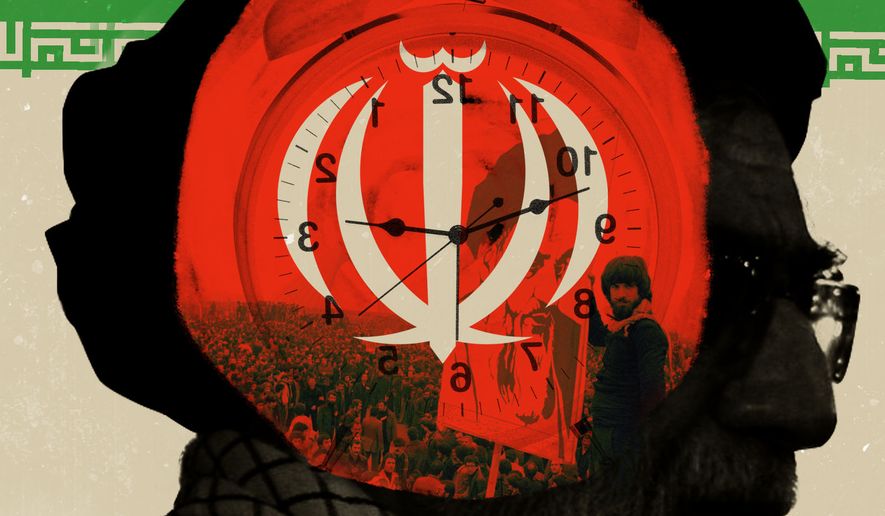
This war began Nov. 4, 1979, when Islamic militants stormed the U.S. Embassy in Tehran and held 52 Americans hostage for 444 days.
People were interested in these podcasts
The leaders of Iran made their war aims plain. Their 1979 constitution gives the army and the Islamic Revolutionary Guard Corps the “ideological mission of jihad in God’s way,” defined in that constitution as “extending the sovereignty of God’s law throughout the world.”
Three years ago next week, Ayatollah Ali Khamenei, the supreme leader of Iran, emphasized to his followers in a televised address: “When you chant ’Death to America,’ it is not just a slogan; it is a policy.”
By June 2025, the regime was dangerously close to acquiring nuclear weapons — within six months with near certainty, according to the Institute for Science and International Security. That was when Israel and the U.S. struck the regime’s nuclear and missile sites and its war-industrial complex in what became known as the 12-day war.
Despite the beating, Khamenei’s revolutionary ardor remained firm. On Feb. 28, the start of what became known as the 40-day war, massive joint U.S.-Israeli strikes killed him at his compound in Tehran. The Institute reports that among the weapons-related sites hit was the Lavisan 2/Mojdeh complex, which the regime had begun rebuilding after the 12-day war.
The day after Khamenei’s death, Mr. El-Sayed, the candidate Mr. Obama rallied for in Michigan, told campaign staff, according to leaked audio: “There are a lot of people in Dearborn who are sad today.”
Nearly eight months on, Mr. Obama asks: “How’s that war going?” The institute said the two rounds of strikes left Tehran facing a much more difficult path to obtaining a nuclear bomb: nine months, a year or even two, with success far less certain.
Nevertheless, those now ruling Iran have shown no inclination to make peace — or even to make meaningful concessions. Satellite imagery from September and October, the institute reports, shows the regime rapidly rebuilding a site at Parchin — linked to nuclear-weapons development and destroyed in March — and renewing activity at another site outside Tehran.
Iran’s current rulers have attacked U.S. military bases in the region, launched drone and missile strikes at their Arab neighbors, and escalated attacks on commercial shipping around the Strait of Hormuz to a record 28 this month, according to a Washington Institute tally.
They are assisting the Houthi rebels in Yemen, who are determined to control the Bab el-Mandeb choke point, and this month hit King Khalid International Airport with a missile, killing a dozen people, including at least one American.
At present, the war is being fought mainly at sea and in energy markets. A U.S. naval blockade has choked the regime’s oil exports, and Treasury Secretary Scott Bessent says it now has negative cash flow. Americans are paying a price too: gasoline averages $4.29 a gallon, up from less than $3 before the war, though down from this year’s peak and well below the 2022 record.
We do not know when the war will end. Nor can we predict with assurance who will win it. On both questions, as they say, the enemy gets a vote.
Remember: Tehran is receiving military, economic and diplomatic support from Moscow, Beijing and Pyongyang.
That brings me to my main point: As difficult as this fight is now, it would have become much tougher had President Trump let the threat grow and left it to a future occupant of the White House.
That is what Mr. Trump’s predecessors did for nearly half a century, answering provocations with limited strikes, sanctions or deals, even after Tehran-backed militants killed, according to the Pentagon, at least 603 American troops in Iraq.
Mr. Obama says, “I didn’t have to fire a missile. I engaged in diplomacy.” Yet his diplomacy culminated in the 2015 Joint Comprehensive Plan of Action, which gave Khamenei billions of dollars in exchange for a promise to slow-walk his nuclear weapons program — a promise that inspectors, barred from military sites, could not fully verify.
Key limitations were to “sunset” in stages through 2030, putting Tehran within a short sprint of full membership in the nuclear weapons club — all within the rules.
Under the JCPOA, Tehran could also have built an industrial-scale missile-and-drone arsenal — more than could be knocked out with the relatively small cache of multimillion-dollar interceptors on which the U.S. and its allies rely. The regime was not prevented or even seriously discouraged from distributing funds and weapons to its terrorist proxies in Lebanon, Iraq, Syria, Yemen and other countries.
Mr. Obama says Iran “now has veto power over the Strait of Hormuz.” It can certainly disrupt shipping there, as recent attacks show, but that is a preview, not the worst case. A nuclear-armed Iran with a missile-and-drone strategic shield could transform that waterway into a private lake once and for all.
At that point, would the oil-rich Sunni Arab Gulf states not have to sever ties with the U.S. and kowtow to Tehran?
Mr. Obama calls this war unnecessary. Others call it a “war of choice.” Yet the alternative would have been a later “war of necessity” — a war with our backs to the wall.
The threat from Tehran has always been a cancer. Choosing inaction would have allowed the threat to metastasize, making the ultimate cure far more difficult, painful and costly for a future administration — and perhaps not possible at all.
• Clifford D. May is founder and president of the Foundation for Defense of Democracies, a columnist for The Washington Times and host of the “Foreign Podicy” podcast.
Follow the author
Please read our comment policy before commenting.