


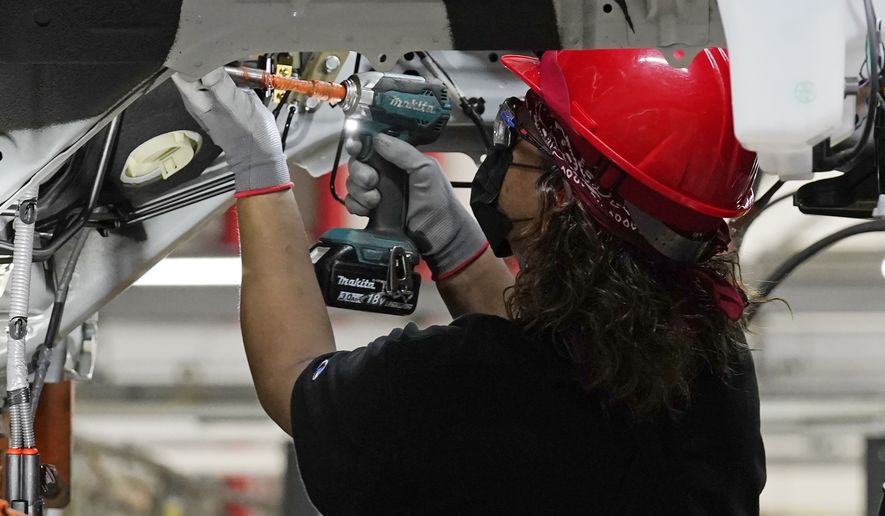


Independent auto repair shops want Congress to go full throttle to fund apprenticeship programs.
Automotive Service Association spokesman Robert Redding told The Advocates that his group wants to ensure funding for “FY27 apprenticeship programs” in the fiscal 2027 appropriations legislation Congress is working to finalize, calling it “a big deal for us.”
People were interested in these podcasts
“We were very pleased with many of the small business provisions in the One Big Beautiful Bill that became law,” Mr. Redding said. “And if they do a third budget reconciliation package, we’re waiting to see if that is going to materialize.”
According to the National Automobile Dealers Association, automotive and truck retail industries continue to face a shortage of service technicians.
“About 39,000 new service techs graduate from U.S. career technical colleges and training programs each year. Yet the industry needs to replace nearly 76,000 techs each year to keep up with retirements and new job demand,” the auto dealership trade group says on its website.
That leaves an annual shortfall of about 37,000 trained techs, according to NADA estimates.
Manufacturers cheer Trump’s push to limit Clean Water Act
The National Association of Manufacturers supports the administration’s latest effort to narrow the scope of which streams and wetlands fall under Clean Water Act authority.
In a letter to the Environmental Protection Agency and the Army Corps of Engineers, the NAM urged the agencies to adopt tighter tests for what counts as “waters of the United States,” also known as WOTUS.
Both agencies are working on a final revised rule that implements the Supreme Court’s 2023 decision in Sackett v. EPA, which found that the Clean Water Act protects only wetlands with a continuous surface connection to relatively permanent, traditional navigable waters.
NAM called for three changes at the agencies:
• Define “relatively permanent” waters by whether they are perennial, rather than under the earlier “wet season” approach.
• Define “perennial” as “having standing or continuously flowing water every day of the year during ordinary conditions.”
• Require that a wetland be “indistinguishable from the jurisdictional water” to have a “continuous surface connection.”
The manufacturers also asked the agencies to allow landowners and companies to show a water’s status using aerial imagery, gauge data, precipitation records and field observations, rather than continuous daily monitoring.
“Manufacturers support a durable and predictable WOTUS framework that provides clear notice of the limits of federal jurisdiction, facilitates efficient permitting and reflects the appropriate balance between federal and state authority contemplated by the Clean Water Act and reaffirmed by the Supreme Court,” Chris Phalen, NAM’s vice president of domestic policy, wrote.
Cautions sounded about Anthropic’s AI safety and security bill
Americans for Responsible Innovation is warning about draft legislation from artificial intelligence company Anthropic that would establish a federal framework to oversee the safety and security of advanced AI systems.
The proposal gives companies too much wiggle room, said ARI, a nonprofit that advocates for federal and state governance of AI and emerging technologies.
The group said the proposal would mandate “third-party safety evaluations and disclosures from AI developers and give the federal government limited authority to block dangerous AI models under certain circumstances.”
Developers could set safety standards and loosen them over time, with companies basically writing their own rules, said ARI President Brad Carson.
He also gave Anthropic credit for stepping up to the plate.
“It’s worth acknowledging the seriousness with which Anthropic has approached this issue and some strong sections in their draft text,” said Mr. Carson. “Unfortunately, the bill text that’s circulating does not meet the minimum requirements necessary for federal guardrails to keep AI development safe.”
Instead, Mr. Carson said, the government should craft binding standards and strengthen them as AI systems become more capable.
This includes binding federal safety standards set by the government, not developers, and strengthened as AI systems grow more capable, giving the government authority to test or inspect models directly and providing narrower preemption so existing state laws aren’t overridden.
Mr. Carson said that there are strong points in the draft bill that should not be overlooked.
“The legislation includes the strongest proposal to date for evaluator access rights,” he said.
President Trump has resisted calls for strict federal regulation of AI, saying the U.S. should not lose its lead in the AI race to China.
Last month, he said that he had an agreement with more than two dozen of the nation’s top artificial intelligence leaders to rely on “tremendous self-regulation” for the industry.
Mr. Trump said he and House Speaker Mike Johnson had a “very productive, extremely friendly” meeting with tech titans, including Anthropic CEO Dario Amodei, OpenAI President Greg Brockman and Nvidia CEO Jensen Huang.
The White House and the AI developers signed a “Joint Commitment on Frontier Responsibilities” that Mr. Johnson, Louisiana Republican, described as “voluntary.” Mr. Trump pointed to “tremendous self-policing” when asked about penalties if AI companies violate the commitment.
The single-page document identifies “four layers of controls and audits” the AI companies are expected to implement.
• The Advocates column is a weekly look at the political action players who drive the debate and shape policy outcomes in Washington. Send tips to theadvocates@washingtontimes.com. Click here to receive The Advocates in your inbox each week.
Contact the author

Please read our comment policy before commenting.