


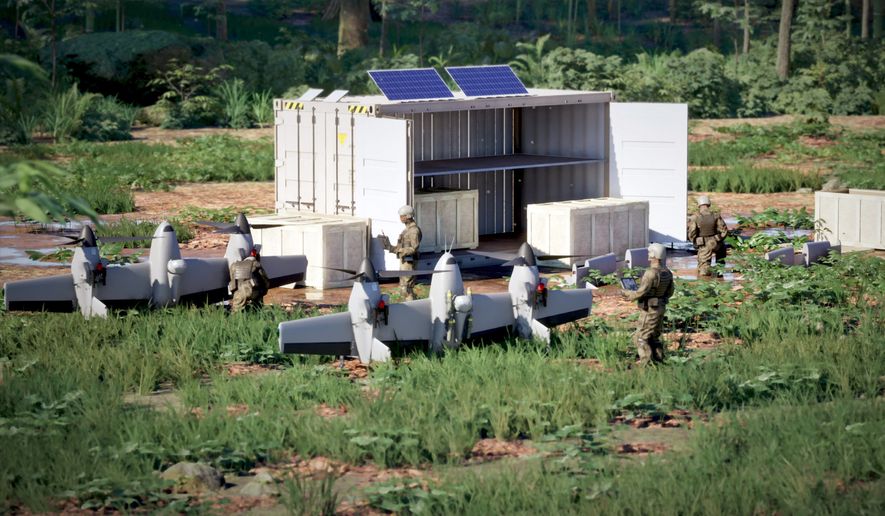

Rising straight off the ground like a helicopter before rotating its wings to fly like an airplane, Sikorsky Aircraft’s new uncrewed aerial system aims to eliminate the need for a traditional runway for drones on the battlefield.
Sikorsky, a division of Lockheed Martin, unveiled the Nomad 100 autonomous military aircraft this week at the Association of the U.S. Army annual convention in Washington.
“Not only are you getting the vertical takeoff and landing capability of [a helicopter], you’re also getting that endurance, range, and speed of a fixed-wing aircraft,” said Ramsey Bentley, director of strategy and business development for Sikorsky Advanced Programs.
People were interested in these podcasts
Nomad drones would be delivered to the battlefield in a standard 20-foot shipping container, officials said.
“Once the container hits the ground, we’re able to unload two bottom aircraft and have them flight-ready and operational in under 15 minutes,” Mr. Bentley told The Washington Times. “The other two aircraft on the top shelf can be fully operational in one to two hours.”
The kit is designed for rapid movement between locations. Once a mission is complete, the container can be repacked, loaded onto a transport vehicle, and moved to a new site to support follow-on operations, company officials said.
Major defense contractors like Sikorsky are aggressively entering the drone market as modern warfare undergoes a fundamental shift. The war in Ukraine has proven that small, relatively inexpensive uncrewed aerial systems and loitering weapons can wreak havoc on the battlefield, disabling or destroying multimillion-dollar main battle tanks, artillery units and naval vessels.
Sirorsky described the Nomad 100 as a multi-role, multi-function aircraft that can carry out intelligence, surveillance, and reconnaissance missions on the battlefield as well as launch laser-guided munitions at enemy forces.
It has a range of more than 800 nautical miles and can cruise at 70 mph. The Nomad 100 can also carry out limited resupply missions using a 60-pound payload, such as delivering medical supplies to wounded troops on the front line.
The Nomad 100 uses a hybrid electric drivetrain. Combustion engines drive a generator that provides electrical power to operate the aircraft. It features multi-fuel technology, allowing it to use a variety of aircraft fuels.
“It’s common aviation fuel, so 10 gallons of fuel provides over 10 hours of operation. It’s a very efficient system for austere environments,” Mr. Bentley said. “It doesn’t have a lot of sustainment requirements as traditional aviation assets do because it’s hybrid-electric. That also greatly reduces the maintenance and sustainment [needs] of the aircraft itself.”
The Nomad 100 uses sophisticated sensors and artificial intelligence technology to understand and adapt to its surroundings.
“When it’s flying, it will actually avoid other obstacles in flight, other aircraft, and things of that nature,” Mr. Bentley said. “As the aircraft comes in to land, it’s going to be looking for obstacles in the landing area.”
The Nomad 100 began as part of a Defense Advanced Research Projects Agency [DARPA] program to develop vertical lift drone capability. Even in the early stages of the program, Sikorsky has contracts with two customers for the Nomad 100 system.
“But we have a lot of interest from both domestic and international customers,” Mr. Bentley said.
Contact the author

Please read our comment policy before commenting.