


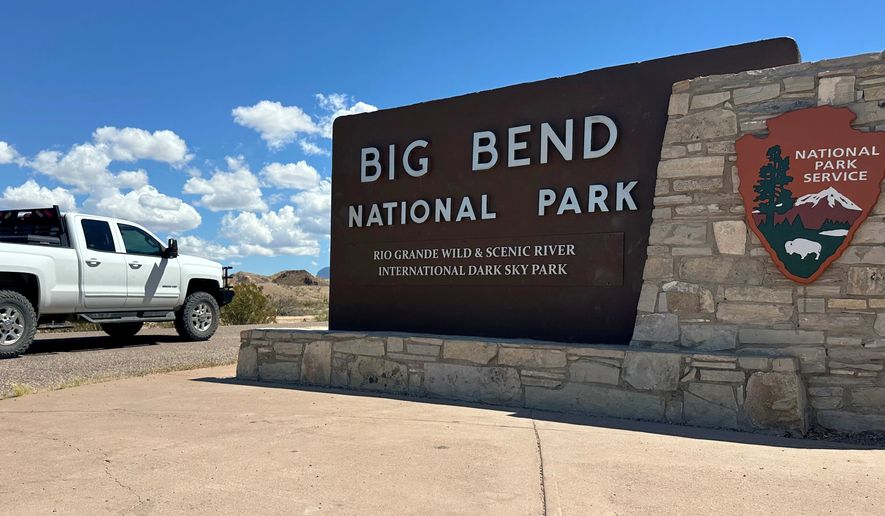

The Supreme Court gave the Trump administration the OK on Monday to resume building border wall in Texas’ Big Bend area, including through the rugged national park, setting aside a lower court’s injunction.
In an unsigned opinion, the justices said courts have scant power to review the Department of Homeland Security’s waiver of environmental and historic preservation laws to speed construction. That means the lower court should have stayed out of the Big Bend dispute, the justices said.
“The government is exceedingly likely to prevail on its argument that the district court lacked jurisdiction to adjudicate respondents’ so-called major-questions-doctrine claim,” the justices said.
People were interested in these podcasts
The ruling will allow President Trump to move forward with wall construction in the Big Bend sector of western Texas, which covers roughly 517 miles of border, focusing initial phases on about 175 miles of steel barriers.
Those miles are part of Mr. Trump’s second-term push to finish the border wall, the most visible promise from his first campaign in 2016.
Judge Kathleen Cardone, a George W. Bush appointee to the U.S. District Court for the Western District of Texas, issued the order halting work on Oct. 2.
She said the 1996 law allowing waivers applies only to areas of the border with high levels of illegal entry.
She said the Big Bend sector has traditionally been the calmest part of the border, so waivers should not apply there.
She acknowledged some confusing language in the law but said that under the major questions doctrine, when Congress is not specific enough in its grant of powers to the executive branch, courts must rule against the administration.
Among the laws the Homeland Security Department has waived to allow construction are the Clean Air Act, the Endangered Species Act and the Native American Graves Protection and Repatriation Act.
The case came to the justices for preliminary review. The Monday order puts her ruling on hold while the case develops.
Yet given the language in the order, the high court has likely telegraphed its eventual ruling if the case returns for a full decision on the merits.
Justice Ketanji Brown Jackson, a Biden appointee, was the only one of the court’s nine members to note her dissent from the ruling.
President Biden declared that he would not build “one more foot” of the wall during his term and instead tried to use the remaining billions of dollars from the Trump administration for environmental remediation.
Piles of steel were left to rust or were sold off at pennies on the dollar.
Mr. Trump campaigned in 2024 on a promise to finish the wall and won tens of billions of dollars in new funding in 2025 to carry it out.
Solicitor General D. John Sauer said the judge’s halt cost the government $1 million a day in losses that could not be recouped.
He also said it was a security risk.
“Leaving a 300-plus-mile gap in border defenses would act as a dangerous magnet for cartels and other bad actors to exploit as other routes close off,” he told the justices in his petition seeking to revive construction.
Wall opponents said the construction would scar pristine wilderness, turning it into “an industrialized corridor.”
The challengers argued that Big Bend’s remoteness was part of its appeal. One said the wilderness saved his life by offering solitude.
Another said the wall, with its lights and access roads, would interfere with the national park’s dark skies and birding opportunities.
They argued that the justices should have left Judge Cardone’s decision in place.
Big Bend accounts for about one-quarter of the 1,954-mile border, but annual illegal crossings detected over the past decade have typically ranged from 1% to 2% of the total borderwide total. As for hard drugs, the vast majority of non-marijuana seizures occur at official ports of entry rather than remote open-border stretches such as Big Bend.
Judge Cardone said that if Congress meant to include the least-active sector as an area of high illegal immigration, it would have written the law differently.
Still, the 1996 law also says the waivers can be challenged in court only when a constitutional question arises.
Judge Cardone had said the dispute over the high-illegal-entry language was a major questions doctrine dispute, which made it a constitutional case.
The high court disagreed.
“There is no such thing as a ’constitutional’ major-questions claim,” the justices said.
They said the balance of factors weighed against a preliminary injunction at this point.
Contact the author
Please read our comment policy before commenting.