



OPINION:
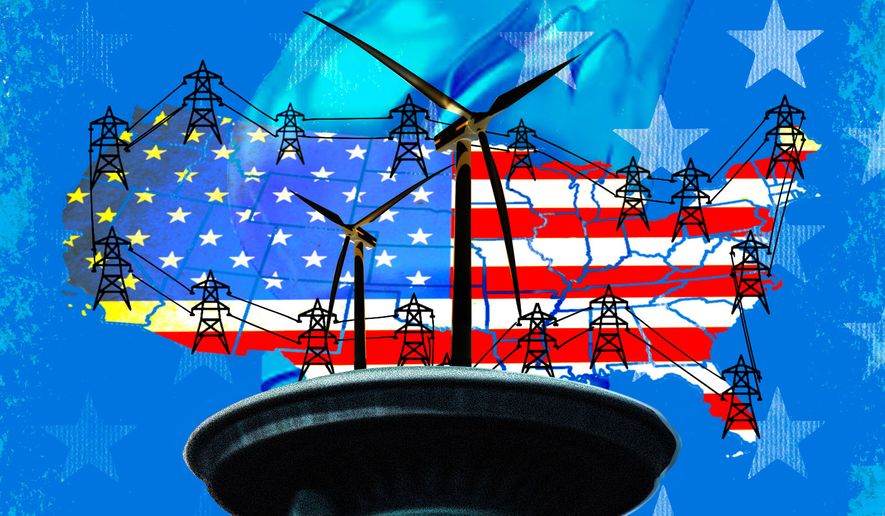
I was hoping I was done writing columns about the menace that is the “permitting” reform legislation the House will consider this week. The legislation, which is designed specifically to expand federal control over the siting, construction and determination of who should pay for transmission lines, has become, for reasons known only to God, a fan favorite among Republicans.
Unfortunately, my friends at Energy Bad Boys wrote a banger of an analysis about permitting reform and the likely combination of that legislation and the looming extension of the wind and solar tax credits. Those tax credits, which Republicans set on a path to repeal in the One Big Beautiful Bill Act, have been in place since 1992. Those tax credits have been extended 11 times in the intervening 34 years, and it seems pretty reasonable to expect that the Democrats will make it an even dozen as part of the inevitable tax package.
Until recently, I would have bet a lot of money that President Trump, given his well-known antipathy toward wind power, would veto an extension of the tax credits, but the administration has already issued a statement of support for the permitting reform legislation, which would all by itself expand the use of wind power. So, perhaps the president has changed his mind. Or maybe he has not been fully briefed on the actual consequences of the permitting legislation.
People were interested in these podcasts
Whatever is going on, the Energy Bad Boys have a pretty simple hypothesis. “As we discussed in our piece ’Gut Reactions to the Midterms,’ the recent elections greatly increase the odds that subsidies for wind and solar will be extended again, whether as part of a broader must-pass spending package signed in the next few years, as happened in 2019 and 2020, or under a future Democratic president.”
They go on: “One of the key factors keeping these subsidies in check over the last several years has been the lack of interregional transmission capacity, which has constrained wind development from approximately 2017 to the present. … However, the Bipartisan American Affordability and Jobs Act (BAAJA), a permitting reform bill that passed the U.S. Senate on Thursday night by a vote of 62-33 and now heads to the House, would lift this bottleneck by making it easier to build new transmission lines and shifting the cost of building them onto consumers like you.”
How would it do that? “BAAJA would expedite the transmission buildout by greatly expanding federal ’backstop’ siting authority, deeming any transmission line selected in a regional or interregional plan, including plans built to serve state renewable mandates, to meet the federal permit criteria. This means a state could reject an interstate transmission line, but [the Federal Energy Regulatory Commission] must approve it anyway simply because a regional planner put it on a map and it meets several loosely defined criteria.”
One final gem from the analysis: “It would also foist more of the cost of that transmission onto ratepayers, rather than the wind and solar developers who need it in the first place, by allocating costs to anyone deemed to ’benefit’ from a line. However, the bill broadly defines the term ’benefit,’ and FERC has previously stretched that term to include progress toward state public-policy goals. … In other words, residents in states without renewable energy mandates could end up being forced to pay for the transmission lines primarily needed to help states with aggressive wind and solar mandates, like Michigan, Minnesota, and Illinois, meet their own policy goals.”
The analysis estimates that the cost to taxpayers of this unattractive cocktail of federal control over transmission siting and construction, and the newly energized tax credits for wind and solar could be as much as $200 billion, depending on what assumptions one makes about the world.
That seems like a lot, and it explains why wind developers and others involved in alternative energy are so eager for this legislation to become law.
It is less clear why Republicans are so hot for this legislation. Why are we trying to solve problems in states for the very people who created the problems? Why should we care whether places such as Massachusetts and Illinois make it more difficult to build things in their states? That sounds like a them problem, not an us problem.
Giving the federal government — in this case, FERC — control over all decisions about which transmission lines will be built and who will pay for them also sounds like a terrible idea, especially in the likely event that the wind and solar production tax credits are extended for the 12th time in the past 34 years.
The Energy Bad Boys have quantified the problem. It would be a nice gesture if congressional Republicans took a moment to read through the analysis.
• Michael McKenna is a contributing editor at The Washington Times.
Follow the author

Please read our comment policy before commenting.