


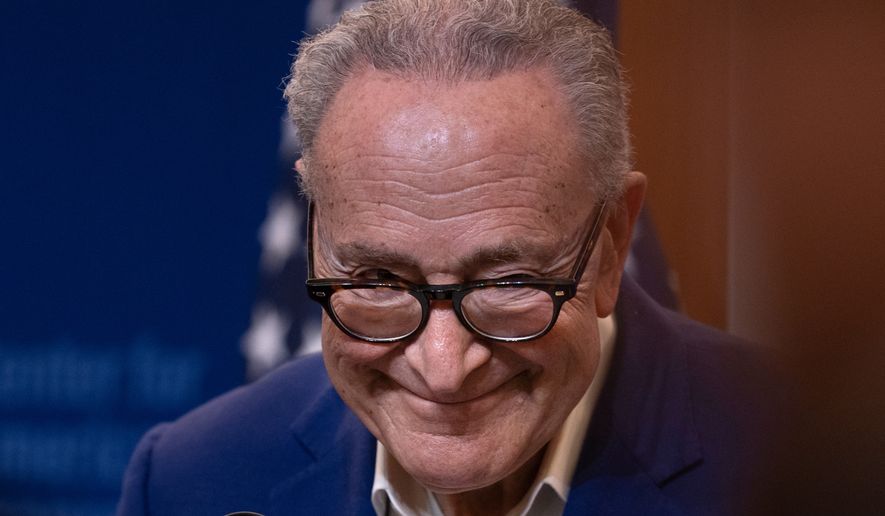

The blue tsunami in the midterm elections last week might sweep away Senate Minority Leader Charles E. Schumer, the New York Democrat who seemed to be a shoo-in for majority leader but is now facing a different kind of wave from his caucus.
Newly elected Democrats are lining up, but not in support of Mr. Schumer, 75, who has represented New York in the Senate for nearly 28 years.
At least five newly elected Senate Democrats have said they will not vote for Mr. Schumer when party lawmakers meet to select a majority leader this month.
People were interested in these podcasts
“It just feels like it is a time for fresh ideas and new ideas and somebody who can unite us instead of dividing us,” Adam Hamilton, the Democrat who flipped a Senate seat in deep-red Kansas, said Sunday on NBC’s “Meet the Press.”
Losing a vote from Mr. Hamilton and a few other newcomers would typically be no big deal for Mr. Schumer.
To win the position of majority leader, he needs support from a majority of his caucus, which stands at 52-54 seats, with Alaska and Mississippi races remaining uncalled.
Yet a bigger movement to replace him is developing, along with a potential opponent for the chamber’s top job.
Sen. Chris Van Hollen, Maryland Democrat, is said to be “open” to challenging Mr. Schumer and already has the backing of Abdul El-Sayed, the Democrat who pulled off a 7-percentage-point win in Michigan’s Senate race.
Mr. Van Hollen is one of the Senate’s most ardent opponents of the American Israel Public Affairs Committee and wants to end U.S. funding to Israel.
Mr. Van Hollen’s candidacy is pushed by Indivisible, the far-left, pro-Palestinian group that calls for an end to all U.S. military support of Israel.
Mr. Van Hollen has received “an outpouring of calls and is now in active listening mode,” said Indivisible Co-Executive Director Ezra Levin, according to Politico.
If opposition to Mr. Schumer gains more momentum, he could find himself without enough support from the far-left, socialist-aligned members of his caucus while losing the backing of newly elected moderates who think he is too liberal.
Annie Andrews, who pulled off a shocking win in what had been reliably red South Carolina, said she would not support Mr. Schumer. She called for “a generational change on both sides of the aisle.”
On Monday, Mr. Schumer’s whip count appeared to be eroding from among long-serving Democrats who have been loyal to him.
“We need a conversation about leadership going forward because we need new energy and ideas,” three-term Sen. Richard Blumenthal, Connecticut Democrat, told reporters in Hartford.
Mr. Blumenthal said later Monday on Capitol Hill that he planned to vote for Mr. Schumer, but added that “the Senate needs to change the way it operates to get more done for the American people.”
At least four newly elected Democrats had not committed to voting for Mr. Schumer, in addition to Mr. Hamilton and the four other newcomer “no” votes.
James Talarico, who flipped the long-red Senate seat from Texas, said he was undecided.
“I’m going to meet with every candidate for any leadership position. I’m going to ask tough questions about their vision and their values and their experience,” Mr. Talarico told CBS News.
Another group of senators, who call themselves the “Fight Club” and say they represent the left-wing populist faction of their party, could also move to block Mr. Schumer. The group of eight includes Sen. Bernard Sanders, a Vermont independent who caucuses with the Democrats, and Sen. Elizabeth Warren, a far-left Democrat from Massachusetts. Neither has committed to backing Mr. Schumer.
If his caucus rejects Mr. Schumer’s bid to lead the new majority, it would be a stunning rebuke of a party leader who raised record-breaking sums on behalf of Democratic Senate candidates.
Mr. Schumer personally recruited several of the Democrats who won in swing states and pumped more than half a billion dollars into races throughout the country, including more than $354 million raised by his aligned super PAC. The spending helped put more seats in play, resulting in wins that far exceeded even his expectations.
“He oversaw the biggest Democratic sweep in the Senate since Watergate,” said Adam Jentleson, a former top Democratic aide who runs the Searchlight Institute, a Washington-based public policy think tank. “To me, the question of whether Schumer deserves to be reelected as leader after the most dominant performance by Senate Democrats in more than half a century is straightforward, and the answer is clearly yes.”
While building a massive war chest for Senate Democrats, Mr. Schumer also accrued anger and frustration from many caucus members and far-left groups, who hoped he would fight harder against Republicans and the Trump agenda.
Mr. Schumer has been a member of his party’s leadership team for decades and has served as Democratic leader for almost a decade.
Some Democrats did not want him to make deals with the Trump administration, as Mr. Schumer did in 2025 when he helped push through a Republican-backed funding bill that raised defense spending and reduced domestic spending.
Mr. Levin, the co-executive director of Indivisible, called on Mr. Schumer to resign for failing to use the filibuster to block the defense bill.
“Sen. Schumer has contributed to and led many important accomplishments that Indivisible is grateful for. But with our democracy on the line, he let us, the country, and the Democratic Party down,” Mr. Levin said.
Other far-left organizations and groups aligned with the Democratic Socialists of America also oppose Mr. Schumer, whom they see as too moderate and beholden to corporate interests to advance a liberal agenda.
Mr. Schumer shrugged off opponents at a press conference the day after the election, telling reporters it is not all about him but about implementing the Democrats’ agenda to lower costs and clean up corruption he believes is rampant in the Trump administration.
“The issue is not me. I’ll be reelected as the majority leader. The issue is focusing on the American people and what they want,” Mr. Schumer said.
Mr. Schumer did not reply to a request for comment from The Washington Times.
Contact the author

Please read our comment policy before commenting.