


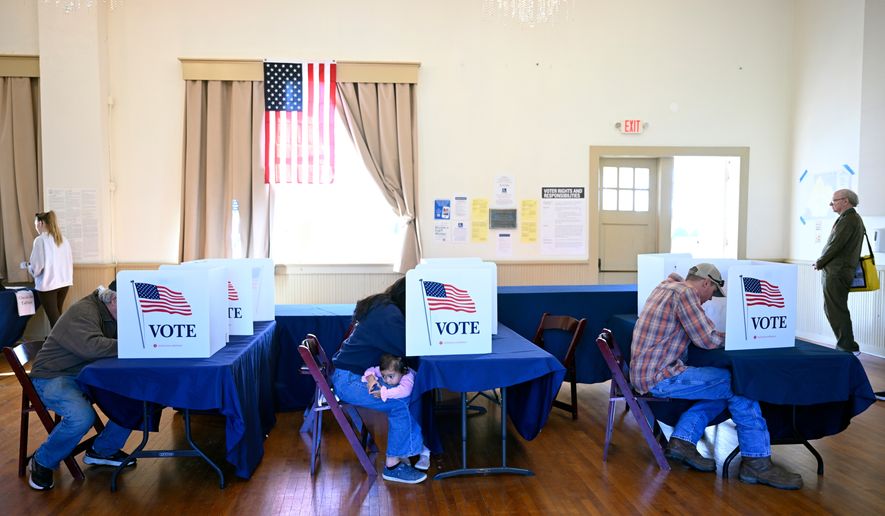

Virginia solidified abortion rights and same-sex marriage on Tuesday as voters in dozens of states decided ballot questions alongside their picks for Congress.
The abortion-related measure creates a “fundamental right to reproductive freedom” in response to the Supreme Court’s 2022 decision that overturned Roe v. Wade and allowed states to restrict abortion if they chose.
It passed with over 60% support, while fewer than 40% voted against it.
People were interested in these podcasts
Another measure, Question 2, erases the Virginia Constitution’s ban on same-sex marriage. The largely-symbolic measure passed by 57% to 43%.
Some LGBT advocates were afraid the Supreme Court will revisit a 2015 ruling that forced states to issue marriage licenses to same-sex couples.
Voters also approved a third ballot question that would restore voting rights to felons after incarceration. It passed by 10 percentage points.
“I voted all ‘yes.’ There were a few little twinges I felt with some of the language, but nothing that stopped me from supporting the gist of each of the three,” said Deborah Fisco, a 67-year-old retired government attorney from Alexandria, Virginia.
Other voters at the Beltway-region polling site told The Washington Times they had voted against all three questions.
“I don’t think the Constitution needs to be changed,” said Rebecca, a woman in her 40s who only provided her first name.
Thirty-nine states put at least one ballot question before voters on Tuesday, a high-stakes subplot to midterm elections that will determine which party controls the House and Senate.
Kentucky residents voted Tuesday overwhelmingly to limit the governor’s pardon power. Voters approved the ballot question, Amendment 1, by a margin of 70% to 30%.
The measure prohibits the governor from granting pardons or commuting sentences for a period running from 60 days before a gubernatorial election to inauguration day. The measure is intended to prevent an outgoing governor from issuing a flurry of pardons or commutations on the way out the door.
Floridians voted Tuesday to expand property-tax relief, backing Amendment 3 with over 60% support.
The measure substantially raises the homestead exemption across its 67 counties, giving residents who own a home and live full-time in it a significant break on property taxes, which have climbed dramatically in the past decade.
Police, firefighters and county officials urged voters to reject the measure.
Polk County Sheriff Grady Judd called Amendment 3 “a train wreck” that does not ensure funding for county services, which rely almost exclusively on property taxes.
Elsewhere, with most of the vote counted late Tuesday, Massachusetts voters overwhelmingly rejected a ballot measure that would repeal the legalization of recreational marijuana. Voters opted not to become the first state to roll back the trend toward cannabis legalization.
The reproductive-freedom measure in Virginia would still allow the state to regulate abortion among women in the third trimester.
But the state could not ban abortions if a fetus is not viable or a doctor thinks an abortion is needed to protect the life, mental health or physical health of the mother. It also bars the state from prosecuting or penalizing a woman or others for receiving or aiding in a miscarriage, stillbirth or abortion.
Question 2 called on voters to remove the part of the Virginia Constitution that defines marriage as only between one man and one woman, per a 2006 vote by Virginians.
However, the Supreme Court held in Obergefell v. Hodges that the Fourteenth Amendment protected same-sex marriage, making the state ban an unenforceable dead letter.
Virginians for Marriage Equality, a group pushing to approve Question 2, warned voters that the federal justice could erase Obergefell one day, making Virginia’s 2006 ban, known as the Marshall-Newman Amendment, the law again.
• Susan Ferrechio contributed to this report.
Contact the author


Please read our comment policy before commenting.