



We may not win every game we play, but there are a host of blessings to count in the chess world this Thanksgiving week.
For starters, Tuesday marks the first game of a much-anticipated world championship match, the first to be contested by players born in this century. Challenger GM Javokhir Sindarov of Uzbekistan has the White pieces in Game 1 of the scheduled 14-game match in Geneva with Indian world champion GM Dommaraju Gukesh, making his first title defense since winning the crown in 2024.
Many rungs below on the ratings chart, we can also be grateful that our ancient game seems to be thriving at the amateur level, despite the siren call of social media and “Grand Theft Auto VI.” Scholastic tournaments routinely attract massive fields, and the U.S. Chess Federation announced earlier this month that membership just hit an all-time high of 118,303 in October, bettering the mark set in March 2024.
People were interested in these podcasts
At a personal level, I remain eternally grateful to The Washington Times for continuing to set aside space online and in print to carve out space for chess, at a time when so many mass-media chess columns have fallen by the wayside. Next year will mark the column’s 35th anniversary.
—-
And finally, here’s a Thanksgiving shout-out to the colorful and pathbreaking personalities who keep the game ever fresh for its fans. The American Chess Magazine recently saluted its “Dirty Dozen” — 12 players over the decades whose stubbornly original approach to the game has earned them cult status. Making the cut was Canadian GM Duncan Suttles, who achieved notable success in the post-Fischer era with a sui generis style that baffled contemporaries and was described as “outlandish hypermodernism.”
More than almost any player of his era, Suttles embraced and refined the controversial positional principles of hypermodern pioneer Aron Nimzovich, championing the very Nimzovichian Modern Defense and becoming known for his predilection for fianchettoed bishop formations and unexpected knight maneuvers.
Suttles’ talents were on display in a 1981 game played in Vancouver against British star GM Anthony Miles, who has his own fan base for his eccentric style both on and off the chessboard. Suttles as White opts for a kind of Modern Defense Reversed, and by 6. b4 e4 7. Ndf2 e3, the two players have already reached a position unknown to opening theory.
But White proves himself more at ease in the odd position that results after 12. Nc3 Kf8?! (Black’s idea is to clear the e8-square for his rook, but the king will not be safe on this square) 13. h3 Nh6 16. e4! dxe4 15. Nxe4 Bf5 16. c3 Qe7 — the pin on the White knight looks nasty, but Suttles finds an unusual way to keep the initiative.
White’s unexpected 17. Nh4!? (Bxh6+ Rxh6 18. Qd2 Bg7 19. Neg5 Re8 20. e4! Bxe4 21. 0-0 Bf5 22. Rae1 also would have stressed the Black defense) Bxh4 18. gxh4 Ng8?! (White is also better on 18…Qxh4+ 19. Qg3! Qxg3+ 20. Nxg3 h4 21. Nxf5 Nxf5 22. 0-0 Ng3 23. Re1 Re8 24. e4) 19. 0-0 Re8 (again the pin looks formidable and, again, Suttles has the answer) 20. Bg5 f6 (Qe6 21. d5 Qd7 22. dxc6 bxc6 23. Qxd7 Bxd7 24. Nc5, with an edge) 21. Nxf6!, when 21…Bxd3 22. Nxe8+ Kxe8 23. Bxe7 Ncxe7 24. exd3 leaves White up an exchange plus two pawns.
White’s e-pawn makes a very delayed debut with powerful effect on 22. e4 Bxe4 23. Bxe4 Qxe4 24. Qg3 Rh7 25. Rf4 Qc2 26. Rxf6+, not only winning a pawn but leaving the Black king in an even more precarious state. The final stages of the games are marred by some oversights, perhaps owing to time pressure given the complexity of the fight. White misses a forced mate with 30. Qa2+! Kg7 31. Rf7+, and Miles could have put up tougher resistance with 32…Qe4!, instead of the game’s 32…Qc2; e.g. 33. Qe3 Qxe3+ 34. Rxe3 Rxe3 35. Bxe3 Ne6, with chances to draw the ending.
White finally cashes in on his fine earlier play on 36. d5?! (simply 36. Re1 promised a cleaner win) g5? (Nxc5 37. bxc5 Qb3! makes White work harder) 37. R3f2 gxh4+? (the last mistake; there were hopes of a perpetual in lines such as 37…Qxc3 38. dxe6 gxh4+ 39. Rg2 Rxg2+ 40. Kxg2 Qg3+ 41. Kh1 Qxh3+) 38. Qxg7+!, and Black resigned as there’s no need to play out 33…Nxg7 39. Rxc2 and Black is down a full rook.
—-
Two other players on the Dirty Dozen list are no surprise: Ukrainian GM Vasily Ivanchuk and Latvian GM Alexei Shirov. The two near-contemporaries fell just short of the world title in their prime in the 1990s, but both played dozens of fighting, idea-packed games that remain a joy to replay.
Ivanchuk had a clear plus score against Shirov in the nearly 50 classical games they contested over the years. Perhaps Ivanchuk’s most memorable win in the series came in a 1996 game played at the Hoogovens Group A Tournament in the Netherlands, when the Ukrainian star was at the peak of his powers.
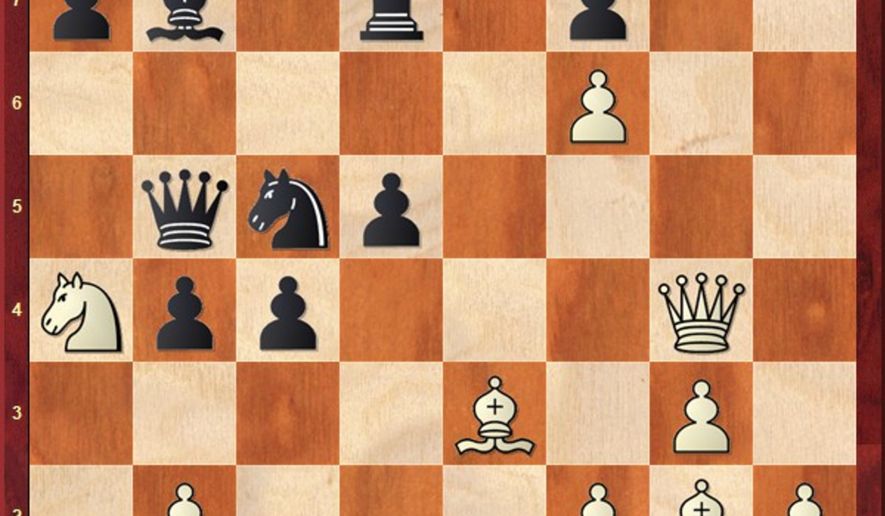
Fittingly, the two combative GMs engage in one of the sharpest lines in the repertoire, a QGD Semi-Slav variation featuring a temporary piece sacrifice by White on Move 9 and deeply unbalanced play in the heavily analyzed main lines. Remarkably, both players are still in the opening book through 19. Be3 Nc5 20. Qg4+ Rd7 (see diagram), when Ivanchuk as White uncorks a stunning speculative sacrifice.
Thus: 21. Qg7 (GM Nikolay Kalinichenko, in his anthology of 100 Ivanchuk games, gives this queen sacrifice a “!!?” notation; White could win a pawn here with the prosaic 21. Nxc5 Bxc5 22. Qg7 Rdd8 23. Bxc5 Qxc5 24. Qxf7, but Ivanchuk instead gives up his queen to two minor pieces and an enduring initiative) Bxg7 22. fxg7 Rg8 (both sides have chances after 22…Rhd8 23. Nxc5 Rc7 24. Nxb7 Rxb7 25. Bxa7 c3 26. Bd4 Kd7 27. bxc3 b3 28. Rfd1 b2 29. Rab1 Ke6 30. c4 Qxc4 31. Bxb2 Qg4 32. Re1+ Kf5 33. Bxd5) 23. Nxc5.
Shirov defends actively, giving up the exchange to get his fearsome queenside pawn mass moving on 23…d4 24. Bxb7+ Rxb7 25. Nxb7 Qb6 (Qxb7? 26. Bxd4! preserves White’s precious pawn on g7, boxing in the Black rook), but Ivanchuk keeps the pressure on with 26. Bxd4 Qxd4 27. Rfd1 Qxb2 (White is also better on 27…Qxg7 28. Rxa7 Kb8 29. Rda1 Re8 30. Nd6 Re1+ 31. Rxe1 Kxa7 32. Nxc4) 28. Nd6+!, and the White rooks and knight weave a mating net for the Black king.
Still nominally down material in the position, White breaks decisively on top on 29. Rdb1 Qxg7 (no better was 29…Qd2 30. Nxc4 Qc3 31. Ra4 b3 [Qxc4 32. Raxb4+ Qxb4 33. Rxb4+ Kc7 34. Rg4 and wins] 32. Na5 Qxg7 33. Rxb3+ Kc8 34. Rc4+, winning) 30. Rxb4+ Kc7 31. Ra6! (protecting the knight and threatening the lethal 32. Rb7+ Kd8 33. Raxa7) Rb8 32. Rxa7+ Kxd6 33. Rxb8 Qg4 (c3 34. Rd8+ Ke6 35. Rc8 corrals the advanced pawn) 34. Rd8+ Kc6 35. Ra1.
Shirov resigns as his c-pawn will soon be lost, his king is cut off from the kingside, and the Black queen will prove no match for White’s two rooks and two extra pawns.
(Click on the image above for a larger view of the chessboard.)
Suttles-Miles, Vancouver Open, Vancouver, August 1981
1.g3 d5 2.Bg2 e5 3.d3 Nf6 4.Nf3 Nc6 5.a3 Be7 6.b4 e4 7.Nfd2 e3 8.fxe3 Ng4 9.Nf3 Bf6 10.d4 h5 11.Qd3 g6 12.Nc3 Kf8 13.h3 Nh6 14.e4 dxe4 15.Nxe4 Bf5 16.c3 Qe7 17.Nh4 Bxh4 18.gxh4 Ng8 19.O-O Re8 20.Bg5 f6 21.Nxf6 Nxf6 22.e4 Bxe4 23.Bxe4 Qxe4 24.Qg3 Rh7 25.Rf4 Qc2 26.Rxf6+ Kg8 27.Rc1 Qe4 28.Qg2 Qd3 29.Rcf1 Rd7 30.Bh6 Kh7 31.Qg5 Nd8 32.R6f3 Qc2 33.Bf8 Ne6 34.Qh6+ Kg8 35.Bc5+ Rg7 36.d5 g5 37.R3f2 gxh4 38.Qxg7+ Black resigns.
Ivanchuk-Shirov, Hoogovens Group A, Wijk aan Zee, Netherlands, January 1996
1.d4 d5 2.c4 c6 3.Nc3 Nf6 4.Nf3 e6 5.Bg5 dxc4 6.e4 b5 7.e5 h6 8.Bh4 g5 9.Nxg5 hxg5 10.Bxg5 Nbd7 11.exf6 Bb7 12.g3 c5 13.d5 Qb6 14.Bg2 O-O-O 15.O-O b4 16.Na4 Qb5 17.a3 exd5 18.axb4 cxb4 19.Be3 Nc5 20.Qg4+ Rd7 21.Qg7 Bxg7 22.fxg7 Rg8 23.Nxc5 d4 24.Bxb7+ Rxb7 25.Nxb7 Qb6 26.Bxd4 Qxd4 27.Rfd1 Qxb2 28.Nd6+ Kb8 29.Rdb1 Qxg7 30.Rxb4+ Kc7 31.Ra6 Rb8 32.Rxa7+ Kxd6 33.Rxb8 Qg4 34.Rd8+ Kc6 35.Ra1 Black resigns.
• Got a hot tip or a cool game to share? David R. Sands can be reached at davidrsands18@gmail.com.
Please read our comment policy before commenting.