


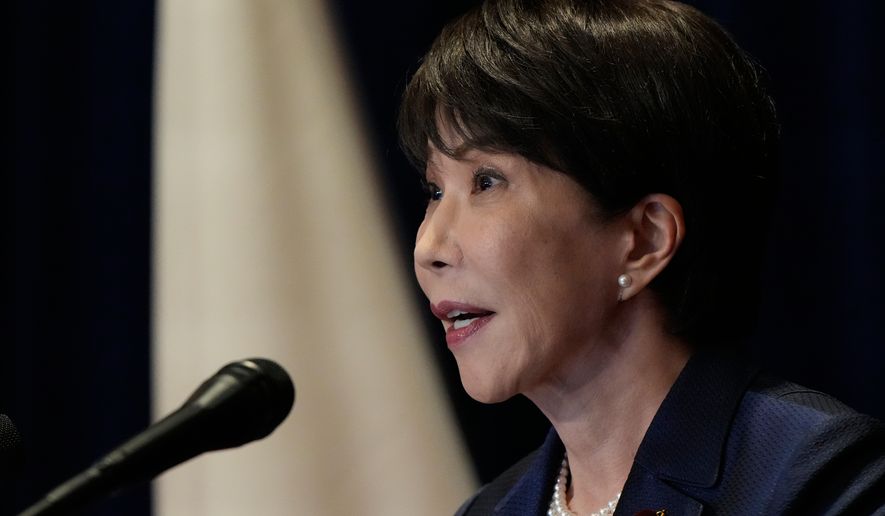

Japanese Prime Minister Sanae Takaichi can only hope that last week’s disappointing Asia Pacific Cooperation Summit in Shenzhen, China, was not a harbinger of what is shaping up to be a difficult 2027 for Japan.
The 65-year-old conservative leader returned to Tokyo amid critical reviews of her time in China, including reports that she was snubbed by China’s Xi Jinping, failed in her bid for a diplomatic breakthrough with Russia’s Vladimir Putin and was ignored by President Trump.
A rocky close to 2026 as she and her team head into 2027 with soaring military risks, numerous diplomatic crises and critical budget woes.
People were interested in these podcasts
The biggest military risk Japan, along with the U.S. and its other Asian allies, faces in the coming year is the closure of the so-called “Davidson Window” — shorthand for the 2021 warning from U.S. Pacific Command Admiral Philip S. Davidson to the U.S. Senate that China will be capable of invading Taiwan in 2027.
But despite the burgeoning threat from Beijing, Ms. Takaichi is financially shackled when it comes to boosting defense spending.
If Communist China attacks democratic Taiwan — no sure thing given Mr. Xi’s aversion to kinetic force, China’s so-called “Garbage Economy” and an ongoing purge of senior officers — Japan would be in the crosshairs.
In 2024, Beijing was infuriated when Ms. Takaichi said a Taiwan contingency would activate Japan’s Self-Defense Forces.
Beijing’s responses included restrictions on rare earths, bans on tourist travel to Japan and a diplomatic and information offensive against Tokyo.
In Shenzhen, Ms. Takaichi’s summit started badly, with reports focusing on alleged slights as she arrived on the airport tarmac.
Then, during her two meet-and-greets with Mr. Xi, he declined to say a single word to her.
Ms. Takaichi did speak to Vladimir Putin, but earned no breakthrough regarding Moscow’s seizure of Japan Tobacco’s assets, nor on the imprisonment of a Japanese journalist for alleged espionage.
Juggling concerns over China, Russia and North Korea while looking to strengthen alliances with Washington and Asian democracies, Ms. Takaichi’s team has been strategizing.
By the end of 2026, Tokyo aims to present a revision of three key security documents: the National Security Strategy, the National Defense Strategy and the Defense Buildup Program.
The last updates were in 2022.
Upgraded area-denial and unmanned coast-defense capabilities, as well as more integrated drone, missile and air defenses, are anticipated.
A major national taboo in Japan regarding nuclear arms that originated in 1945’s atomic bombings is also expected to be challenged. Nuclear submarine acquisitions and the placement of U.S. atomic arms on Japanese soil could be presented.
“Japan is doubling down on self-defense,” said Paul Midford, a specialist in Japan’s foreign affairs at Meiji Gakuin University. “Yet it appears defense spending will not rise past the 2% of GDP level it has already reached, as Takaichi is unwilling to raise taxes.”
Boosting defense with deficit spending would spike Tokyo’s borrowing costs and weaken the yen, further accelerating inflation, Mr. Midford noted.
That is a no-no, as inflation is currently “the fulcrum of voter discontent,” he said.
More options exist for progress on the regional diplomacy front.
One hand Ms. Takaichi can play is Japan’s relatively solid relations with ASEAN and India, said Haruko Satoh, who teaches foreign policy at Osaka University.
In ASEAN, Tokyo’s ties to Manila are tight. Japan has ended a decades-long policy of not selling arms, and has offered weapons — including used destroyers — to the Philippines.
The Philippine archipelago occupies a similar strategic position to Japan: It has a bilateral alliance with the U.S., and covers Taiwan’s southwestern flank.
But Ms. Satoh — referencing the prime minister’s 2025 remarks describing a Chinese attack on Taiwan as an existential crisis for Japan — reckons Ms. Takaichi’s “blunder with China regarding Taiwan is costing her and Japan dearly, and I don’t know if she really understands this.”
Conversely, China’s APEC snubs may have strengthened her hand with Japan’s wide swath of conservatives.
“China’s diplomatic slights of Takaichi were well noticed in Japan and angered conservatives,” Mr. Midford said.
Some observers noted that the Japanese leader inexplicably faced a 16-inch step down from her plane to the staircase upon landing in China — a deliberate endangerment of Ms. Takaichi, Mr. Midford said, “as she has an arthritic knee and arthritis.”
She also went ignored or unnoticed in China by Mr. Trump, who focused on his trilateral with Mr. Putin and Mr. Xi.
Just prior to APEC, Japan was stunned to learn Washington expects Tokyo to triple the amount it pays to host U.S. troops in 2027.
On Tuesday, Ms. Takaichi made clear Tokyo will continue to financially support the International Criminal Court, currently headed by Japan-born Tomoko Akane. In October, Washington announced sanctions on the ICC, Ms. Akane and other officials for its probes into alleged Israeli war crimes and its potential indictment of U.S. service members.
Amid the friction, a united front with South Korea could make sense. Both export superpowers have suffered tariffs and been compelled to make multi-billion-dollar investments in the U.S.
Both are also facing tensions with Washington: Japan with U.S. payment demands, and Korea with its plan to remove its troops from U.S. command by 2030.
Despite this common ground, the Asian democracies are divided by emotive historical disputes.
Some Japanese insist that they paid massive reparations for their 1910-1945 colonial rule of the peninsula in the 1960s; that senior officials have apologized to Korea scores of times; and that Seoul has reneged on prior agreements.
Some Koreans insist that Japan is insincere, pointing to a lack of information on Japanese aggression in school textbooks, and visits by some politicians to Yasukuni Shrine, where Japan’s war dead — including a handful of war criminals — are enshrined.
“Takaichi is trying to consolidate a closer relationship with Seoul,” Mr. Midford said. “Japan … sees no significant barriers as long as Seoul does not raise history issues.”
Contact the author

Please read our comment policy before commenting.