


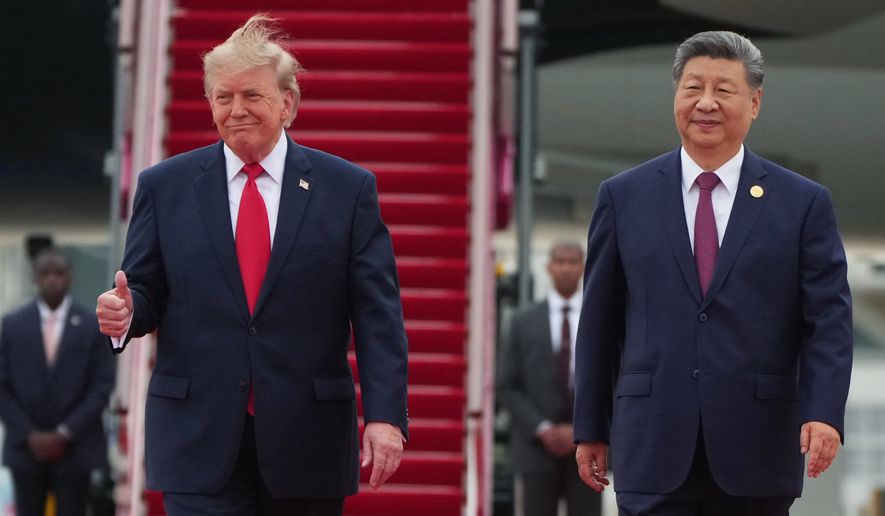

Chinese President Xi Jinping told President Trump last week that the U.S. should continue to “do the right thing” on Taiwan — an official statement viewed as a veiled reference to the Trump administration’s hold on a new multibillion-dollar arms package for the island democracy.
The Chinese leader’s comment was included in the official Chinese Foreign Ministry statement on the bilateral meeting between the two leaders on Thursday in Shenzhen, China.
The statement said that on Taiwan, the United States “should keep doing the right thing and avoid major setbacks in China-U.S. relations.”
People were interested in these podcasts
The White House provided no similar readout of the bilateral meeting.
In December, the administration announced a new $11.3 billion arms sale to Taiwan that included advanced high-mobility artillery rocket systems, howitzers, anti-tank missiles and drones.
However, a second major arms package worth $14 billion that was approved by Congress has been blocked by the administration since May — the timing coinciding with Mr. Trump’s summit with Mr. Xi in Beijing that month.
Beijing had denounced the earlier arms sale as an infringement on Chinese sovereignty over the island, which China claims. The U.S. does not recognize the claim and regards Taiwan’s status as unresolved. The island historically was never Chinese territory and broke from the mainland in 1949 when Nationalist forces fled China for Taiwan during a civil war.
Secretary of State Marco Rubio told reporters in September that the blocked $14 billion sale, which includes advanced missile defenses, is being delayed over worries about shortages in U.S. military production of needed weapons.
The secretary said all arms sales to foreign states require balancing U.S. needs in different parts of the world against “whether we can afford to sell something, because we may need it for ourselves.”
Critics have warned that Mr. Trump may be preparing to make a deal with China over Taiwan that could include restricting U.S. arms sales in exchange for closer trade and economic ties with Beijing.
The Chinese readout of the Trump-Xi meeting in Shenzhen stated that Mr. Trump reiterated to Mr. Xi the decades-long U.S. position that Washington does not support Taiwan independence.
China, for its part, has been pressing the administration to adopt the more forceful assertion that the U.S. opposes — rather than “does not support” — Taiwan independence.
Beijing also regularly demands that the U.S. end arms sales to Taiwan.
The Chinese statement on the summit also quoted Mr. Xi as telling the president that the two nations should “extend the list of cooperation and shorten the list of problems.”
“Disagreements that cannot be resolved immediately should be constructively managed to prevent conflicts from escalating,” Mr. Xi was quoted as saying in the statement.
The Chinese leader also called for the U.S. and China to bolster communication and coordination on artificial intelligence to reduce risks and ensure AI remains under human control.
In February, Mr. Xi told Mr. Trump in a phone call that the U.S. must use “prudence” regarding arms sales to the island that he considers Chinese territory. He vowed that China would never allow Taiwan to be separated from the mainland.
Around the same time, a Chinese military spokesman, Senior Col. Jiang Bin, took a tougher stance on the issue at a Defense Ministry briefing telling reporters the U.S. must use “extreme caution” in handling Taiwan matters.
In May, on a flight to the United States from China, Mr. Trump said he may restrict arms sales to Taiwan in a bid to improve relations.
Asked aboard Air Force One about the blocked $14 billion arms package, the president said he would decide soon whether to go ahead or restrict the sale.
“You know, the whole thing with the arms sales was in great detail, actually, and I’ll be making decisions,” Mr. Trump said of his discussions with Mr. Xi. “But you know, I think the last thing we need right now is a war that’s 9,500 miles away. I think that’s the last thing we need. We’re doing very well.”
Around the same time, U.S. Trade Representative Jamieson Greer said Mr. Trump was considering using the arms sales to Taiwan as leverage in ongoing negotiations with China, something he said past presidents have done.
“Right now, the president’s considering how to move forward on that. The reality is, it’s really important for the United States and China to have a stable relationship,” he said in an interview on ABC’s “This Week.”
Mr. Trump has been less vocal in his support for Taiwan than his predecessor, President Joseph R. Biden, who on three occasions declared he would use military force to defend Taiwan if China attacked.
Mr. Trump has said he was assured by Mr. Xi that China would not attack Taiwan during his presidency.
U.S. military commanders have warned that Mr. Xi has ordered the People’s Liberation Army to be ready for military action against Taiwan by April.
Mr. Xi said during the May summit that the U.S. mishandling of Taiwan could lead to conflict.
American arms sales to Taiwan were codified by Congress in the 1979 Taiwan Relations Act that calls for supplying defense weapons to the island.
Republican and Democratic lawmakers have been vocal supporters of selling more arms to Taiwan.
Ten Democratic senators said in a statement in May that the administration should formally notify Congress of the $14 billion in U.S. arms sales that Congress pre-approved in January 2026.
Contact the author
Please read our comment policy before commenting.