


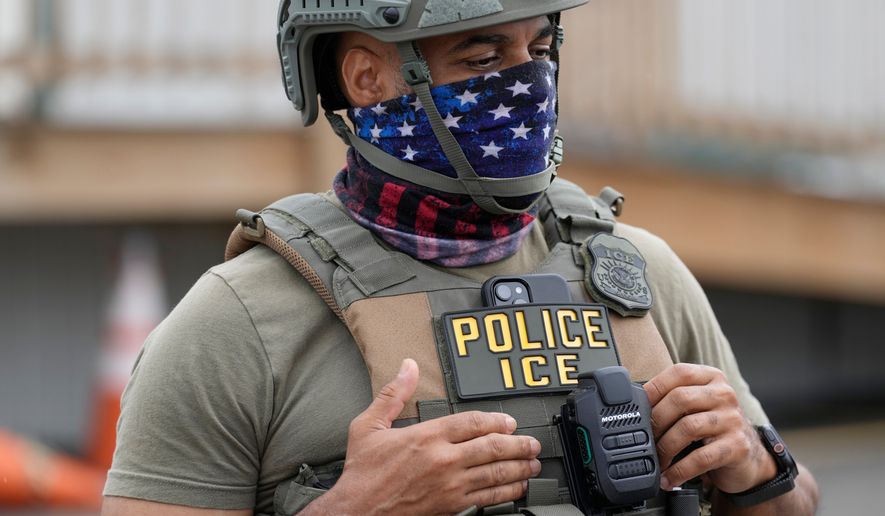

A federal appeals court ruled Monday against Virginia’s law barring ICE and other federal officers from wearing masks while on duty in the state.
But the 4th U.S. Circuit Court of Appeals said the legislature was on firmer ground in restricting local police and sheriffs from helping U.S. Immigration and Customs Enforcement spot deportation targets.
The three-judge panel said the principles of federalism dictated both results: The state cannot interfere with how federal agents carry out their duties, but neither can the national administration commandeer cooperation from state or local actors when it is forbidden by the state government in Richmond.
People were interested in these podcasts
“The commonwealth may choose to participate in such efforts or permit its own subordinate political actors to do so. But the inverse is also true,” wrote Judge Toby Heytens, a Biden appointee. “Just as the Commonwealth was allowed to make one choice in the past, it is allowed to make a different choice going forward. Indeed, that is the essence of democratic self-government.”
The court overturned an injunction against local cooperation. But it allowed an injunction to stand against the anti-masking law.
Virginia adopted the measures as part of a wave of anti-ICE sentiment in the wake of President Trump’s mass deportation campaign.
The anti-masking law barred federal officers from wearing face coverings that shielded their identity, and required them to wear name tags or other unique identifiers so their identities could be known. It included exceptions for health or undercover work.
The anti-cooperation law targeted what’s known as 287(g) agreements, which allow state or local officers to assist ICE in spotting deportation targets.
Usually that means scouring prisons and jails for deportable aliens, though in some cases officers are also trained to look for targets while out in the field.
Some 21 jurisdictions in Virginia have operative 287(g) agreements, according to the latest ICE data. That’s down from 24 as of Sept. 1.
The Buchanan County Sheriff’s Office, Scott County Sheriff’s Office and the Rappahannock, Shenandoah, Warren Regional Jail Authority have all dropped off ICE’s list.
Loudoun County is the largest jurisdiction on the current list.
Gov. Abigail Spanberger had already canceled all state-level 287(g) cooperation.
A federal district judge in September had refused to block Virginia’s new anti-cooperation law, saying it meddled with existing contracts. Judge Robert Payne had, however, said the state could bar new jurisdictions from signing up.
The appeals court, though, said the 287(g) agreements between the feds and the local agencies had always allowed termination by either side. Judge Heytens said Virginia’s law restricting cooperation doesn’t really rewrite the agreement, it terminates it and offers a new one — with conditions the state wants to impose.
Judge Robert King, a Clinton appointee, sided with his colleagues on the cooperation part of the ruling. But he said he would also have upheld the state’s anti-masking provisions.
In his opinion, he harkened back to Hollywood westerns and compared ICE to the evildoers.
“Only the bad guys — the bank robbers and the stagecoach bandits — wore masks,” he said. “And the people of Virginia should not be expected to guess about whether masked men who confront them are legitimate law-enforcement officers and not robbers or common criminals.”
Judge King’s analogy overlooked the Lone Ranger, a good guy who did wear a mask to prevent the bad guys from knowing his identity, protecting those close to him from retribution.
The judge also said the fact that mask decisions are left up to individual officers undercut the feds’ argument.
“I cannot and will not accept the proposition that individualized discretion, untethered to any identifiable source of federal law, enjoys constitutional supremacy over a duly enacted statute of the commonwealth,” he wrote.
Contact the author

Please read our comment policy before commenting.