



OPINION:
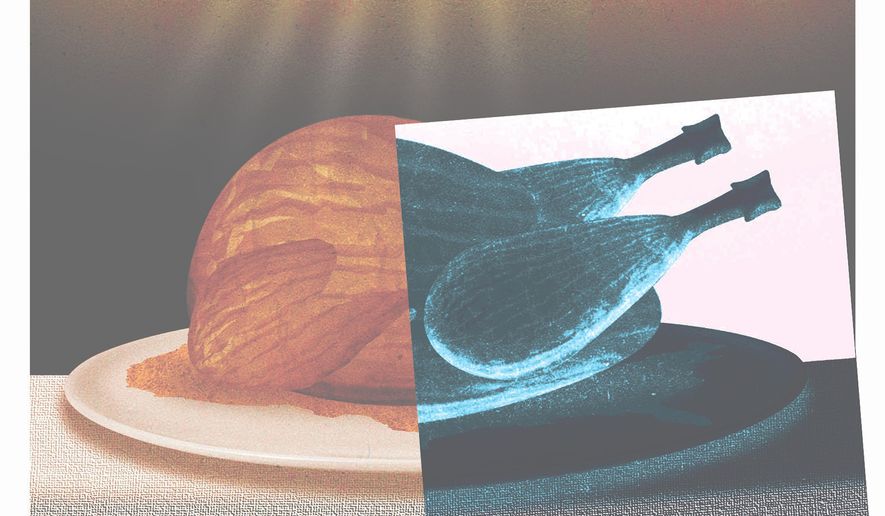
As we careen into the holidays, it seems important to note that the first Thanksgiving on American soil probably occurred in May 1541 near what is now Canyon, Texas. There, the Rev. Juan de Padilla celebrated Mass for 1,500 soldiers under the command of the conquistador Francisco Vazquez de Coronado.
Or the first Thanksgiving may have taken place on Sept. 8, 1565, when the Rev. Francisco Lopez said Mass for the 800 newly arrived Spanish Colonists in St. Augustine, Florida.
The leader of the settlers who landed at Berkeley Hundred — in present-day Henrico County, Virginia — on Dec. 4, 1619, commanded: “We ordaine that this day of our ships’ arrival, at the place assigned for plantation, in the land of Virginia, shall be yearly and perpetually kept holy as a day of Thanksgiving for Almighty God.”
People were interested in these podcasts
Despite all that, the Pilgrims’ celebration in Massachusetts remains the dominant narrative of Thanksgiving in our society, and for good reason.
In 1621, in the wake of a bountiful harvest after a year of terrible sickness and unimaginable hardship — almost half the small contingent of 102 souls died of disease or privation during that first year — the Pilgrims set aside a day to give thanks to God for all of it.
Thanksgiving for bounty? Of course. Thanksgiving for sickness and hardship? Absolutely. The Pilgrims correctly believed that everything we receive is a gift from God, both the events and people we immediately recognize as good and those in which we have trouble finding the good.
The reality is that bad things happen to all of us, and for whatever reason, God lets them happen. Our lives are not solely our own; we did not create ourselves, nor did we create the universe in which we live. Consequently, we are rarely in a position to determine which experiences are good and which are bad.
Many of the bad experiences people endure are also the richest opportunities for learning and for growth, although they may not be understood as such in the moment. Danish philosopher Soren Kierkegaard captured this when he wrote: “Life can only be understood [looking] backwards, but it must be lived forward.”
The Pilgrims knew all this and were grateful not only for the harvest but also for favorable circumstances. They were also grateful for God’s providential, watchful and caring love, however that was manifested.
The word they chose to describe themselves, pilgrim, is derived from the Latin “peregrinus,” which simply means wanderer. They were animated by an understanding that we are all wanderers here.
They were well familiar with St. Paul’s admonition that we “have not here a lasting city.” Everything we see and touch will one day cease to be. The only things that last are the divine and whatever share of the divine we have curated through our lives. For some, these are uncomfortable facts. For others, they are a source of comfort and resilience.
One of the participants in that first Thanksgiving in Massachusetts was Richard Warren. He was almost certainly a refugee from debtors’ prison back in England, and, like the rest of the Plymouth Colony, barely survived his first year on the western edge of the North Atlantic. At times, he must have wondered whether dying in a new land was God’s plan for him.
It was not, at least not immediately. His wife and children, who had stayed behind in England, joined him in 1623. They had two more children before Richard died in 1628. His children survived into adulthood and had large families.
It is estimated that 40% of those who claim Mayflower ancestors are related to Richard Warren. His descendants include John Warren, the founder of Harvard Medical School, the Roosevelts, former President Ulysses S. Grant and this author.
All of us remain very grateful for his sacrifice and steadfastness in those first difficult moments on this continent, which ultimately yielded fruit a hundredfold. God’s plan for Richard, indecipherable to him in the moment, was to help plant the seeds of a new nation.
This Thanksgiving, think about Richard Warren and the millions of others who have struggled and still struggle to improve their lives and those of their children, neighbors and nation. Make sure to thank the author of all things for these people and for everything you have been given, both the good and bad.
• Michael McKenna is a contributing editor at The Washington Times.
Follow the author
Please read our comment policy before commenting.