


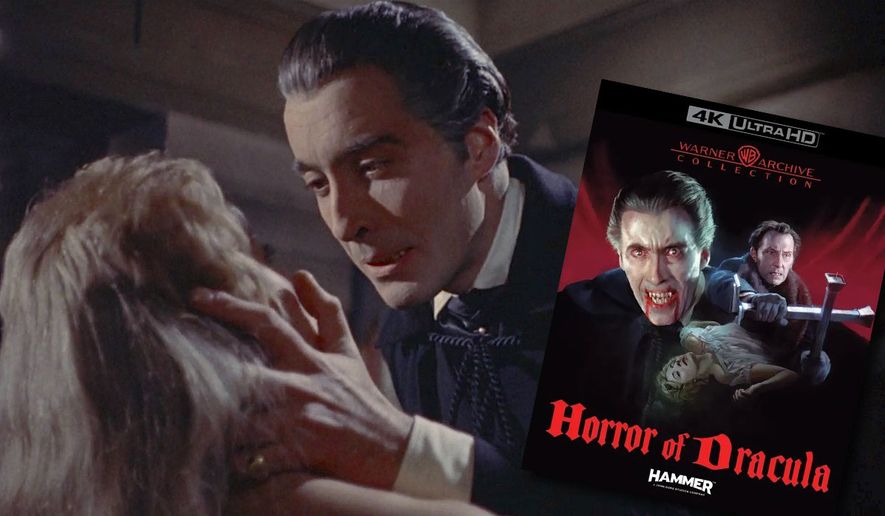

Arguably, the gold standard for Gothic vampire films debuts in the ultrahigh definition disc format, meticulously restored and sure to thrill fans of the genre in Horror of Dracula (Warner Archive Collection, not rated, 1.85:1 and 1.66:1 aspect ratio, 82 minutes, $39.99).
Although Bela Lugosi’s black-and-white version of the Count back in 1931 gave the world an unforgettable template for aristocratic horror, Christopher Lee’s portrayal offered a bloodier, more sensual and ferocious version that put Hammer Films on the map as a maestro of horror films in the 1950s and 1960s.
The 1958 film directed by Terence Fisher brought to vivid color a very loosely adapted version of Bram Stoker’s novel, introducing viewers to Jonathan Harker (John Van Eyssen), who travels to Transylvania to meet the unassumingly polite Count Dracula at his castle, under the guise of accepting a position as his librarian.
People were interested in these podcasts
However, Mr. Harker has a secret mission to destroy the undead bloodsucker, a plan that quickly unravels when he encounters a seductive female vampire (Valerie Gaunt) and discovers the power of his host.
When Mr. Harker disappears, vampire hunter Dr. Van Helsing (Peter Cushing) arrives to investigate and soon finds himself in a desperate battle against Dracula, who has set his sights on the unsuspecting family of Mr. Harker’s fiancee, Lucy (Carol Marsh).
As the Count spreads his deadly plague, transforming innocent victims into his creatures of the night, Dr. Van Helsing, with help from Lucy’s brother Arthur (Michael Gough), races to permanently stop the supernatural predator before he claims another victim.
Lee would ultimately appear in seven Hammer films as Dracula, with mixed critical results, but his presence was always completely mesmerizing onscreen with a single silent stare.
As much as Lee dominates the screen, so does Cushing as his nemesis (a role he would take on against Lee three times in his career), with scenes of Cushing staking vampires and that epic showdown with Lee inside Dracula’s castle.
Owners of this two-disc 4K set get four versions of the film, all newly restored in UHD.
The first disc offers the original British “Dracula” in its 1.66:1 theatrical framing, available in both the 81-minute theatrical cut and an extended, uncensored director’s cut running approximately 82 minutes.
The second disc features the American “Horror of Dracula” in its wider 1.85:1 theatrical framing, again offering both the original theatrical version and the extended director’s cut.
The latter restores approximately three minutes of previously censored footage, including material involving Lucy’s staking, Dracula’s seduction of Mina and the Count’s climactic destruction.
I would argue the best is the British director’s cut, which restores previously censored footage while preserving the original “Dracula” movie title and the 1.66:1 theatrical framing for the most complete viewing experience of this horror masterpiece.
4K in action: Fans and cinema historians will not be disappointed in this painstaking UHD restoration of “Horror of Dracula” that involved scanning the best surviving 35mm film elements in 4K, followed by extensive digital cleanup to eliminate scratches, dirt, flicker and image instability.
According to Hammer Films, working with materials supplied by Warner Bros., specialists at Britain’s Silver Salt Restoration spent months repairing damaged frames, correcting color inconsistencies and carefully preserving the film’s original grain structure.
Most important to releasing the definitive version was the recovery at Warner Bros. of the previously censored footage that included portions of Dracula’s death, which also required cleanup.
The restoration also used the latest high dynamic range technology to revive cinematographer Jack Asher’s saturated color palette, restoring the rich hues that helped define Hammer’s Gothic horror films.
The candy-colored reds especially stand out, from the bright red lips of female victims complementing the blood dripping from Dracula’s teeth to his bloodshot eyes, while the deep blues, lush greens and warm amber tones of the castle interiors gain renewed vibrancy.
Greater depth and detail can be seen in the scarred impression of a cross in Mina’s hand, the subtle dimpled bite marks on Mr. Harker’s neck, the curling smoke of a decayed candle and even the actors’ cold breath in a bedroom scene.
Skin tones remain natural, shadows more ominous and the original 35mm grain structure preserved, giving the nearly 70-year-old production a fresh appearance while respecting its film stock origins.
Best extras: Viewers get five optional commentary tracks, four newly recorded in 2026 and one archival track from 2012.
The first disc offers a new commentary on the British director’s cut featuring film historians Lucy Bolton and Jonathan Rigby (author of “English Gothic”) and a 2012 commentary by Mr. Rigby and noted Hammer Films historian Marcus Hearn.
The British theatrical cut features a new 2026 commentary by Lizbeth Myles and Paul Cornell, creators of the Hammer House of Podcast.
The second disc offers a new commentary on the American director’s cut with film historians Steve Haberman and Constantine Nasr. The American theatrical version includes a new commentary by filmmaker Heidi Honeycutt and cult-film historian Toby Roan and also carries the previously recorded 2012 track with Mr. Rigby and Mr. Hearn.
For those not wanting to watch the movie at least five times, I would recommend Mr. Haberman and Mr. Nasr’s track for a deep dive into story, themes and Fisher’s directorial vision, and Mr. Rigby and Mr. Hearn’s track for a nuts-and-bolts analysis exploring production design, shot choices, costuming, cast and crew stories and the 2012 restoration, certainly relevant to the latest effort.
Viewers also get a 58-minute snoozer of a documentary on the director’s early career and the circumstances that led him to Hammer’s Gothic horror productions.
Despite such esteemed participants as Fisher biographer Tony Dalton, horror writer Stephen Laws, Hammer historian Wayne Kinsey and “Little Shoppe of Horrors” publisher Dick Klemensen, viewers will find the interviews tedious and will shake their heads, wondering why it took 45 minutes before concentrating on Fisher’s work for Hammer.
Much, much better is a 38-minute retrospective of the career and life of Lee explored through an interview between his maternal niece Dame Harriet Walter and film historian Mr. Rigby (author of “Christopher Lee: The Authorised Screen History”).
The two often offer personal stories of interacting with the legendary actor over the years and a selection of clips from his horror roles in “The Curse of Frankenstein,” “The Mummy” and, of course, “Horror of Dracula.”
Equally worth watching is a 25-minute professorial critical essay written by Mr. Haberman on the director’s vision of good versus evil in terms of religious themes, also rooted in Stoker’s original novel and read by Doug Bradley (Pinhead from the “Hellraiser” movie franchise).
Mr. Haberman, a film historian, describes Dr. Van Helsing as the sole source of Christianity in the film, with Dracula representing unbridled sexual lust and the power of perversion. Stoker’s icon is interpreted in the movie as supernatural evil, erotic, violent and predatory.
Finally, viewers get a 2026 introduction to the movie from Hammer Films CEO John Gore, who briefly explains the restored and uncensored version.
Contact the author

Please read our comment policy before commenting.