



A version of this story appeared in the daily Threat Status newsletter from The Washington Times. Click here to receive Threat Status delivered directly to your inbox each weekday.
The military is using ruggedized mobile data centers in extreme environments around the world, and some of the nation’s top defense companies are competing to provide them.
During the Iran war, Iranian strikes on regional data centers highlighted the need for mass digital storage distributed across modern-day battlefields rather than concentrated in a single, relatively easy-to-target location. Mobile data centers closer to the front lines, rather than relying entirely on more traditional cloud servers, can also help warfighters access information more quickly during combat.
Those two factors, combined, have sparked a race within the defense sector.
People were interested in these podcasts
One of the entrants is Menace-I, the result of a partnership between rising defense industry power Anduril and Amazon Web Services, already a primary provider for the military’s secure cloud.
Tom Keane, Anduril’s senior vice president of engineering, said Menace aims to offer an alternative to cloud servers and could also replace some of the data center infrastructure lost to Iranian missile strikes or other attacks.
“That infrastructure needed to be reconstituted,” Mr. Keane told The Washington Times. “We actually learned that it was too hard to do that in the field … that digital assets couldn’t be replenished in the field.”
Menace-I is a purpose-built computer meant to bring secure, artificial-intelligence-powered decision aids and communications to combat. At the AWS Summit in Washington last week, the company debuted its next step for data use in the military, one that will incorporate cloud connectivity into its deployable data center.
Both systems have been independently tested in combat environments. AWS says that its Outpost system is already deployed in every area of responsibility for the U.S. military around the world.
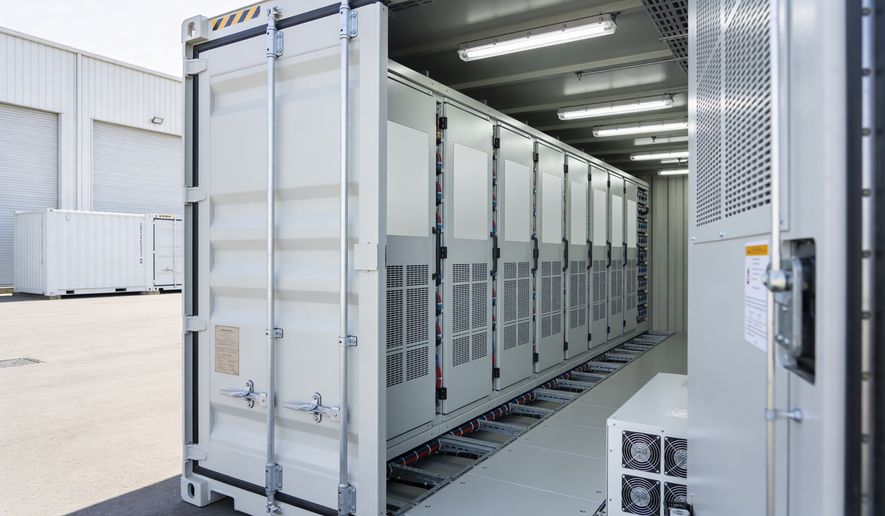
The AWS-Anduril partnership has a competitor in Armada, a San Francisco-based AI hardware company. That company’s Galleon platform is remarkably similar to Menace, with both companies choosing to build their platform into standard-size shipping containers already used by the military.
Armada has fielded a Galleon deployable data center with the U.S. Navy. It essentially acts as an intelligence server aboard a warship. Armada CEO Dan Wright told The Times that his company’s testing has been successful.
“We were able to show that you can run different applications, ’air gapped’ at the edge,” he said in a May interview. “Process drone data in the middle of the ocean, totally securely at the edge and just send the metadata back.”
Anduril and Amazon say their collaboration — AWS is one of the key businesses involved in a multibillion-dollar military contract marketplace — will let troops and unit commands select exactly how much compute power they need and quickly order a suite of hardware and software tools.
“The Iranians started targeting multiple data centers — Oracle and AWS between Bahrain, Qatar, Abu Dhabi — obvious, easy, massive targets,” Mr. Keane said. “Our customers are telling us that they want multiple Menaces that are distributed.
“They will deploy them in a geographically dispersed way,” he said.
Contact the author

Please read our comment policy before commenting.