



OPINION:
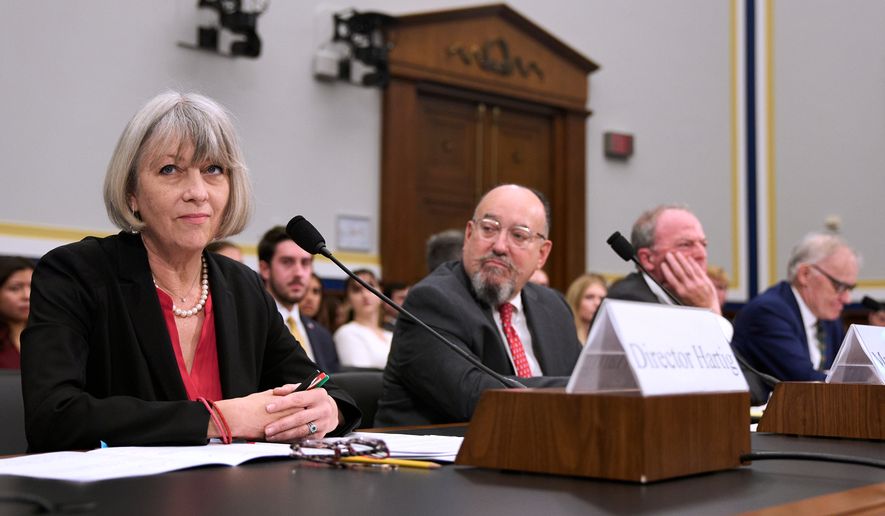
Mike Gonzalez’s testimony last week before the U.S. House about how the Smithsonian has gone woke was not just another skirmish in the culture wars. It was an indictment of a taxpayer-funded institution entrusted with the nation’s memory.
The Smithsonian is not a private debating society, campus seminar room, or boutique foundation devoted to fashionable theory.
It is the world’s largest museum complex. It receives more than $1 billion a year in federal appropriations. And it speaks with the implicit authority of the United States.
People were interested in these podcasts
When parents bring their children to it, they do not expect partisan gibberish masquerading as scholarship. They expect the story of America: glory, tragedy, triumph, sacrifice, redemption — warts and all.
Mr. Gonzalez was blunt: the Smithsonian has been “captured” by people “using it to subvert America from within.” Strong words. But testimony before Congress is not the place for euphemism when the evidence is in plain sight.
The hearing followed the White House Domestic Policy Council’s July 4 report, “Saving America’s Story,” which alleged ideological capture at the National Museum of American History.
The Smithsonian’s origin started with James Smithson’s bequest to create in Washington “an establishment for the increase and diffusion of knowledge among men.” The National Museum of American History opened in 1964 with the expectation that it would help foster patriotism by helping a republic understand why it is worth preserving.
The current leadership has inverted that mission. The Smithsonian treats America not as a great and imperfect republic capable of self-correction, but as a crime scene.
Mr. Gonzalez highlighted the disappearance, marginalization or reframing of the Founding generation. A visitor to the museum will find no major exhibit devoted to the Founding era, George Washington, Thomas Jefferson, the Continental Congress, the Pilgrims, the Puritans, or central moments of the Revolution.
When the Founders do appear, it is often chiefly through slavery. Their constitutional achievement, anti-slavery efforts, and role in building a free republic are minimized or ignored. That is not balance. It is reductionism.
The most damning evidence concerns mission. The museum changed its mission statement. The older mission spoke of exploring “the infinite richness and complexity of American history.” The newer framing emphasizes “empowering people to create a just and compassionate future” by exploring and sharing “the complexity of our past.”
The difference is not stylistic. It is substantive. “American history” disappears. “Infinite richness” disappears.
Smithsonian defenders insist that reframing history means adding voices, not erasing them. But Mr. Gonzalez’s testimony forces the harder question: when does inclusion become displacement?
The answer appears when museum leaders describe history as a “prime tool” of social justice, when educational programming is designed to create “change,” and when staff are trained through materials that portray museum spaces as implicated in “white supremacy,” “hetero-patriarchy,” “colonization” and “imperialist theft.”
Mr. Gonzalez’s simplest line was his most important: “Culture is not passed on in the bloodstream.” It must be taught, curated and loved enough to be handed down.
National museums do not exist merely to display objects. The Star-Spangled Banner is not simply fabric. Washington’s uniform is not simply cloth. The Declaration is not merely parchment.
These are artifacts of a civilization built on the proposition that rights come from God, that government exists by consent, and that human beings are capable of ordered liberty.
If taxpayer-funded programming exports activist curricula into classrooms, the Smithsonian is not merely displaying history. It is warping the minds of children.
Mr. Gonzalez’s solution: “clean house.”
That phrase will offend some Washington sensibilities. But Congress has a duty to supervise the institutions it funds. Taxpayers supply roughly 62% of the Smithsonian’s budget. We are entitled to scholarship rather than activism, patriotism rather than national self-loathing, and intellectual honesty rather than ideological ventriloquism.
The predictable response is that critics want to “whitewash history.” False. Slavery was real. Jim Crow was real. Indian removal was real. Anti-Catholicism, antisemitism and other forms of bigotry were real.
But so were the Declaration, the Constitution, the Northwest Ordinance, abolitionism, the Union Army, the Civil War amendments, the civil rights movement, the defeat of fascism and communism, the expansion of liberty, and the astounding capacity of this republic to repent, reform and renew itself.
America’s story is not one of sinless perfection. It is the story of ordered liberty struggling upward through fallen human beings and flawed institutions. It is the story of a people who proclaimed universal principles before they fully lived up to them, and then, through blood, law, sacrifice, faith, argument and courage, moved closer to those principles.
Only a foolish people would subsidize its own cultural erasure. The American people are not foolish. They will support museums that tell the whole truth. But they shouldn’t be asked to fund institutions that teach their children to regard America as an oppressor nation whose inherited narrative must be dismantled.
Mr. Gonzalez’s testimony gave Congress the way forward. Now Congress must act.
• Charles Stimson is a Senior Research Fellow at the Heritage Foundation.
Please read our comment policy before commenting.