


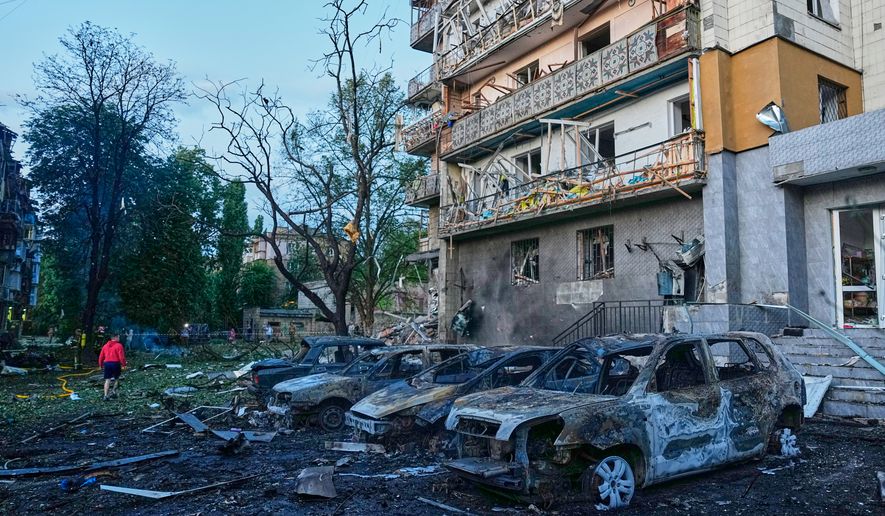

Ukrainian President Volodymyr Zelenskyy pleaded Sunday for more U.S.-made Patriot missile interceptors after a Russian missile and drone attack left one dead in Kyiv, while regional strikes pushed overall casualties higher.
Mr. Zelenskyy said in a social media post that Russia had launched more than 40 missiles and 120 drones in the attack, which reportedly sparked fires across five districts in the capital.
It was the latest in a series of increasingly aggressive Russian assaults against Kyiv and other key cities in Ukraine. The Kremlin is seeking to leverage Ukraine’s dwindling missile defense capabilities to extract sweeping concessions from Mr. Zelenskyy’s government.
People were interested in these podcasts
Over the past week, Russia has fired more than 1,400 drones and nearly 100 missiles at Ukraine, Mr. Zelenskyy said Sunday.
Although Ukrainian forces effectively repel drone waves, Russian ballistic missiles present a far more severe challenge.
“Protection against ballistic missiles is our constant and top priority right now. Interceptors are needed every day, and I am grateful to everyone who takes our agreements seriously and ensures the delivery of anti-ballistic capabilities,” Mr. Zelenskyy posted on social media. “Right now, these packages are literally saving lives during every massive Russian attack.”
The interceptors are a cornerstone of global air defense; U.S. military bases and allies across the Persian Gulf rely heavily on them to counter Iranian ballistic missile threats.
With the U.S. defense industrial base struggling to produce enough Patriot missile interceptors within the required time frame, President Trump recently announced that he would grant Ukraine a license to produce them.
Key U.S. lawmakers say the announcement should be viewed as a commitment by Washington to Kyiv, with the Trump administration looking more favorably on Ukraine’s prospects for victory.
Rep. Michael McCaul, Texas Republican and chairman emeritus of the House Foreign Affairs and Homeland Security committees, was recently in Ukraine. He told “Fox News Sunday” that Ukraine holds the upper hand, except for its vulnerability to Russian ballistic missile strikes.
“I think Trump likes a winner, and that’s why he came out at the NATO summit supporting Ukraine’s efforts in getting Patriot licensing agreements into Ukraine,” said Mr. McCaul, referring to Mr. Trump’s comments at the recent NATO meeting in Ankara, Turkey.
“They need these interceptors,” Mr. McCaul said. “Every night when I was in Kyiv, they’re getting bombed by ballistic missiles. … And we have to help them to stop that bombing.”
Patriot missile production in Ukraine may not start for years. It is unclear exactly what any production arrangement between Ukraine and the two prime U.S. defense contractors that make the Patriot system, RTX and Lockheed Martin, will look like.
Ukraine will inherit the same defense manufacturing bottlenecks hamstringing the American industrial base.
The Patriot relies on a solid-rocket motor. Production of that component is deeply strained to the point that the Pentagon has said it will take a direct financial stake in a private company to accelerate the process.
Still, the problems go even deeper. As international demand for air defense capabilities has increased, the single U.S. source of ammonium perchlorate, a critical chemical in solid rocket motors, has been squeezed to maximum capacity.
• John T. Seward contributed to this article, which is based in part on wire service reports.
Contact the author

Please read our comment policy before commenting.