


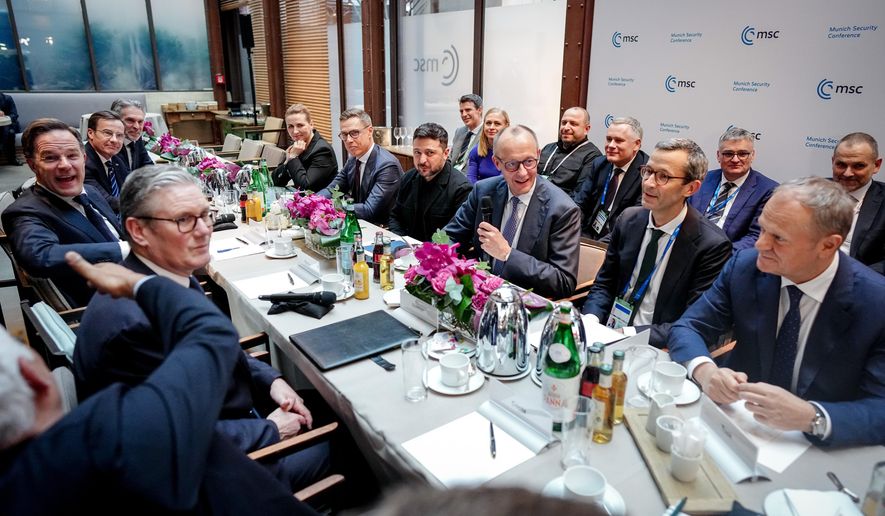

Some U.S. lawmakers were overseas on Feb. 14 when the Department of Homeland Security shut down because Senate Democrats blocked funding.
Senators were attending the Munich Security Conference as part of an official congressional delegation, or CODEL.
House members had a CODEL planned as well, but it, along with other overseas trips, was canceled because of the shutdown. Some members opted to go to Munich anyway but had to pay their own way.
People were interested in these podcasts
The disparate House and Senate rules for CODELs during the shutdown put a renewed spotlight on lawmakers’ international travel.
Some trips are taxpayer-funded, while others are privately sponsored. Lawmakers have a few disclosure rules to follow, but CODELs remain one of the least transparent aspects of Congress.
“No single source identifies all international travel undertaken by the House or Senate, and there is no means to identify the number of trips taken, destinations visited, travelers, total costs, or costs paid for by funds appropriated to legislative and executive branch entities,” the Congressional Research Service said in a report on the topic.
The State Department’s Congressional Travel Office helps coordinate more than 500 CODELs during a typical year, according to a State Magazine article written last year by the office’s deputy director, Martin J. Gurch, and legislative management officer, Steve Harper.
“Congressional travel allows its members to see firsthand how U.S. foreign policy objectives are being implemented by the [State] Department and other U.S. foreign affairs agencies, such as USAID,” they said. “The impressions and understandings gained by members of Congress and staff while traveling abroad can directly impact legislation and oversight affecting program direction and funding, personnel, post operations and construction, and reporting requirements, as well as the Senate confirmation process.”
Lawmakers also use their overseas trips to advocate for American values on the world stage and to improve diplomatic relations. During a recent junket to Denmark, members of Congress sought to tamp down anger toward the U.S. amid President Trump’s talk of acquiring Greenland.
Taxpayer-funded trips are subject to disclosure only when foreign currency is used. The law allows the Treasury Department to purchase local currencies for members of Congress and their staff when they travel overseas as part of their official duties.
Congressional leaders who approve official travel must submit a quarterly report itemizing the amounts spent in foreign currencies, along with their U.S. dollar equivalents.
The Congressional Research Service said those reports, published in the Congressional Record, “appear to represent the largest publicly available component” of how taxpayer funds are spent on official congressional international travel, although they cover a narrow range of expenditures.
The reports do not include any travel expenses booked in U.S. dollars or other government funds spent to support the trips. That includes expenses associated with Capitol Police and military escorts, as well as the State Department office that helps coordinate travel and flights on military aircraft provided by the Defense Department.
The foreign currency expenses for the Senate’s CODEL to the Munich Security Conference have not yet been published.
One recent foreign travel expenditure report in the Congressional Record shows $117,075 spent on a bipartisan CODEL that six House members and three aides took to Italy in September.
The majority of those funds were for transportation and a per diem for meals and lodging, but Rep. Ron Estes, Kansas Republican, spent $25,092 on “other purposes” that the report does not detail.
Estes spokesperson Natalie Turner told The Washington Times that all miscellaneous items for members on the trip were listed under Mr. Estes’ name on the expenditure report because he led the House Budget Committee CODEL.
“The ‘other purposes’ expenses on the report include three passenger rental vans, airport transportation, parking, tolls, mileage and overtime for staff, which should be accurately attributed to the committee as a whole,” she said.
Another recent report summarizes the expenses incurred by Senate Foreign Relations Committee members and staff in the fourth quarter of 2025.
The total for all three months was $752,939 and included trips to Canada, Israel, Qatar and several European countries, as well as expenses for canceled CODELs to Japan.
For privately sponsored international travel, lawmakers must receive advance approval from the House or Senate ethics committee and submit disclosure forms after the trip for the covered expenses.
Public Citizen, a government watchdog group, says privately sponsored travel is subject to abuse because corporations, unions and other special interest groups provide free transportation, meals and lodging for lawmakers and staff.
“These trips often used to be little more than junkets, as lobbyists made use of the laxer travel rules to wine and dine members, senators and congressional staff on behalf of paying clients,” the group said.
Such abuses led to rules enacted in 2007 that prohibit lawmakers from accepting travel expenses from lobbying firms, individual registered lobbyists or individuals acting on behalf of a foreign government.
Those changes were made after a Senate investigation into lobbyist Jack Abramoff, who over the course of a decade provided lawmakers with lavish trips and gifts, such as golf excursions to Scotland and jaunts to the Northern Mariana Islands.
The Congressional Research Service report lays out the pros and cons of increasing disclosure requirements for congressional travel.
On the upside, it could “more fully inform the public about the necessities and benefits of congressional international travel.”
Enhanced disclosure “could raise security concerns if patterns of congressional international travel are easily available.”
Contact the author

Please read our comment policy before commenting.