


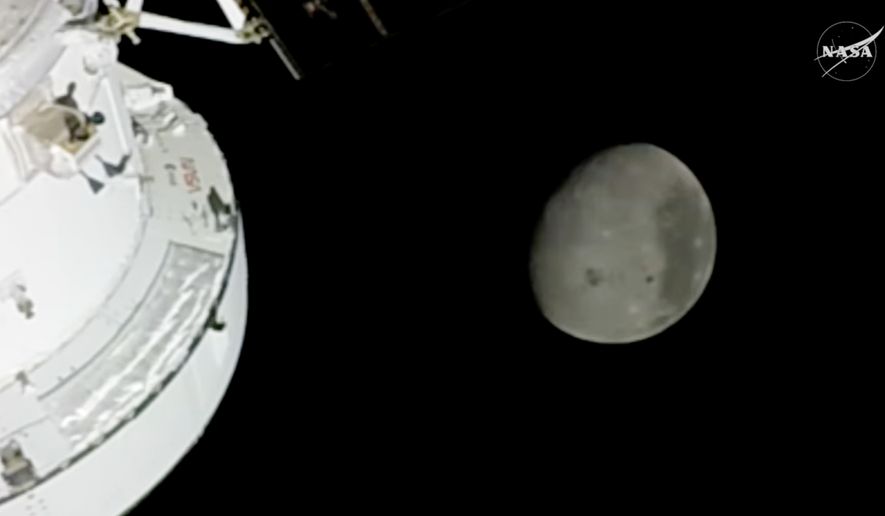

President Trump has set an ambitious goal to put Americans back on the moon by 2028, send robots to Mars and launch more than 1,000 spacecraft over the next four years — all with an emphasis on commercial ventures.
He laid out the space agenda in a memorandum, saying it would “reinvigorate” America’s leadership in space transportation.
The presidential order directs NASA Administrator Jared Isaacman to facilitate commercial transportation to and from the moon, facilitate commercial robotic access to Mars and explore commercial avenues to send humans to and from Mars.
People were interested in these podcasts
This builds on a December executive order outlining plans to return “Americans to the Moon by 2028 through the Artemis Program.”
White House science and technology adviser Michael Kratsios said that this “commercial-first approach” enables Americans on the moon by 2028.
This order emphasizes developing additional locations for spacecraft launch pads and landing zones.
The U.S. launched 217 of the 329 commercial space launches worldwide in 2025, according to the Department of Transportation. But that number is expected to soar to 10,000 FAA-licensed launches and reentries a year by 2035.
Transportation Secretary Sean Duffy asked the public and industry Friday about where the U.S. should build new spaceports and how it should set aside “priority airspace” for important space-launch routes.
Currently, 83% of launches come from just three sites: Vandenberg Space Force Base in California, and Florida’s Cape Canaveral Space Force Station and Kennedy Space Center. To accommodate the increased launch and reentry demand, more sites are needed.
“Public input is essential as we plan for the future of commercial space transportation,” said Federal Aviation Administration Administrator Bryan Bedford in a statement. “By hearing from industry, local communities, aviation stakeholders, and the broader public, we can better identify viable spaceport locations and develop airspace routes that support more frequent launches while maintaining the highest standards of safety and efficiency.”
The evolution of U.S. national space transportation policy originated under the Clinton administration in 1994, was updated by President Obama in 2013, and was expanded by Mr. Trump to rely further on commercial space companies like Elon Musk’s SpaceX and Jeff Bezos’ Blue Origin.
Mr. Trump’s memorandum repeals Mr. Obama’s 2013 directive, which had federal agencies rely on commercial space products and services while NASA developed government heavy-lift launch systems — an explicit break from that framework as Mr. Trump’s commercial-first approach takes its place.
The president’s memorandum follows his August 2025 executive order to boost American space launch competitiveness.
Contact the author

Please read our comment policy before commenting.