


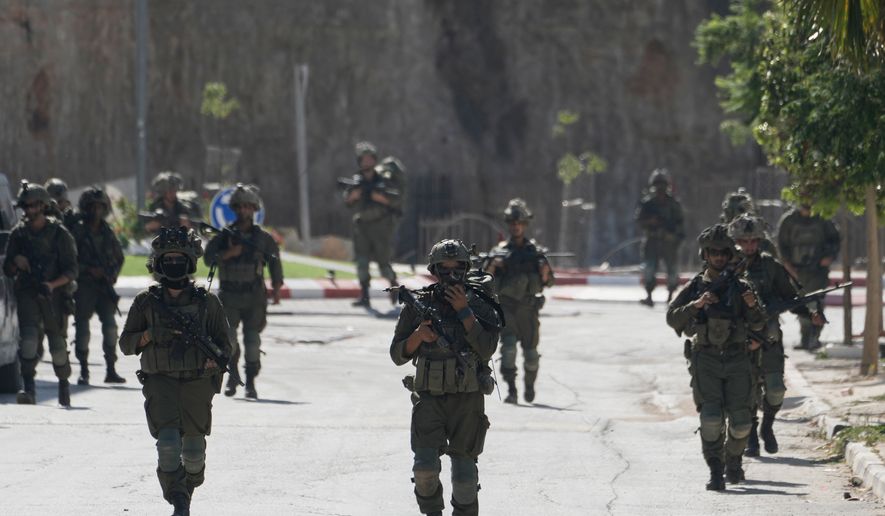

Hundreds of Israeli military checkpoints scattered across the West Bank have created a slow-motion health crisis, healthcare workers say, one worsened by a recent surge in regional violence.
The United Nations Office for the Coordination of Humanitarian Affairs recorded roughly 925 “movement obstacles” restricting Palestinian movement in the West Bank in its April 2026 report.
Aid workers say these obstacles, combined with hostile interactions with Israeli settlers and military personnel, have caused significant delays in emergency medical and mental health care.
People were interested in these podcasts
“When I say structural violence, I mean because of the occupation itself, they don’t have access to the health system because of the movement restrictions, or they don’t have access to social services,” said Brenda Galaz, a mental health activity manager for Doctors Without Borders in the West Bank. “There is a lot of financial stress in the family because they cannot provide anymore with their families with basic things like food, shelter, health coverage.”
Israel maintains that the checkpoints protect the lives of both Palestinians and Israelis in the area. Israel’s intelligence agency, Shin Bet, says the checkpoints and related security measures helped thwart more than 1,000 terror attacks in 2024 alone.
The Washington Times has reached out to the Israeli Defense Forces and the Coordinator of Government Activities in the Territories for comment.
Movement restrictions and Israeli military incursions in the West Bank have intensified since the Oct. 7, 2023, attacks on Israel, which killed more than 1,000 people and touched off a multiyear war in Gaza.
Settler communities, which have staked an intense ideological claim to the territory, are also a source of distress for Palestinians in the region. Israeli settlements are often built close to Palestinian villages, and clashes between the two groups have grown more frequent since the Oct. 7 attacks and the start of Israel’s operations in Lebanon.
International organizations say the restrictions have jeopardized Palestinian health by delaying emergency care and making daily life more difficult and dangerous.
The World Health Organization recorded at least 50 cases of delayed medical care in the West Bank between January and June 2026, with Israeli security forces playing a significant role in impeding movement.
In one case, a 30-year-old woman in the West Bank village of Sinjil died of cardiac arrest in July after soldiers failed to open a checkpoint gate at the town’s entrance, according to OCHA.
The Israeli military also operates “flying” checkpoints — set up with little to no advance notice — further complicating travel for residents.
“Going to work, taking a child to school, attending a medical appointment are becoming more sources of stress,” said Oday Alshobaki, a former Palestinian journalist who now works as an MSF communications officer in the West Bank. “Today I’m supposed to go from Bethlehem to Ramallah and I’ve been checking the situation since the morning to know what time is best to move. It could take me like a whole day just to move.”
Israeli security officials say the unpredictability of the checkpoints is intentional, meant to make it harder for militants to plan around a fixed pattern. New checkpoints can also go up in response to fresh intelligence about a potential attack.
The constant surveillance and threat of violence from security personnel and settlers has taken a measurable toll on Palestinian mental health, aid workers say — one MSF has tracked for years.
MSF’s clinical data shows that in June 2025 alone, 94% of new patients admitted to its mental health program in Hebron were seeking care as a direct result of a violent incident. Patients there frequently show symptoms consistent with depression, anxiety and post-traumatic stress disorder — a diagnosis reserved for prolonged, repeated exposure to trauma rather than a single incident.
MSF’s Hebron program is one of the organization’s most comprehensive in the West Bank, aiming not just to treat patients but to teach them to recognize symptoms in themselves and their neighbors. Alongside its mobile clinics, the program runs group sessions on coping and early recognition.
“It’s not to talk about mental illness, but it’s more to talk about normal reactions and then what you can do with that — and then when to seek support,” said Cynthia Matildes, an MSF mental health activity manager who oversees the Hebron program. “The target is more to cover this area and maybe to restore slowly, or to at least do something with the social fabric.”
Conditions for international aid groups in the West Bank grew more difficult after the Israeli government imposed new registration requirements in March 2025, including a demand for personal staff information, Ms. Galaz said.
MSF refused, citing staff safety concerns, and relocated its international staff to Amman, Jordan, while continuing operations in Gaza and the West Bank with Palestinian staff registered under the Palestinian Authority. Facing a March 1 deadline to leave the territory, MSF initially proposed sharing a limited, consent-based list of staff names before ultimately reversing course after failing to secure safety guarantees from Israel.
Israel, for its part, has said some MSF staff members had ties to terrorist activity and that the organization’s initial refusal to share information raised serious security concerns. MSF has denied the allegation.
Contact the author

Please read our comment policy before commenting.