



A version of this story appeared in the daily Threat Status newsletter from The Washington Times. Click here to receive Threat Status delivered directly to your inbox each weekday.
KYIV, Ukraine — Mykhailo Fedorov, Ukraine’s recently ousted defense minister and one of President Volodymyr Zelenskyy’s longest-serving political allies, has called for wartime elections, signaling his clearest break yet with the administration that launched his political career.
In a nine-minute video released Tuesday, Mr. Fedorov said Ukraine faced a “systemic crisis of governance” and argued that Russia should not be allowed to determine how long Ukrainians go without choosing their leaders.
“Democracy cannot be held hostage by Russia,” the 35-year-old former minister said. “We must find a legal, safe and realistic mechanism that will allow Ukraine to renew its full democratic process even in the conditions of a long war.”
People were interested in these podcasts
He stopped short of demanding an immediate vote or announcing a presidential bid.
Instead, he acknowledged some of the formidable obstacles to holding an election while Russia occupies roughly a fifth of the country, millions of Ukrainians live abroad and about 1 million are serving in the military. Ukrainian law bars national elections under martial law.
Yet the speech went far beyond election logistics: Without mentioning Mr. Zelenskyy by name, Mr. Fedorov attacked corruption, opaque decision-making and a system in which loyalty is rewarded over competence.
“The old system lives by its own rules too often. It protects itself. It is scared of change,” he said, arguing that corruption during wartime directly deprives the military of resources needed to fight Russia.
For a man who was an architect of Mr. Zelenskyy’s 2019 digital campaign and then spent nearly seven years at the heart of his government, the speech amounted to an extraordinary political turn.
From dismissal to street protests
Mr. Fedorov was dismissed in mid-July after just six months as defense minister. He had arrived at the ministry promising to apply the data-driven methods he championed as Ukraine’s digital transformation minister to procurement, drones, mobilization and military management.
His tenure quickly brought him into conflict with then-Commander in Chief Gen. Oleksandr Syrskyi. After his removal, Mr. Fedorov accused the military leadership of blocking reforms and said he did not know how Ukraine could win the war under the existing arrangement.
Mr. Zelenskyy said the two men had become unable to work together.
Mr. Fedorov has also argued that his attempts to introduce greater competition into defense procurement threatened entrenched commercial interests and contributed to his dismissal.
Olena Tregub, secretary-general of the Independent Anti-Corruption Commission, or NAKO, has said Mr. Fedorov introduced greater use of battlefield effectiveness data into procurement decisions, although broader procurement reforms predated his tenure.
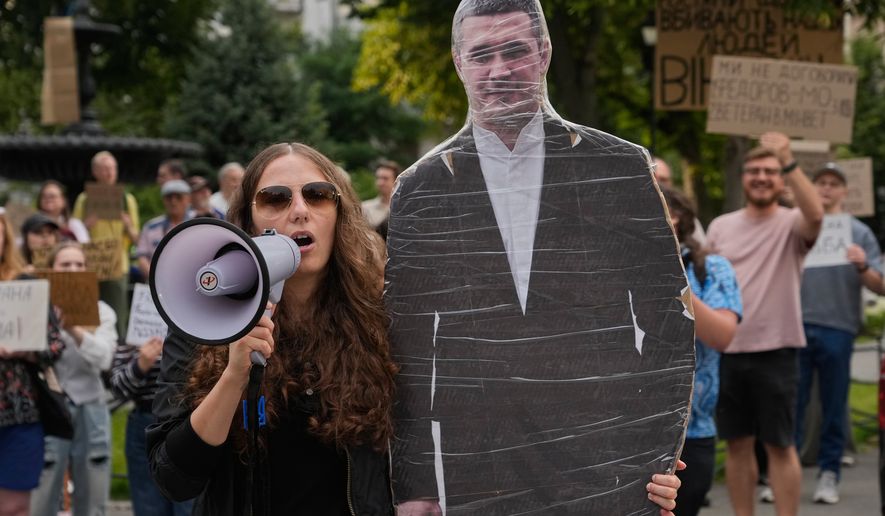
His dismissal triggered rare wartime street protests in Kyiv and other cities. Demonstrators demanded his return and increasingly called for Gen. Syrskyi’s removal as well.
Mr. Zelenskyy dismissed the army chief days later and replaced him with Gen. Mykhailo Drapatyi, a younger commander viewed as more receptive to technological and organizational reform. The president also offered Mr. Fedorov another senior role overseeing military technology, but the former minister declined.
The protests continued. A march in Kyiv on Sunday, one month after Mr. Fedorov’s dismissal, again drew roughly 2,000 people. Until this week, however, Mr. Fedorov kept his distance from those demonstrations and continued to leave open the possibility of working with Mr. Zelenskyy.
“In that video … he essentially virtually joined the protesters,” Ms. Tregub told The Washington Times. “He now presented himself pretty much as a challenger of Zelensky, but still in a very, I would say, not very direct manner.”
That ambiguity, she said, may also become his biggest political weakness.
“He didn’t say a single bad word about the president,” Ms. Tregub said. “He was talking about corruption, about a bad system of governance. But the system has certain names, and he didn’t name a certain name.”
Mr. Fedorov, she noted, is himself an insider who spent seven years in the Zelenskyy camp.
“In his video, he tried to make [it] in the way that he still doesn’t break a full relationship with the president,” she said. “One foot in, one foot out. And people feel this.”
Ukrainian commentator Vitaliy Portnikov made a similar argument before Mr. Fedorov’s latest speech, saying the former minister owes his rise to Mr. Zelenskyy and cannot credibly condemn the system without confronting the president’s role in it. At the same time, Mr. Portnikov called the decision to fire such a popular minister a political mistake that effectively gifted Mr. Zelenskyy’s critics a new figure around whom to rally.
Polls show opportunity
The political opportunity is visible in recent polling. A Socis survey conducted from July 28 to Aug. 2 found 62.5% of respondents viewed Mr. Fedorov’s dismissal negatively or mostly negatively, while more than 57% supported the protests against it.
In a hypothetical presidential contest, Mr. Zelenskyy received 22.3% among decided voters, former armed forces chief and current ambassador to Britain Valerii Zaluzhnyi 21.4%, and Mr. Fedorov 13.1%.
In a hypothetical runoff between Mr. Fedorov and Mr. Zelenskyy, Socis gave the former minister 63.8% among voters choosing between the two, against 36.2% for the president.
Mr. Zelenskyy may also have inadvertently elevated his former minister. Mr. Portnikov noted that Mr. Fedorov left government at the height of his reputation as a reformer rather than amid a scandal, making the dismissal fundamentally different from previous changes at the Defense Ministry.
But there is a major problem with Mr. Fedorov’s new signature issue: Ukrainians do not appear to want wartime elections.
A survey by the Kyiv International Institute of Sociology conducted from July 20 to Aug. 3 found only 15% favored holding elections before fighting ends. Another 23% would support a vote after a ceasefire backed by reliable security guarantees, while 57% said elections should wait until a final peace agreement and the complete end of the war.
Political analyst Volodymyr Fesenko has said even a ceasefire would only begin the process. Ukraine would need new electoral legislation and mechanisms for soldiers, refugees and displaced voters, a process he estimates could take about six months.
The timing has nevertheless given Mr. Fedorov’s anti-corruption message added force.
On Wednesday, Ukraine’s anti-corruption agencies announced a major investigation involving current and former officials and alleged laundering of roughly $3 million.
Mr. Zelenskyy fired Iryna Mudra, a deputy head of the presidential office, after investigators searched her home. She has not been publicly named as a suspect, and investigators have not implicated Mr. Zelensky.
Parliament, meanwhile, voted 312-0 to confirm Yevhenii Khmara as defense minister, effectively closing the most obvious route for Mr. Fedorov to return to government.
Mr. Fedorov still has no party, has announced no candidacy and has attracted no major public defection from Mr. Zelensky’s camp. But his dismissal has given him something he lacked while inside government: an independent political constituency.
Whether he is prepared to use it remains an open question.
Please read our comment policy before commenting.