


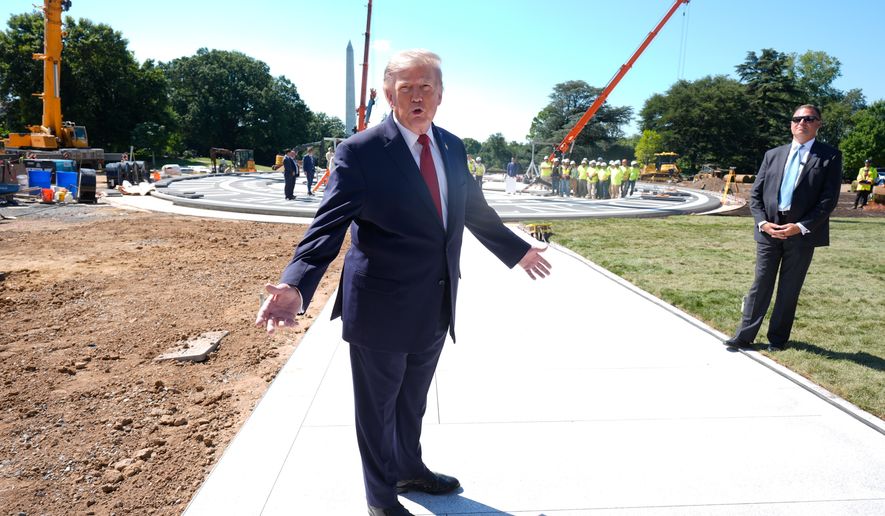

President Trump maintained on Wednesday that his administration’s economic pressure campaign against Iran is working and will stand in for diplomatic efforts, at least for now.
Speaking to reporters at the White House, Mr. Trump repeated his insistence that Iran cannot obtain nuclear weapons and indicated that his administration’s standing policy of economic warfare has thus far been successful.
“Right now, I think the situation is so good,” he said. “We have possession, complete control of the [Strait of Hormuz]. I mean, outside of nuisance value, and there is nuisance value when they shoot a drone every once in a while.”
People were interested in these podcasts
Iran closed the Strait of Hormuz, a narrow waterway connecting the Persian Gulf and the Gulf of Oman, shortly after the U.S. and Israel launched attacks on the country in late February. Since then, commercial ships have been wary of entering the passage for fear of being targeted by Iranian drones or missiles.
Mr. Trump’s claim that the U.S. controls the strait stems from the operation of a naval blockade of Iran’s ports, which the president reauthorized last month. The blockade is just one aspect of Washington’s economic pressure campaign on Iran, which also includes a massive sanctions regime and asset seizures.
U.S. Central Command, which oversees military operations in the Middle East, said Wednesday its forces had redirected 65 commercial vessels, disabled three and boarded two since the start of the blockade.
Mr. Trump added that diplomacy with Iran could happen “maybe at some point.” On Tuesday, he had insisted that the economic pressure campaign would continue and the White House had no plans to talk to the Iranians in the near future.
Earlier this month, Iranian and U.S. officials indicated that the two sides were circling a deal that would reopen the Strait of Hormuz, establish a ceasefire and open the door to further technical talks.
However, diplomatic momentum collapsed as Iran demanded that the U.S. break off its naval blockade and ease sanctions before the strait could be reopened.
The strait itself has become the center of nearly every conversation surrounding the war. For Iran, the waterway is key to its influence in the region after the war, with key ministers and security officials insisting that Tehran maintain significant control over the waterway.
Tehran is currently in the midst of negotiations with Oman, the sultanate bordering the Strait of Hormuz, to hammer out a framework for future control of the waterway. Reports indicate that the deal, which is still pending, will outline specific paths for commercial vessels to take through the strait, and that Iran will charge “service fees” for safe passage.
The U.S. has firmly rejected any Iranian control over the strait and has insisted that the waterway remain toll-free, as it was before the war.
The diplomatic stall comes as reports indicate Iran may be preparing for an escalation in the conflict by striking at more U.S. military targets in the region. The alleged escalation is likely intended to force Mr. Trump to commit more resources to a war that is approaching its sixth month.
The attacks could target U.S. military assets beyond the Middle East, including some located within NATO territory.
The Financial Times reported this week that Iran plans to attack Bezmer Air Base in Bulgaria, which has been used to refuel U.S. aircraft, and military infrastructure in Cyprus.
Iran has shown a capacity and willingness to lash out at American allies. A British airbase on the island of Cyprus, located in the Mediterranean, was struck by a drone in March. The attack drew a firm rebuke from Britain and France.
Iranian missiles have also reportedly targeted U.S. military assets in Turkey, a NATO member, at least four times since February. Alliance air defenses eliminated the threats each time, but NATO officials have been quick to insist that the incidents do not trigger the charter’s mutual defense clause.
Iran’s attacks on U.S. military positions in the Middle East and beyond aim to convince regional powers that Washington cannot protect them.
Esmail Baghaei, spokesperson for Iran’s foreign ministry, said Wednesday the U.S. military presence in the Middle East is a destabilizing force and again called on Gulf nations to limit their interactions with “unreliable” partners.
Contact the author


Please read our comment policy before commenting.