



A version of this story appeared in the daily Threat Status newsletter from The Washington Times. Click here to receive Threat Status delivered directly to your inbox each weekday.
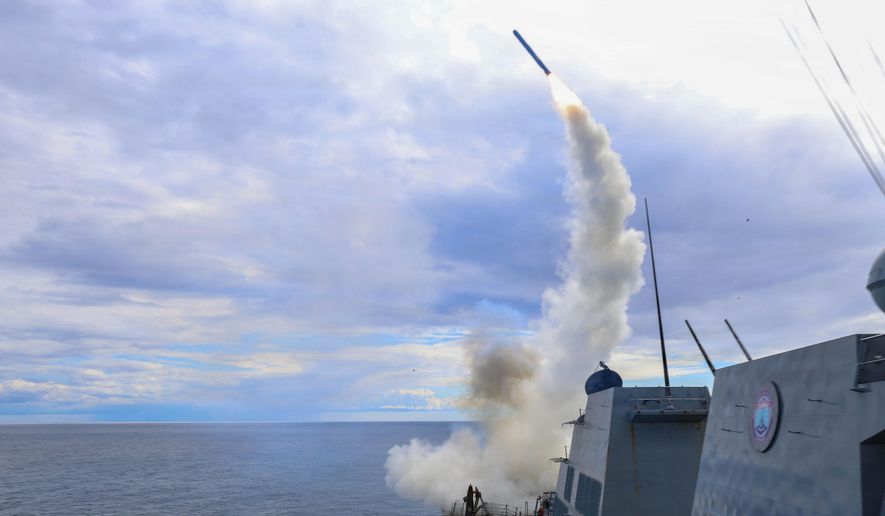
The U.S. has fired more Tomahawk cruise missiles in military operations against Iran than during any other conflict.
More than 2,300 Tomahawks have been expended in combat since 1991, when the missile debuted in the Gulf War, with about 1,000 launched against critical Iranian targets in the early stages of the current conflict with Iran.
U.S. officials are now scrambling to replenish stockpiles depleted by an unsustainable burn rate. The Center for Strategic and International Studies think tank estimated that Tomahawk inventories won’t return to pre-war levels until 2030, if not later.
People were interested in these podcasts
“From an inventory perspective, of course it’s been very significant. On the other hand, I would say munitions exist to be used,” said Mark Cancian, a retired Marine Corps colonel and senior adviser with the CSIS Defense and Security Department. “The fact that they are being used is not in itself a problem. The problem is that the inventory is now low enough that the Joint Staff and the chairman [of the Joint Chiefs] are very worried about what that might mean for a conflict with China and deterrence against China,” Mr. Cancian told The Washington Times.
The Tomahawk is a precision weapon that launches from ships, submarines and ground launchers. It can strike targets 1,000 miles away, even in heavily defended airspace.
“Tomahawk is the Navy’s most important strike weapon, able to target hostile forces hundreds of miles away without ever risking the lives of our sailors,” said Phil Jasper, president of Raytheon, which produces the missiles.
Just under 300 Tomahawks were deployed during Operation Desert Storm, where dramatic video footage of missile strikes taken from the nose cones became a staple of TV news coverage.
U.S. and coalition forces fired 802 Tomahawk missiles during Operation Iraqi Freedom in 2003, the largest single-campaign use of precision cruise missiles in history until the current conflict.
Tomahawks were used heavily in the first couple of days of the U.S. and Israeli air campaign against Iran. Tehran’s air defenses were effectively neutralized in less than a week, so stand-off munitions like the Tomahawks were mostly replaced with less expensive, shorter-range firepower.
“That would be harder to do against China because their air defenses are much stronger. We would need to use standoff munitions for much longer in the conflict,” Mr. Cancian said.
Some of the other U.S. conflicts in which Tomahawks were used were short operations lasting little more than a few days, he said.
“It reflects the kind of conflict that we are having with Iran,” Mr. Cancian said. “Iran is quite well-armed, and the conflict is going on much longer.”
The Navy is the primary service using the Tomahawk missiles, firing the long-range subsonic ordnance primarily from surface warships and submerged submarines.
But the Army has its own issues with munitions supplies.
Service officials are looking for a defense contractor to manufacture thousands of ground-launched rockets per year over the next decade, amid reports of dwindling stockpiles of critical munitions.
The Pentagon awarded a $22.9 billion contract on Monday to Raytheon to increase production of Tomahawks.
The Tomahawk is designed to fly at extremely low altitudes at high subsonic speeds and is directed over an evasive route by mission-tailored guidance systems.
The Tomahawk contract is a result of the Trump administration’s “Arsenal of Freedom” initiative for industry to rapidly scale up weapons manufacturing by eliminating bureaucratic hurdles.
Before the acceleration contract, Raytheon’s baseline production hovered at roughly 60 to 90 Tomahawk missiles per year, according to reports.
“This Tomahawk award increases our ability to increase the joint force, ensuring our warfighters never face a fair fight,” Under Secretary of War Michael P. Duffey said.
Acting Navy Secretary Hung Cao said the $22.9 billion deal with Raytheon will accelerate missile delivery at “unprecedented speed.”
“Guaranteeing our naval and joint forces have the lethal firepower they need to deter aggression and protect the homeland is paramount,” Mr. Cao said.
Raytheon officials said the agreement with the Pentagon will support their efforts to reach an annual production rate of more than 1,000 Tomahawk missiles while ensuring a stable, predictable supply for the Navy and its allies.
Contact the author

Please read our comment policy before commenting.