



Trump administration officials on Wednesday said economic pressure on Iran is working and will eventually force the regime to agree to a peace deal, even as commercial traffic in the Strait of Hormuz remains low.
President Trump insisted that Tehran is near bankruptcy and has few options for retaliation after he decided to pivot away from regular military strikes and rely almost entirely on a naval blockade.
“They have No Money - Their country is ‘shot.’ All they have is FAKE NEWS and 300% INFLATION, and getting worse!” Mr. Trump wrote on Truth Social. “Iran is all talk and no action, the Bully of the Middle East No Longer. Praise be to Allah!”
People were interested in these podcasts
Mike Huckabee, the U.S. ambassador to Israel, told Newsmax later in the day that Mr. Trump was putting a “real squeeze” on Iran’s economy and that joint U.S.-Israeli strikes on the country had put the Islamic regime in its weakest position since its founding in 1979.
The confident comments come as the U.S.-Iran war inches closer to the six-month mark. Administration officials, including Mr. Trump himself, had previously asserted the war would last only a few weeks.
Mr. Trump and Israel launched the war in late February, declaring that Iran could not be allowed to build a nuclear weapon and calling on Iranian citizens to revolt and seize the levers of power.
In response, Iran’s forces closed the Strait of Hormuz, a narrow waterway connecting the Gulf of Oman and the Persian Gulf, using a combination of sea mines, small boats, missiles and drones.
The strait, through which at least 20% of the world’s oil travels each year, has remained effectively closed ever since, with a brief period of respite after the signing of the Islamabad Memorandum of Understanding in June.
Despite this, Mr. Trump has consistently said the U.S. controls the Strait of Hormuz and has warned Iran not to strike at commercial vessels in the region.
“We have total control over the Hormuz Strait right now. They do not have control, we have control; we own it,” he told reporters at Joint Base Andrews.
U.S. Central Command, which oversees military operations in the Middle East, is maintaining a comprehensive naval blockade of Iran’s ports and has turned away dozens of ships over the past month.
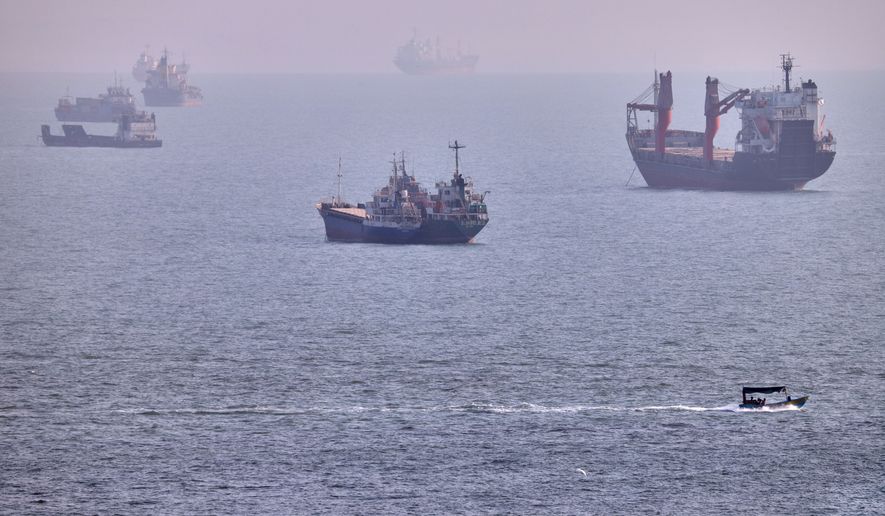
Despite Mr. Trump’s claims, naval tracking data suggests that traffic in the Strait of Hormuz remains far below pre-war levels. Kpler, a data analytics platform that offers intelligence on shipping and maritime logistics, reported just eight vessels transiting the waterway on Tuesday, down from 10 the week before.
The ships also reportedly traveled through Iranian-controlled waters, suggesting the vessels may be coordinating with Iranian maritime authorities.
The strait’s closure has driven up global energy prices, with Brent crude oil trading at about $89 a barrel on Wednesday afternoon. That’s an increase of at least $10 from the same time last week.
The average U.S. price of gasoline stood at $4.04 per gallon on Wednesday, a 36% increase from when the war started on Feb. 28, according to the AAA motor club.
Iran, for its part, has repeatedly insisted that its forces control the Strait of Hormuz and that commercial vessels wishing to transit must coordinate with its maritime authority.
Iran is in the final stages of negotiations with Oman, which also borders the strait, over a deal that could determine future control over the waterway.
Reports indicate that the deal would establish temporary new routes that ships would need to travel through in coordination with the governments of Iran and Oman.
While the U.S. has maintained that they are well aware of what is going on during negotiations over the strait, Iranian officials insist that a successful deal with Oman to open the waterway would not immediately mean that ships can travel safely.
Last week, Iran outlined several conditions that Washington would need to meet for the strait to be completely open for commercial traffic. Namely, Iran wants comprehensive sanctions relief, billions of dollars worth of assets unfrozen, a removal of the U.S. naval blockade and a regional ceasefire.
Meanwhile, Pakistan and Qatari mediators are working to transmit diplomatic proposals between Washington and Tehran in the hopes that they could revive the Islamabad Memorandum of Understanding or at least restart negotiations.
Iran’s Ambassador to Pakistan Reza Amiri Moghadam met with Pakistani Foreign Minister Ishaq Dar on Wednesday in Islamabad, where the minister stressed that “dialogue and diplomacy remain the only effective means of addressing outstanding issues,” according to a readout from the country’s Ministry of Foreign Affairs.
Tahir Andrabi, spokesperson for Pakistan’s foreign ministry, told reporters that his country is working hard to bring the U.S. and Iran to the negotiating table despite their wide differences.
“Pakistan remains engaged alongside our brotherly states in sincere efforts to resolve the crisis in the Middle East and the Gulf. Pakistan is making all-out efforts to bring the two parties to the negotiating table and pave the way for peace and stability in the region,” he said.
“Pakistan will continue to offset spoilers using direct and indirect channels and enable continuation of constructive dialogue to resolve all outstanding issues. And in the context of our peace efforts,” he said.
Contact the author


Please read our comment policy before commenting.