



A version of this story appeared in the daily Threat Status newsletter from The Washington Times. Click here to receive Threat Status delivered directly to your inbox each weekday.
President Trump predicted in March that his military “excursion” into Iran would last several weeks.
Instead, he’s been trapped in a doom loop of violence and negotiations for nearly half the year, hamstrung by an aversion to deploying U.S. ground troops and the tenacity of a regime that’s been on a war footing for decades.
That cycle was on display Tuesday as a Pakistani mediator hailed progress toward a peace deal after yet another meeting with Iran’s foreign ministry — even as Tehran hard-liners made new demands, Iran-backed rebels fired on ships in the Red Sea and the U.S. Navy used Hellfire missiles against a Panama-flagged vessel to enforce its blockade of Iranian ports.
People were interested in these podcasts
Oil prices rose and U.S. stocks dove despite word of an emerging deal, a sign that investors are growing skeptical of repeated claims of progress.
Mr. Trump insisted he will achieve his goal of keeping a nuclear weapon out of Tehran’s hands. But the conflict has lasted longer than promised, making it appear as if he is stuck in “a problem of his own making,” said Gordon Gray, a former U.S. ambassador to Tunisia and professor of Gulf and Arabian Peninsula affairs at George Washington University.
He said Mr. Trump relied heavily on Israeli Prime Minister Benjamin Netanyahu’s belief the Iranian regime could be toppled, and sidelined experts in favor of his gut instincts.
Most importantly, “he was emboldened and made overconfident by the success of the operation in Venezuela to capture [Nicolas] Maduro,” Mr. Gray said, referring to the January raid to arrest and extradite the strongman president to the U.S. on drug-related charges. “If he had thought it through, he would have realized there is a vast difference between Venezuela and Iran.”
Iran’s Islamic regime has been in a war posture on and off since it seized control of the country in 1979, including a major conflict with Iraq. The lack of an embassy or U.S. presence during those decades makes it harder to gather on-the-ground intelligence than in places such as Venezuela.
Mr. Trump says the U.S. retains the upper hand, militarily and economically, and that he will not accept a bad deal with Iran, even with the war polling poorly and the November midterm elections looming.
Yet political pressures hang over his wartime decisions, particularly regarding the commitment of ground forces that might be needed to upend the hard-line regime in Tehran.
“Similar to all presidencies since the aftermath of the 1991 Gulf War, Trump is executing this campaign with one hand tied behind his back,” said Ludovic Hood, a senior fellow at the Hudson Institute, a Washington think tank. “Political constraints and hesitation, particularly in the lead-up to the midterms, all but prevent him from bringing the necessary force to bear to change the regime’s calculus or behavior.”
That leaves the U.S. reliant on air power, though experts say airstrikes alone are unlikely to change the regime’s behavior.
SEE ALSO: Hard-liners in Iran remain defiant despite peace rumblings
Mr. Trump is “smart enough to realize that committing ground troops would not only be massively unpopular at home, but also hopefully he realizes that the terrain of Iran, the size of the country and the number of people who live there would make it very, very difficult for the U.S. military to prevail,” Mr. Gray said. “It’s not Iraq, in other words. And look how difficult Iraq was.”
Mr. Trump had reason to be confident about the air campaign early on. The first day of strikes killed Iran’s supreme leader and decimated military infrastructure, though the regime replaced the ayatollah with his son, Mojtaba Khamenei, leaving the hard-line regime in place.
Iran clamped down on oil traffic in the Strait of Hormuz, transforming the conflict into a drawn-out battle of economic leverage and unleashing a seemingly endless cycle of near-deals and military threats.
“I think there is a chance we may have a deal today or tomorrow to open the strait and move towards a more normalized position in this conflict,” Treasury Secretary Scott Bessent told CNBC on Aug. 4.
No deal arrived that day, or the next or the next, leaving Wall Street and commercial shippers in limbo.
Tehran upped the ante over the weekend by saying the U.S. had to meet a series of demands, from lifting its maritime blockade to paying war reparations, for Iranian forces to ease off the Strait of Hormuz.
Mr. Trump responded that if anyone should pay reparations, it is Iran for its years of terror in the Middle East and against its own people.
“If there are damages to be paid, I think Iran should pay those damages,” Mr. Trump said Monday in the Oval Office.
The new demand seemed to complicate the path to a deal, only for Pakistan’s defense minister Khawaja Asif to point to progress in reaching a pact.
“Things are shaping up again in favor of a peace arrangement or a deal,” he told Bloomberg. “The signals in the last two, three days are that we are close to some sort of an arrangement.”
But if anything, Iran’s hard-liners seemed to dig in on Tuesday.
Mohsen Rezaei, newly appointed secretary of Iran’s Supreme National Security Council, told Chinese Ambassador to Iran Cong Peiwu that his country would not relinquish control of the Strait of Hormuz unless the U.S. lifted its naval blockade, according to a readout of the meeting.
“If an agreement is reached between Iran and Oman regarding the passage route in the Strait of Hormuz, this agreement will be separate from the issue of closing the Strait of Hormuz,” he said in comments first published by state-affiliated media.
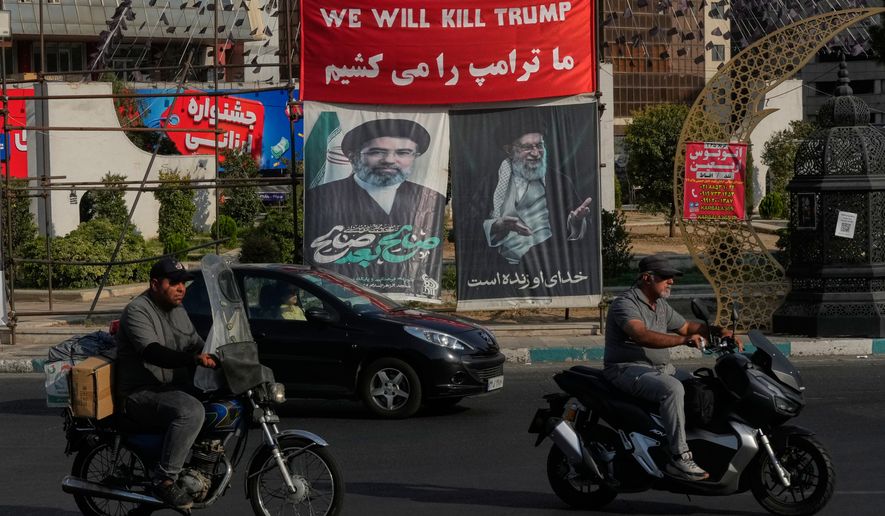
Hard-liners in the country have expressed extreme skepticism about continuing to negotiate with the U.S. and insist that the economic pressure resulting from the closure of the Strait of Hormuz will eventually force Washington to sue for peace.
The average U.S. price of gasoline stood at $4.01 per gallon on Tuesday, roughly unchanged from a week ago but a 35% increase from when the war started, according to the AAA motor club.
“Trump and his administration officials repeatedly promised Americans that gas prices would come down this summer, but now Labor Day weekend is right around the corner, and there’s no relief in sight,” Democratic National Committee spokeswoman Kendall Witmer said.
Mr. Trump says economic pain will be short-lived and the U.S. retains the ability to “decapitate” Iran with a heavy assault. For now, he seems to be relying on economic pressure to grind down his Iranian foes, hoping it turns the tide against the Islamic regime.
“On the one hand, Trump would likely take a deal that put long-term and verifiable constraints on Iran’s nuclear program and largely reopened the Strait of Hormuz,” Mr. Hood said. “On the other hand, I suspect he knows that the somewhat divided regime is playing hardball, if not overplaying its hand, and moreover, the regime is on the ropes insomuch as the economy is cratering and a deeply disillusioned and increasingly angry populace may well vent their frustrations again soon.”
Contact the author


Please read our comment policy before commenting.