



A version of this story appeared in the daily Threat Status newsletter from The Washington Times. Click here to receive Threat Status delivered directly to your inbox each weekday.
President Trump said Wednesday he believes the Iran war will end shortly after the midterm elections in November, as the U.S. escalates its military and economic pressure campaign against Tehran.
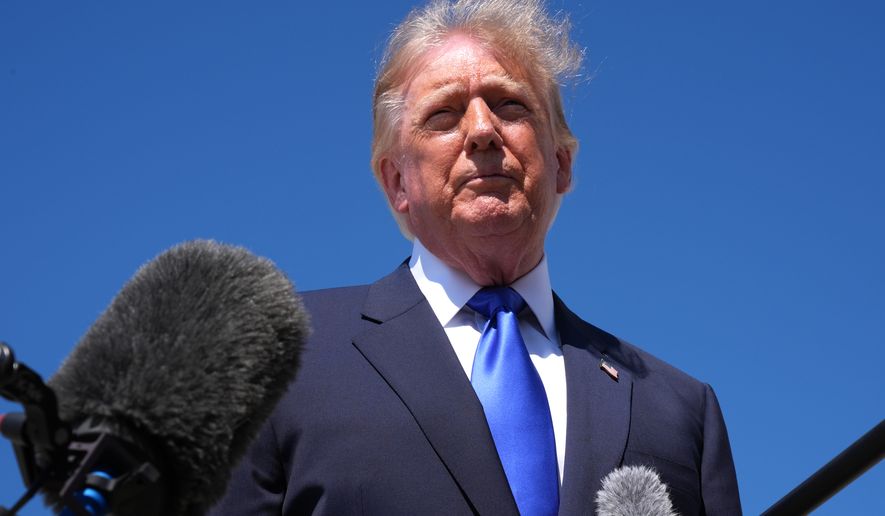
Speaking to reporters ahead of a visit to Dallas for the midterm Republican convention, Mr. Trump insisted that Iran is getting weaker by the day.
“I think the war’s going to end immediately after the election because they can’t hold out any longer,” the president said.
People were interested in these podcasts
Mr. Trump launched the war on Iran with Israel in late February, promising to eliminate Tehran’s ability to build a nuclear weapon by attacking the regime’s enrichment infrastructure and destroying its conventional weapons.
Meanwhile, the International Atomic Energy Agency passed a resolution Wednesday to report Iran to the U.N. Security Council for the first time in 20 years. The measure, backed by the U.S., Britain, France and Germany, found that Tehran had failed to cooperate in an extensive investigation into traces of uranium detected at undeclared enrichment sites.
Twenty-three of the IAEA’s 35-member board voted for a resolution, forwarded by the U.S., Britain, France and Germany, to report Iran. Eight countries abstained, one did not vote and China, Russia and Niger stood formally opposed.
Iran condemned the decision, with its U.N. mission in Vienna arguing that the resolution will ultimately cause the “collapse of the proliferation regime as a whole.”
The resolution and Mr. Trump’s comments follow an intense exchange of fire between U.S. and Iranian forces in the Middle East this week.
The U.S. military on Tuesday struck five oil tankers in the Strait of Hormuz in response to Iranian attacks on ships. The U.S. strikes are part of a joint military and economic pressure campaign aimed at crushing the Iranian regime or forcing a negotiated settlement of the war.
U.S. Central Command, which oversees American military operations in the Middle East, confirmed that it had destroyed four vessels in the Gulf of Oman and another in the Persian Gulf near Kharg Island, an islet used by Iran as a major oil export hub.
CENTCOM also said its forces destroyed three Iranian oil tankers earlier this week in response to an attempted attack on an aircraft carrier.
Iran has responded to Tuesday’s attacks with attempted strikes on U.S. military assets. The Islamic Revolutionary Guard Corps on Tuesday launched missiles at targets in Jordan, which hosts U.S. forces, including the Al-Azraq air base.
The Jordanian military said it intercepted 18 of the 20 missiles fired by Iran and two fell in deserted areas. Officials reported no casualties or major damage. CENTCOM separately confirmed that the Iranian attack was ineffective.
Iran’s Foreign Ministry called recent attacks on cargo vessels in regional waters terrorism and said they constitute a violation of the U.N. charter and international law. The ministry also categorized Iran’s retaliatory responses as defensive attacks.
Separately on Tuesday, the Iran-backed Houthi rebels in Yemen launched a massive attack on energy facilities and civilian infrastructure in Saudi Arabia, injuring about 73 people, according to Saudi officials.
The attacks, which included missiles and drones, hit four southern cities in Saudi Arabia and sparked fires at oil facilities, leading to a temporary halt in operations.
Houthi leaders said the attacks were in response to more than 120 airstrikes Saudi Arabia carried out in Yemen over the last few weeks.
Saudi-coalition forces in Yemen, which have increasingly clashed with Houthi fighters in recent weeks, launched a series of strikes on rebel-held areas in the country’s southwest in retaliation on Wednesday.
The increase in fighting on both fronts has forced international energy prices to skyrocket.
Brent crude, the major trading classification and global price benchmark for light, sweet crude oil, reached over $100 a barrel Wednesday, the highest price since July, following intense fighting between U.S. and Iranian forces over control of the Strait of Hormuz.
Trading Economics, which tracks the price of crude oil, recorded the price per barrel at approximately $101.53 on Wednesday afternoon. That’s the highest the price has reached in over a month, and slightly higher than the price per barrel recorded in July after fighting between the U.S. and Iran resumed.
The price remains well below the highs seen during the early stages of the war, when the price per barrel stood at approximately $114.
The price increase has translated into higher gas prices in the U.S. as crude oil is the primary ingredient in unleaded gasoline.
The average price of gas was $4.22 per gallon on Wednesday, up 7 cents from the prior day and 42% since the war began, according to the AAA Motor Club.
Diesel set an all-time high of $5.94 per gallon on Wednesday, an increase that could raise prices of other goods as shippers pass along higher fuel costs.
Contact the author


Please read our comment policy before commenting.