



A version of this story appeared in the daily Threat Status newsletter from The Washington Times. Click here to receive Threat Status delivered directly to your inbox each weekday.
OPINION:
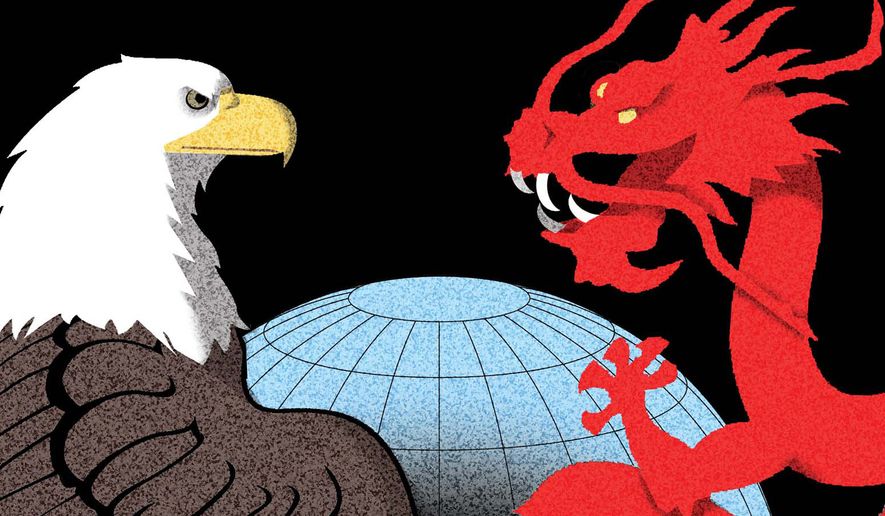
At the 25th anniversary session of the Shanghai Cooperation Organization last week, Chinese President Xi Jinping proposed an alternative model to Western alliances.
He urged developing nations and the Global South to leverage “SCO wisdom” to press for a more equitable, orderly multipolar world and to reform global governance institutions. The secretary-general of the United Nations, Antonio Guterres, and other guest delegations were in attendance for the anniversary session.
The 26th meeting of the Council of Heads of State of the Shanghai Cooperation Organization convened on Sept. 1 in Bishkek, Kyrgyzstan. Leaders from the 10 member states — China, Russia, India, Pakistan, Iran and Belarus, as well as the four Central Asian nations — signed the Bishkek Declaration and 13 other documents dealing with security, technology and anti-drug cooperation.
People were interested in these podcasts
Mr. Xi committed China to providing localized technical projects, collaborating on artificial intelligence with the organization’s member countries and deepening connectivity through the Belt and Road Initiative, a massive global economic strategy proposed by Mr. Xi in 2013.
The Belt and Road Initiative, with 146 member states, seeks to link Asia, Europe, Africa and Latin America through a network of ports, railways, roads and energy pipelines. The World Bank and other studies say the initiative’s transport projects have lowered trade costs, integrated developing regions into global supply chains, increased local gross domestic product and lifted millions out of moderate poverty.
Critics say that aggressive, large-scale lending by Chinese state banks has saddled several developing nations with heavy external debt burdens.
Mr. Xi talks about alternatives to Western alliances and the creation of multipolar institutions, an appealing message to developing nations and the Global South.
It is ironic, however, that two of the 10 members of the Shanghai Cooperation Organization, Russia and Iran, are pariah states. Russia invaded Ukraine in February 2022, despite security guarantees provided to Ukraine after it sent all its nuclear warheads to Russia. Iran is the leading state sponsor of terrorism, and in 1999, 2009, 2019, 2022 and 2026, its regime killed thousands of peaceful protesters.
A new alliance among Turkey, Saudi Arabia and Pakistan — the Mecca Defense Alliance — was established in August. Indeed, this is unprecedented cooperation of three U.S. allies intent on building a security architecture independent of the U.S.
The BRICS — Brazil, Russia, India, China and South Africa — was formed in 2006 and has 11 members, with more than 30 countries that have either applied or expressed interest in becoming members.
It appears that Mr. Xi’s exhortations for a more multipolar world resonate with several developing countries and the Global South, despite the inclusion of Russia and Iran in the Shanghai Cooperation Organization and BRICS.
Mr. Xi is competing with several U.S.-led international organizations: the Quad — Australia, India, Japan and the U.S. — AUKUS — Australia, the United Kingdom and the U.S. — and NATO.
NATO was established in April 1949 with the mission of safeguarding the freedom and security of all 32 member countries through diplomacy and military means. Article 5 of the North Atlantic Treaty is clear: An armed attack against one member is considered an attack against all of them.
Any real or perceived tension between the U.S. and member countries within NATO, the Quad or AUKUS will make Mr. Xi’s efforts to create “an orderly multipolar world” — with China in the lead — more attractive to developing countries and the Global South.
Since World War II, the U.S. has played a global leadership role. The Marshall Plan, established by the U.S. in 1948, provided $13 billion to help rebuild Western European economies.
It was U.S. leadership that established NATO.
Our allies and partners continue to look to the U.S. for this type of global leadership, and developing countries and the Global South should look to the U.S. as a partner and the democratic leader they should emulate.
• The author is a former associate director of national intelligence. All statements of fact, opinion or analysis expressed are those of the author and do not reflect the official positions or views of the U.S. government. Nothing in the contents should be construed as asserting or implying U.S. government authentication of information or endorsement of the author’s views.
Follow the author

Please read our comment policy before commenting.