



OPINION:
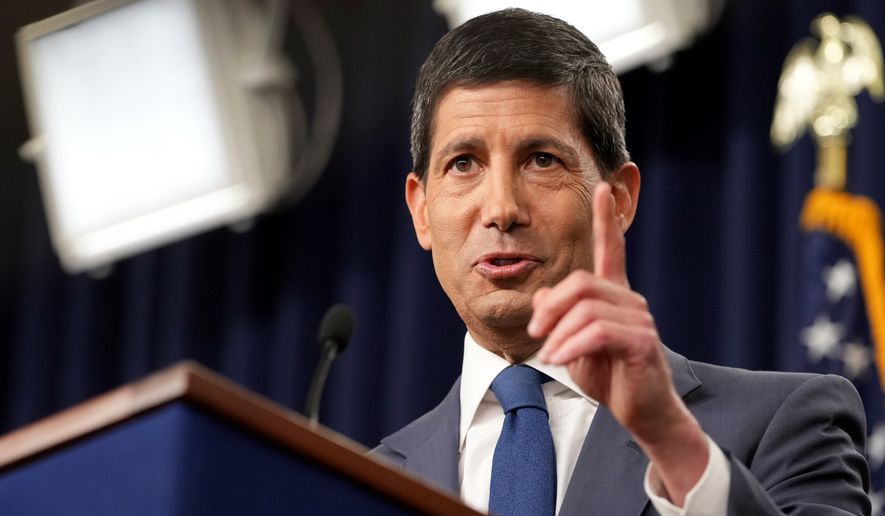
Federal Reserve Chairman Kevin Warsh has told anyone who will listen that the central bank will get inflation down to 2%.
At a July conference convened by the European Central Bank, he pronounced: “If there were people in households or the business sector or the financial markets who thought that this central bank was going to be comfortable with an inflation objective above 2%, well, I guess they’d be disappointed.”
He testified in Congress that he had “no tolerance for persistently elevated inflation.”
People were interested in these podcasts
He is the Fed’s prodigal son.
Long an inflation hawk, Mr. Warsh spun polemical arguments for lower interest rates when he emerged as a candidate for the top job (after all, President Trump’s appetite for low interest rates is well known).
All this may be a distraction.
After the COVID-19 shutdowns, a burst of consumer demand fueled by relief checks banked during the shutdown and lingering kinks in global supply chains pushed up inflation in 2021.
Many economists and policymakers, including then-Fed Chairman Jerome Powell, argued that this burst was transitory, but inflation proved stubborn.
Ultimately, the Fed started tightening monetary policy in March 2022, but it was too late.
Inflation accelerated to 9.1% by June 2022.
Inflation often comes in big bursts, as it did with oil supply shocks of the 1970s.
Lax monetary policy, in no small measure caused by President Nixon’s pressure on Fed Chairman Arthur Burns, ultimately required Chairman Paul Volcker to impose draconian interest rate hikes.
Mr. Powell endured similar pressure from President Biden, who delayed announcing his nomination for a second term until November 2021.
Mr. Warsh wants to resist the fates of Burns and Mr. Powell but is critical of the Phillips Curve model used by economists to frame the trade-off between containing inflation and keeping unemployment down.
He is right about the Phillips Curve.
Wages have hardly kept up with inflation since Mr. Trump returned to office, and in recent months have lagged even further.
Mr. Warsh’s inflation problem is not in labor markets; it is with a destabilized world.
Inflationary shocks are rocking the global economy with increasing frequency: the Russian invasion of Ukraine, COVID-19, Mr. Trump’s tariffs, the war with Iran, the impacts of climate change on weather cycles, and the imperative of building out artificial intelligence data centers.
Do not blame Mr. Trump too much — his tariffs were a response to Chinese mercantilism and a global outbreak of economic statecraft.
However, the tariffs were poorly crafted.
Before the war, Iran amassed enough enriched uranium to make six nuclear weapons.
Still, Mr. Trump did not make a case for the war to Congress, the American public or our allies, and he lacked a coherent strategy beyond decapitating Iran’s leadership.
Now he lacks the support needed to launch a ground campaign to evict the Islamic Revolutionary Guard Corps from the shores of the Strait of Hormuz.
Oil remains expensive, and inflation rages on.
Americans have learned that geopolitical shocks, weather events and the like cause bursts of inflation, but when such shocks occur so often, expectations harden that inflation cannot be brought down to the Fed’s 2% goal.
Five-year inflation expectations compiled by the Federal Reserve Bank of New York and the University of Michigan confirm this.
With wages struggling to keep up with inflation, consumers become inclined to spend ahead of anticipated price increases. It would take a mighty jolt of higher interest rates to curtail spending enough to break inflation.
In 1980 and 1981, Volcker raised the federal funds rate above 19% twice.
In June and July, inflationary pressures eased as the temporary ceasefire lowered fuel prices. Consumer exhaustion prompted manufacturers and retailers to seek ways to contain prices.
Still, much of this was illusory.
Oil prices have rebounded, and shrinkflation — smaller quantities in similar packaging — is prevalent.
Restaurants are swapping out beef for less expensive chicken but pricing the latter aggressively.
Midrange restaurants that sell those $15 or $20 burgers are skimping on service.
The airline industry, no longer bedeviled by discount flyer Spirit Airlines, which failed in May, is pushing folks onto buses by curtailing flight capacity.
Price increases in the auto sector have moderated, but only because car buyers have fewer affordable choices.
Ford is discontinuing the moderately priced Escape, offering consumers the similarly sized but more expensive Bronco Sport and other larger vehicles.
The Strait of Hormuz will pose risks even after the war resolves.
Energy markets are being rewired, and higher costs will create ongoing price pressures on petroleum products.
Now that China has weaponized heavy metals and rare earth minerals, alternatives are emerging, but those cost more and go into more products than you can count.
The semiconductor and electronic components markets are in a historic supply squeeze.
In a world of rolling crises, Mr. Warsh must have the stomach to be the next Paul Volcker to avoid the failures of Burns and Mr. Powell.
• Peter Morici is an economist and emeritus business professor at the University of Maryland, and a national columnist.
Follow the author
Please read our comment policy before commenting.