



Your humble columnist is about to embark on his first trip to Spain and thought that would be a good excuse for a quick dip into the legacy of one of Europe’s oldest and most storied chess nations.
Having picked up the newfangled board game from the invading North African Moors (the Spanish word for “chess” — ajedrez — derives from “al-shatranj,” the Arabic word for the game), Spain was one of the first European powers in chess, vying with Italy for supremacy in the early days of the Renaissance as the modern game’s rules were being formulated.
Most famously, a Spanish cleric named Ruy Lopez de Segura in 1561 published one of the first treatises on chess play and opening theory, in the process lending his name to the king’s pawn opening that remains a staple of play to this day.
People were interested in these podcasts
Ironically, none of his four surviving games collected in Chessgames.com feature Ruy Lopez’s eponymous opening, but we do have a short, sharp win by the Spanish pioneer over a leading Italian rival, reportedly played before Pope Pius IV during a stay in Rome. It’s a King’s Gambit Declined and features a piece sacrifice that would quickly become part of the tactical arsenal of any self-respecting chessplayer.
Black’s 5. fxe5 dxe5? (it would later be found that Black can hold the balance with 5…d5!, as White loses material on 6. exd5?! Bxf3 7. Qxf3 Qh4+, hitting the loose bishop on c4) 6. Bxf7+! Kxf7 7. Nxe5+ offers one of the earliest demonstrations on record of the need to keep an eye on the unique vulnerability of the f7-square in so many opening lines.
The priest shows no mercy in converting his advantage: 7…Ke8 8. Qxg4 (already two pawns to the good, White keeps pushing for more) Nf6 9. Qe6+ Qe7 (Be7 10. Qf7 mate) 10. Qc8+ Qd8 11. Qxd8+ Kxd8 12. Nf7+, and Black resigned. Even if he captures the White knight in the corner, he will be down two pawns and the exchange with no compensation.
—-
Spain has produced no world champions so far, although Cuba was a Spanish possession when the great Jose Raul Capablanca was born there in 1888. The greatest Spanish player of the post-World War II era was Arturo Pomar Salamanca, a prodigy and anchor of Spain’s Olympiad team who became the country’s first grandmaster in 1962.
Pomar never quite matched the promise of his early youthful successes, but notched a number of fine tournament wins and defeated some of the top players of his era. (His two tournament games with Bobby Fischer included a loss and a hard-fought draw.)
One of Pomar’s best efforts came against Danish star GM Bent Larsen at a Spanish team event in 1976. Larsen at the time was still one of the world’s top-rated players, but Pomar as White lands the first blow in the Symmetrical English line: 13. a4 Bc6 14. Ne4 (the four knights form a picturesque central stable as both sides try to keep the pieces on the board) a6 15. d4 cxd4 16. exd4 Bxe4 17. Bxe4 Nc6 18. 0-0!?, offering a pawn to get his king to safety and rapidly complete his development.
With Black’s king still in search of sanctuary, Larsen takes an immediate wrong turn, allowing White to blow up the center to his advantage: 18…Ncxd4 19. Re1 Nf3+?! (0-0 was safer, but it’s still double-edged in lines such as 20. Nxh5!? gxh5 21. Qxh5 Re8 22. g4 Nh6 23. Rad1 e5 24. g5) 20. Qxf3 Bxb2 21. Rad1 Be5? (the bishop will prove a poor blockader on the half-open file) 22. Nd5!, already threatening 23. Bxf5 Qxf5 24. Qxf5 gxf5 25. f4.
White breaks on top with the energetic 23…e6? (Kf8 was the last chance to organize a defense) 23. Bxf5 gxf5 24. Rxe5! (blasting through Larsen’s rickety central bulwark) dxe5 (Kf8 25. Qf4! dxe5 26. Qxe5 Rh6 27. Nb6 Qe8 28. Qxb8! Qxb8 29. Nd7+) 25. Qc3 f6 (the four knights earlier in the game have been replaced by a boxed set of Black pawns, but White’s attack continues apace; on 25…exd5, White wins with 26. Qxe5+ Kd7 27. Rxd5+ Kc6 28. Qd6 mate) 26. Nxf6+ Kf7 27. Qxe5, with 28. Rd7+ now a deadly threat.
Pomar’s queen and knight run riot in the final phase, with Black’s king finding no relief: 30. Qc7+ Kg6 31. Nf4+ Kf6 (Kh6 32. Qf7 Qg8 33. Qf6+ Kh7 34. Nxe6 Qg6 35. Qf8 Rxf8 36. Nxf8+ Kg7 37. Nxg6 Kxg6 38. b4, and the pawn ending is won for White) 32. Qd6 Qe8 33. Nd5+, and Black resigned not needing to see lines such as 33…Kf7 (Kg7 34. Nc7 Qh8 35. Nxe6+) 34. Qc7+ Kg6 35. h5+! Kxh5 36. Qh7+ Kg4 37. Kg2 f4 38. f3+ Kg5 39. gxf4 mate.
Remarkably, Pomar scored some of his greatest successes on a part-time basis, needing to take time off from his day job as a postal worker for much of his career.
—-
Barcelona-born GM Miguel Illescas Cordoba followed in Pomar’s footsteps in carrying the banner for Spanish chess, even breaking his predecessor’s record with his eighth national championship title in 2010.
For just a small taste of Illescas Cordoba’s talent at the board, we offer a game against U.S. IM Stuart Rachels from the 1987 New York Open, just two years before Rachels’ own stunning U.S. national title win. Things are actually looking pretty placid for much of the Sicilian Dragon battle, with Rachels as Black comfortably equalizing and many pieces already off the board by 24. Re1 f6.
But the fight is not over yet and White pounces on one careless move by his opponent to land a stunning knockout: 24. Bh6 Qd6 25. Rf1 Qd3?? (Black may have assumed his opponent was ready to split the point, but this move opens up some unexpected mating opportunities; it’s still equal on 25…Kf7) Rxf6!!.
Back-rank tricks that may have already been familiar to Ruy Lopez and his peers manage to snare yet another unwary victim. Black is suddenly lost after 26…Qd1+ (the White rook and queen are immune — 26…Qxe2 27. Rf8 mate, and 26…Bxf6 27. Qe8 mate) 27. Rf1!, blocking the check while keeping the mating threat on f8 alive if the queen moves away.
Rachels resigned as there’s no salvation in 27…Qd6 (Qxe2 28. Rf8 mate again; or 27…Rd2 28. Qxd1 and wins) 28. Qxe5! Rf7 29. Qe8+ Qf8 30. Qxf8+ Rxf8 31. Rxf8 mate.
—-
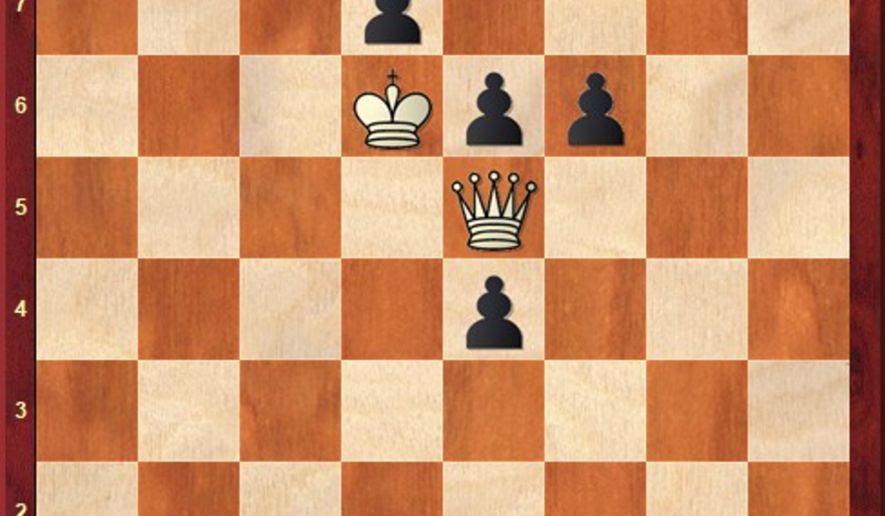
Today’s diagram hearkens back to last week’s U.S. centennial column and the 1876 mate-in-three composed by famed American problemist Sam Loyd. The solution: 1. Qb2! e3 (e5 2. Qa2! Kxc8 [Ke8 3. Qg8 mate] 3. Qa8 mate) 2. Qg2! e2 [Kxc8 3. Qa8 mate] 3. Qg8 mate.
(Click on the image above for a larger view of the chessboard.)
Ruy Lopez-Di Bona da Cutri, Exhibition Match, Rome, April 1560
1. e4 e5 2. f4 d6 3. Bc4 c6 4. Nf3 Bg4 5. fxe5 dxe5 6. Bxf7+ Kxf7 7. Nxe5+ Ke8 8. Qxg4 Nf6 9. Qe6+ Qe7 10. Qc8+ Qd8 11. Qxd8+ Kxd8 12. Nf7+ Black resigns.
Pomar-Larsen, 20th Spanish Team Championship, Zaragoza, Spain, 1976
1. c4 g6 2. Nc3 c5 3. g3 Bg7 4. Bg2 Nh6 5. b3 d6 6. Bb2 Nc6 7. e3 Nf5 8. Nge2 Bd7 9. Nf4 Rb8 10. h4 h5 11. Na4 Ne5 12. Nc3 Qc8 13. a4 Bc6 14. Ne4 a6 15. d4 cxd4 16. exd4 Bxe4 17. Bxe4 Nc6 18. O-O Ncxd4 19. Re1 Nf3+ 20. Qxf3 Bxb2 21. Rad1 Be5 22. Nd5 e6 23. Bxf5 gxf5 24. Rxe5 dxe5 25. Qc3 f6 26. Nxf6+ Kf7 27. Qxe5 Rd8 28. Rxd8 Qxd8 29. Nxh5 Qh8 30. Qc7+ Kg6 31. Nf4+ Kf6 32. Qd6 Qe8 33. Nd5+ Black resigns.
Illescas Cordoba-Rachels, New York Open, New York City, May 1987
1.e4 c5 2.Nf3 d6 3.d4 cxd4 4.Nxd4 Nf6 5.Nc3 g6 6.Be3 Bg7 7.Be2 Nc6 8.O-O O-O 9.Qd2 d5 10.exd5 Nxd5 11.Nxd5 Nxd4 12.c4 e5 13.f4 Be6 14.fxe5 Nxe2+ 15.Qxe2 Bxd5 16.Rad1 Bxe5 17.Rxd5 Qc7 18.h3 Rfe8 19.b3 Rad8 20.Rxd8 Rxd8 21.Kh1 a6 22.Bg5 Rd7 23.Re16 24.Bh6 Qd6 25.Rf1 Qd3 26.Rxf6 Qd1+ 27.Rf1 Black resigns.
• Got a hot tip or a cool game to share? David R. Sands can be reached at davidrsands18@gmail.com.
Please read our comment policy before commenting.