



A version of this story appeared in the daily Threat Status newsletter from The Washington Times. Click here to receive Threat Status delivered directly to your inbox each weekday.
The public statements around the new alliance among Turkey, Saudi Arabia and Pakistan have been unfailingly diplomatic, but make no mistake: The pact the three Muslim nations signed last month has captured the wary attention of the U.S. and is generating concern in India and Israel.
The alliance is already planning joint military exercises, the Turkish Defense Ministry said in a briefing Thursday. Its spokesman, Rear Adm. Zeki Akturk, called on the world to act against Israel’s “genocide.”
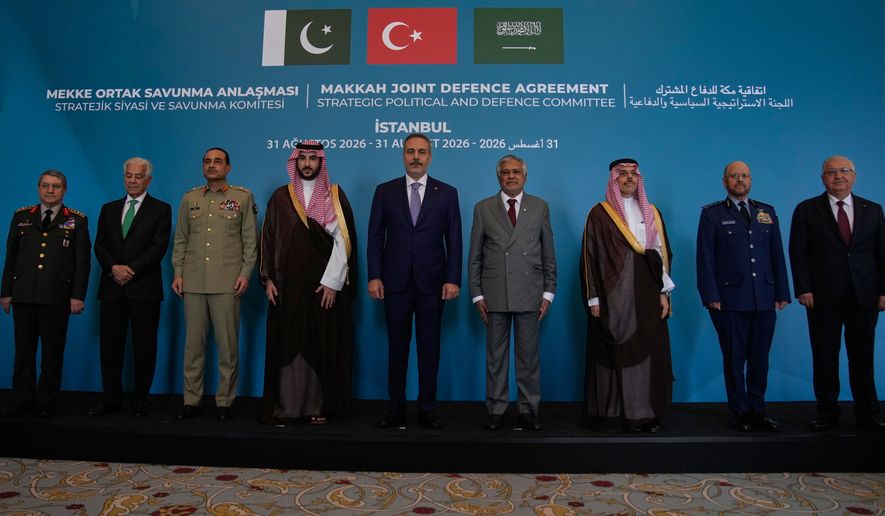
Four days earlier, the alliance’s foreign, defense and military chiefs met in Istanbul to work out the pact’s early details: an official name, a headquarters and a chain of command.
People were interested in these podcasts
The Mecca Defense Alliance — created last month, five months into the American-Israeli war with Iran — is an unprecedented bid by three U.S. allies to build a security architecture that operates independently of Washington.
Each brings a distinct strength: Turkey’s booming weapons industry looking for markets, the Saudis’ cash, and Pakistan, with its estimated 170 warheads, the Muslim world’s only nuclear arsenal.
Washington spent two decades binding all three closer. Turkey joined NATO in 1952. Washington officially designated Pakistan as a major non-NATO ally in 2004. Saudi Arabia earned the same designation in November.
All three countries say the new triad alliance is purely for defense.
Khawaja Asif, Pakistan’s defense minister, told reporters in Istanbul last week that the agreement may have cost India — a U.S. major defense partner that has fought four wars with Pakistan since 1947 — some sleep, but the pact is not intended as a provocation.
Regional analysts, however, say the alliance is about who will wield power in a post-Iran Middle East.
“The Turks are making no bones about the fact that this is aimed at Israel,” Kabir Taneja, executive director of the Observer Research Foundation’s Middle East office in Dubai, told The Washington Times. “I don’t think for the Turks this is aimed at Iran at all.”
Turkey and Iran have not fought a war in centuries, Mr. Taneja said.
U.S. and Israeli strikes on Iran began Feb. 28. President Trump halted them on July 29.
The pause collapsed Aug. 30, when the United States struck rocket launchers on Larak Island and Iran fired on American forces in Jordan and the Emirates. Iranian missiles killed two Filipino crew members aboard a Saudi crude tanker Sept. 1, and the U.S. hit about 100 targets across Iran in reply.
The war also has been costly for the Americans.
An Iranian strike on Kuwait’s Shuaiba port killed six U.S. Army Reserve soldiers on March 1, and a sergeant died days later of wounds from an attack on Prince Sultan Air Base in Saudi Arabia. Eighteen American service members have died since February.
The three alliance members’ foreign, defense and military chiefs met Aug. 31 at an Ottoman palace on the Bosphorus for the first session of the Strategic Political and Defense Committee.
Turkish Foreign Minister Hakan Fidan named the alliance, placed its secretariat in Riyadh and said a Pakistani would serve as the first secretary-general for three years.
Adm. Akturk said the post rotates among the three, and the alliance is working toward joint planning, training and exercises, as well as joint production and technology development.
“It seems to be a command structure similar to NATO’s,” Anil Raman, a retired Indian brigadier at the Takshashila Institution in Bangalore, told The Washington Times. “But I do not foresee it being as effective.
“A threat against Saudi Arabia would be taken far more seriously than, perhaps, tomorrow, if there is a conflict between India and Pakistan,” he said.
President Trump “has been talking about burden sharing,” said Rabia Akhtar, who directs the Center for Security, Strategy and Policy Research at the University of Lahore. By taking charge of their region, she said, the three are “giving Washington just what it needs — a little break from the Middle East.”
“Giving blessings by the Americans does not mean that the Americans support it,” Mr. Taneja said. The region, he said, should build its own architecture and stop asking Washington to bail it out.
The alliance carries no Pakistani nuclear guarantee for Saudi Arabia, Ms. Akhtar said, and Islamabad will not offer one. Doing so would damage Pakistan’s standing with Tehran, Washington, Beijing and the nonproliferation regime.
That dovetails with Mr. Asif’s comments a year ago, when Pakistan and Saudi Arabia announced their bilateral defense pact. He said then that what Pakistan has would be available to the Saudis — before clarifying to Reuters the same night that nuclear weapons were excluded.
Nor are the Saudis expected to be dragged into Pakistan’s ongoing clashes with India.
“In these short conflicts, it matters less how much integration you have done,” said Mr. Raman, the retired Indian brigadier. “If you have a sizable quantity of missiles and drones, you would win the battle for that day, or those couple of days.
“I quite strongly don’t think Saudi Arabia is going to send its land forces to Pakistan to fight India,” he said. “That’s not happening.”
Washington signed a civil nuclear agreement with Saudi Arabia on July 22 and sent it to Congress on Aug. 24. Mr. Trump tied it to Saudi normalization with Israel, and members of both parties questioned whether the terms were more favorable than those in the nuclear deal extended to the United Arab Emirates in 2009.
“Mecca does not necessarily change the American asks,” Ms. Akhtar said. “It changes the strategic environment in which those asks are being negotiated.”
Mr. Fidan said the alliance rests on sovereignty and noninterference and is not directed against any state.
Asked Aug. 31 about Israeli statements calling Turkey a strategic threat, he called Israeli Prime Minister Benjamin Netanyahu a criminal and a perpetrator of genocide whom the international system must confront.
Israel answered the same day. On Aug. 31, it signed a $3.5 billion agreement to build Greece’s national air defense around David’s Sling and other Israeli systems — its largest defense export ever, and the first time it has supplied another country a complete air defense architecture.
Greece and Turkey are NATO allies who have spent decades at odds over territorial waters in the Aegean and over divided Cyprus. Israel and Turkey are competing in Syria, where Israeli jets bombed a base in August that Israel said Turkish forces were preparing to use.
Amichai Chikli, Israel’s diaspora affairs minister, called the Greek deal the answer to Turkish President Recep Tayyip Erdogan’s neo-Ottoman ambitions.
Turkey told Iran about the new alliance before the signing and even invited Tehran to join, Mr. Fidan said.
Field Marshal Asim Munir, Pakistan’s chief of defense forces, flew to Tehran on Aug. 24.
Others want in. Saudi Arabia has invited Bangladesh, which says it is interested.
However, these neighbors are exceptionally wary, nowhere more so than in Abu Dhabi, which may decide where the alliance stops. The Emirates have the Abraham Accords, ties to Israel, India and China, and their own defense industry.
No Persian Gulf state has absorbed more fire. Emirati defenses had handled 520 ballistic missiles, 26 cruise missiles and 2,221 drones by April, said Anwar Gargash, adviser to the Emirati president.
Saudi Arabia has taken Iranian fire, too, but has published no totals.
Both also have a route around the Strait of Hormuz, which Iran now sees as key to securing a favorable end to the war.
The Saudis are bypassing the strait by transporting 5 million barrels a day overland to the Red Sea port of Yanbu. About 1.1 million barrels of Emirati crude are being rerouted daily to Fujairah on the Gulf of Oman.
Turkey, a NATO member, has also been targeted by Iran. NATO destroyers in the eastern Mediterranean shot down four Iranian ballistic missiles headed for Turkey in March, and the alliance sent Patriots to the Kurecik radar base. Ankara asked Tehran for an explanation and did not answer militarily.
“I would not describe the UAE as excluded,” Ms. Akhtar said. “I would describe it as watching very carefully.”
Arms, nukes and cash
From the moment the three new defense partners agreed to cooperate, money began flowing from Saudi Arabia to Pakistan and on to Turkey for weapons that Islamabad can now afford.
“In the future, if such a conflict does take place, Indians will face a far more formidable Pakistani operational challenge,” Mr. Raman said. “It doesn’t have to be in actual military terms of either Turkish or Saudi forces participating directly.”
India’s economy grew 7.6% in the first quarter, Mr. Taneja said, while Pakistan lurches from one bailout to another, with the Saudis now Islamabad’s lender of last resort.
China supplies roughly 80% of Pakistan’s arms imports, according to a May study by the Center for International Policy.
India, meanwhile, has contracted for at least $25 billion in American weapons since 2008. In May, the Trump administration notified Congress of a potential $230 million package for the M777 howitzers India fired at Pakistan.
Four days before the Istanbul meeting, India’s army signed for the Javelin anti-tank missile, a weapon it first saw at a Yudh Abhyas exercise in 2009.
India refused it for 16 years because American companies would not part with the seeker technology on Indian terms. The order is small: 25 launchers and about 200 missiles, through an emergency procurement route.
Mr. Trump imposed 50% tariffs on Indian goods in August 2025 and cut them to 18% in February, but the trade deal remains unsigned. He has said more than two dozen times that he ended the May fighting between India and Pakistan by threatening tariffs, a claim India rejects.
Arzan Tarapore, a research scholar at the Walter H. Shorenstein Asia-Pacific Research Center at Stanford University, does not read the mutual defense agreement as a sign of growing Pakistani-Chinese cooperation against India. Instead, he said, the alliance follows Pakistan’s policy of expanding its horizons in the Middle East.
Since May, India’s borders with China and Pakistan have been relatively quiet, with no serious fire exchanged since an hour of small-arms fire in Rajouri in July.
However, Pakistan’s army said Thursday that it had killed 15 militants crossing from Afghanistan and called them Indian-sponsored.
The Indian and American armies train together this month, for the first time in two terrains — the Rajasthan desert facing Pakistan, then the Himalayas, less than 60 miles from the Line of Actual Control.
“Both those settings, dealing with both of India’s adversaries, are being exercised in this Yudh Abhyas,” Mr. Raman said.
“It’s a kind of political signaling that India and the U.S. continue to have these different kinds and levels of ties,” he said. “It doesn’t signal anything much more than that.”
India is not picking a side. Iranian President Masoud Pezeshkian arrives in India on Saturday for the BRICS summit India chairs, with Russian President Vladimir Putin and, for the first time in seven years, Chinese President Xi Jinping also expected to attend.
For India, an emboldened Pakistan — reinforced by support from powerful new allies — cannot be taken lightly.
“If we saw assets and forces from these countries deployed, or undertaking anything beyond squad- or platoon-level training, on Pakistani soil, that would certainly set off a trigger,” Mr. Raman said.
“If the Saudi and Turkish air forces suddenly decided to start training in large numbers in Pakistan, that would be something we would not appreciate.”
Please read our comment policy before commenting.