



A version of this story appeared in the daily Threat Status newsletter from The Washington Times. Click here to receive Threat Status delivered directly to your inbox each weekday.
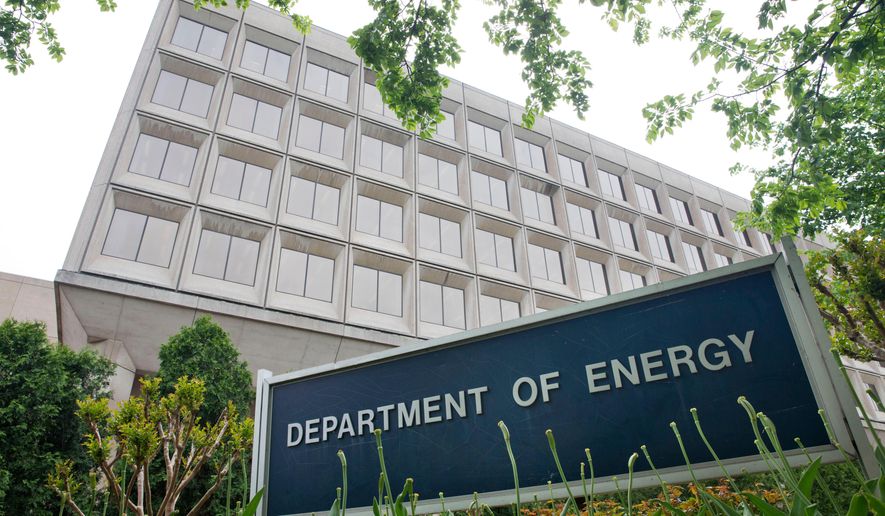
The Energy Department’s nuclear agency has conducted an explosive test in the Nevada desert designed to detect low-yield nuclear blasts from China and Russia, the National Nuclear Security Administration said Wednesday.
The non-nuclear chemical high-explosive experiment was carried out inside a tunnel at the Nevada National Security Site where the first U.S. nuclear bombs were built. The site is located about 65 miles northwest of Las Vegas.
The NNSA said in a statement the data from the test will be used to assist scientific models and refine algorithms used in detecting foreign nuclear detonations.
People were interested in these podcasts
The blast seeks to bolster U.S. detection capabilities of what the NNSA said is a “decoupled” explosion — “the type of test the United States determined that China conducted in June 2020 at its Lop Nur nuclear test site.”
“Just as a stealth aircraft looks smaller on radar, decoupling can greatly muffle the signals detected by nuclear detection sensors, making a large explosion appear smaller,” the statement said.
Traditional or coupled underground nuclear tests use a bomb planted deep in a hole near rock, allowing shock waves to reach sensors. Decoupled tests are detonated inside a large underground chamber to reduce the seismic signature.
No date was given for the tests.
Researchers obtained measurements from multiple advanced sensors, including accelerometers, seismometers, infrasound sensors, electromagnetic sensors, chemical and radiotracer samplers, and meteorological sensors, the statement said.
The goal was to improve the ability of scientists to better gauge underground explosions and improve U.S. capabilities for detecting and characterizing nuclear blasts when they take place.
The rare announcement of a nuclear-related explosion comes as President Trump called for the United States to resume underground nuclear tests following covert nuclear tests by China and Russia.
Mr. Trump announced in October 2025 that he had instructed to the Pentagon to immediately resume nuclear testing on an equal basis with China and Russia.
“We’ve halted [testing] many years ago, but with others doing testing, I think it’s appropriate to do so,” he said at the time.
So far, no such U.S. tests have happened.
In March, Thomas G. DiNanno, undersecretary of state for arms control and international security, told Congress during a hearing that the U.S. is set to resume underground tests in response to what he termed significant covert Chinese and Russian nuclear testing.
The nuclear activities by Beijing and Moscow had created an unacceptable hindrance for the U.S. and provided a major advantage for adversaries developing nuclear warheads.
Mr. DiNanno said that despite a supposed international moratorium on nuclear tests, Chinese and Russian technicians had conducted tests “at yield” – the term describing underground blasts that produce a significant, self-sustaining nuclear chain reaction and release measurable amounts of explosive energy.
“I think it’s extremely important to understand that the Russians and Chinese are testing at yield. That creates an intolerable disadvantage for the United States by not testing,” he told the Senate Foreign Relations Committee March 24.
Earlier in February, Mr. DiNanno disclosed in a speech that China has been conducting nuclear tests at its Lop Nur site in western China, including one on June 22, 2020. Plans by China include blasts with yields in the “hundreds of tons” equivalent of TNT, he said.
The Chinese military “sought to conceal testing by obfuscating the nuclear explosions because it recognized these tests violate test ban commitments,” he said, adding that the Chinese used decoupling to limit seismic monitoring.
Contact the author
Please read our comment policy before commenting.