


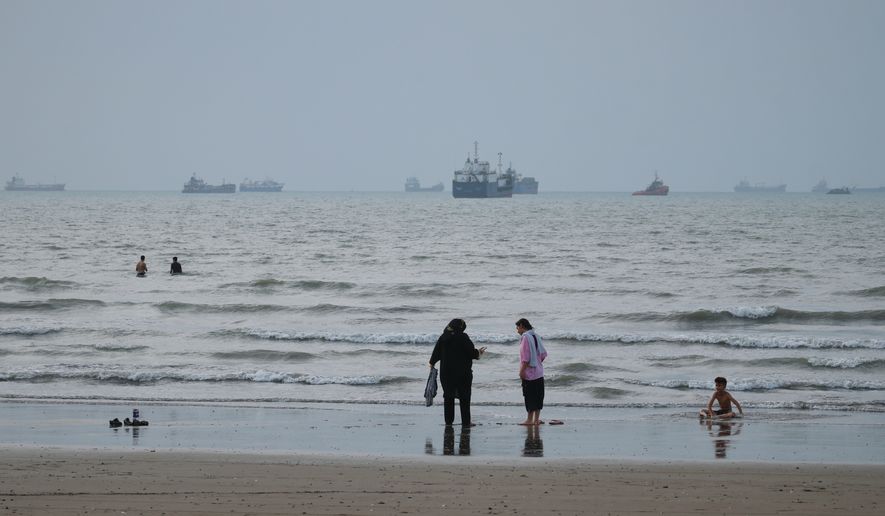

Vice President J.D. Vance on Thursday said the U.S. is not in diplomatic talks with Iran and that the silent treatment would continue as long as control of the Strait of Hormuz is contested.
Speaking to reporters in the White House, Mr. Vance said Iran’s blockade of the strait and its attacks on tanker vessels in the waterway remain the primary obstacles to peace.
“We’re not talking to them. And we’re not going to talk to them unless they stop shooting at commercial shipping,” he said.
People were interested in these podcasts
The U.S. has not met diplomatically with Iran since June, after both sides signed the Pakistani-brokered Islamabad memorandum of understanding. Mr. Vance led the original delegation for the first round of direct talks with Iran.
Asked about the Trump administration’s efforts to combat inflation and improve affordability, namely with rising gas prices, Mr. Vance quickly blamed Iran.
“We would have had an energy crisis because the Iranians refused to stop acting like terrorists in the Strait of Hormuz,” Mr. Vance said. “The Iranians would like zero million barrels to come out of the Strait of Hormuz. Last night, 15 million barrels came out of the Strait of Hormuz. That’s because of the United States of America.”
The U.S. has coordinated an escort campaign in the strait through Omani waters in recent weeks, allowing for millions of barrels of oil to move safely out of the Persian Gulf. However, the ships often must travel at night to avoid detection from Iranian forces, and transit levels remain far below prewar levels.
Gasoline prices are a particular worry for the Trump administration. The average price per gallon is above $4 per gallon, on average, up from about $3 at the start of the war, according to the AAA auto club.
At least one-fifth of the world’s oil and natural gas flows through the Strait of Hormuz each year, and its closure has forced international energy prices to soar. Brent crude, the international benchmark for crude oil, sat at about $95 a barrel on Thursday afternoon, compared to $79 in early August and $66 a year ago.
Mr. Vance’s comments come as the U.S. war with Iran shows no signs of de-escalating, with missiles and drones fired from both sides across the Middle East in the most explosive week since July.
President Trump on Thursday raged against reports that the Iran war has severely depleted the nation’s munitions stockpiles. In a social media post, the president insisted that stockpiles of the essential ammunition are “virtually unlimited” and said the U.S. is producing them “at levels never seen before.”
“Far more than we could ever use for this, or for any other War (which is highly unlikely!), that could improbably take place,” Mr. Trump wrote on Truth Social.
A Fortune report analyzing the cost of the first two months of the war, which began in late February, found that the U.S. burned through roughly 45% of its Precision Strike Missiles and about half of its Terminal High Altitude Area Defense (THAAD) interceptors, or about $24 billion worth of ballistic missiles and interceptors.
An independent analysis published by the Center for Strategic and International Studies found that it could take up to four years for the Pentagon to rebuild the U.S. stockpile of critical munitions to prewar levels.
Chairman of the Joint Chiefs of Staff Gen. Dan Caine reportedly briefed Mr. Trump on the extent of the nation’s munitions shortage in July, shortly before the president decided to temporarily pause the air campaign against Iran.
Notably, The Wall Street Journal reported on Thursday that Mr. Trump has been privately considering declaring an end to the Iran war despite the heavy presence of U.S. troops in the region and an ongoing naval blockade.
Mr. Trump paused active combat operations against Iran in late July after citing diplomatic progress. He recently has been relying on an expanding economic pressure campaign to force Iran to the negotiating table by facilitating the collapse of its economy.
Separately, reports are circulating that Trump aides are looking to avoid a major escalation in the war ahead of the Nov. 3 midterm elections as officials grow increasingly concerned about the political cost of the war on Republicans up for election.
Iran has already signaled that it is prepared to escalate the conflict further.
Iran targeted U.S. bases in Kuwait and the United Arab Emirates with missiles and drones on Thursday, marking the third consecutive day of strikes on American assets in the region. U.S. defense officials have said that neither of the attempted attacks caused significant damage.
Iran’s Islamic Revolutionary Guard Corps said this week that it had launched successful attacks on U.S. bases in Jordan and Bahrain, targeting radar and training sites. While Iranian security officials said the attacks caused serious damage, regional ministries and U.S. Central Command rejected Tehran’s claims.
Contact the author


Please read our comment policy before commenting.