


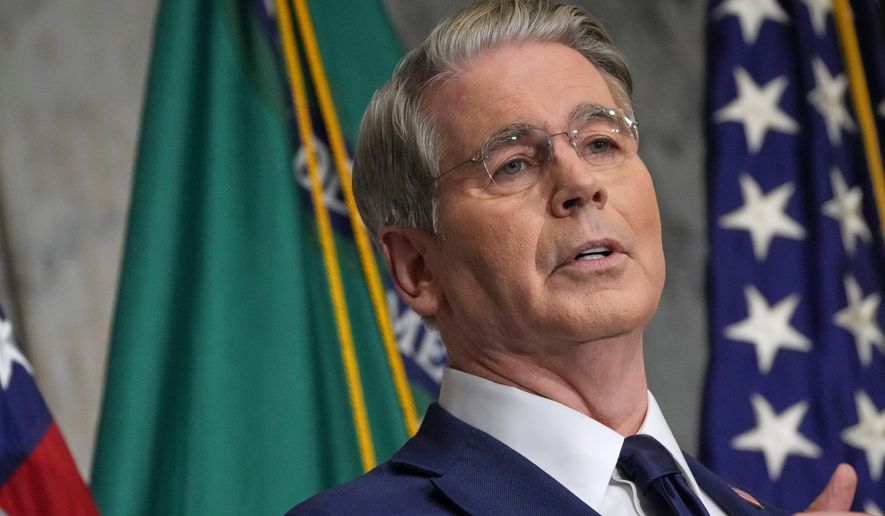

The IRS opened a new front against affirmative action Thursday, proposing a regulation that would allow the agency to strip private schools of their tax-exempt status if they use race-based preferences in their admissions or financial assistance decisions.
Treasury Department and IRS officials said tax-exempt groups can be required to comply with good “public policy” goals and that includes enforcing nondiscrimination on the basis of race or ethnicity.
Other preferences for income, hardship or academic or athletic achievement would still be permitted.
People were interested in these podcasts
But the Trump administration said trying to forge diversity by picking winners and losers based on race will cost schools their special tax status.
“Schools rebranding race-based preferences as equitable, inclusive or diversity-enhancing does not change their discriminatory nature,” said Treasury Secretary Scott Bessent.
The rule would apply to all levels, from primary schools to universities, and would also cover professional and trade schools. The IRS figured more than 18,000 private institutions, with 750,000 students, may be affected.
The proposed regulation infuriated Democrats, who labeled the change racist.
“This isn’t about ‘fairness,’ it’s about the president targeting anyone who stands in the way of his campaign to roll back the clock on civil rights progress that generations of Americans have fought and bled for,” said Rep. Richard E. Neal, the top Democrat on the House Ways and Means Committee, which oversees the IRS.
At issue is the schools’ status as 501(c)(3) organizations. Those are nonprofits that operate for religious, charitable or educational purposes. Donations to them are tax-deductible, which provides an immense benefit in their fundraising.
Public schools and those that receive substantial federal money are already barred from using race-based preferences after the Supreme Court’s 2023 ruling striking down affirmative action policies at Harvard University and the University of North Carolina.
The IRS on Thursday said that same principle can be applied to other private schools. The agency said the Supreme Court has long recognized that the IRS can condition tax-exempt status on an organization’s ability not to act “contrary to public policy.”
“Today’s proposed regulations put institutions on notice, and schools that continue to engage in racial discrimination should expect to lose that status,” said Frank J. Bisignano, the IRS’ CEO and acting head.
The new proposal will be published in the Federal Register on Friday, kicking off a public comment period.
A regulation would be finalized by May 31, 2027, and the rules would become binding in the next taxable year after that.
The proposal would apply even in cases where racial discrimination might be deemed legal, such as where it was seen as remedial for past discrimination.
Religious schools would be able to keep their tax-exempt status even if their selection based on faith meant they ended up picking people of the same national origin or ethnicity.
IRS officials said the downside of losing tax-exempt status is so big that most schools will heed the new rule.
But donors who endow scholarships specifically directed toward a race or ethnicity will have to adjust.
The IRS said it thinks many of those donors will convert their race-based criteria to alternative measures, such as income, geography or first-generation student status.
The new proposal is the latest in a string of moves by the Trump administration to put teeth behind the Supreme Court’s ruling in the Harvard case.
Justice Department lawyers have been badgering universities that have tried to use workarounds to get at race without explicitly asking the question on admissions forms.
DOJ has launched probes of more than 15 schools and has fired off letters challenging admissions practices at George Washington University, Duke University, Yale University and several schools in the University of California system.
Contact the author

Please read our comment policy before commenting.