


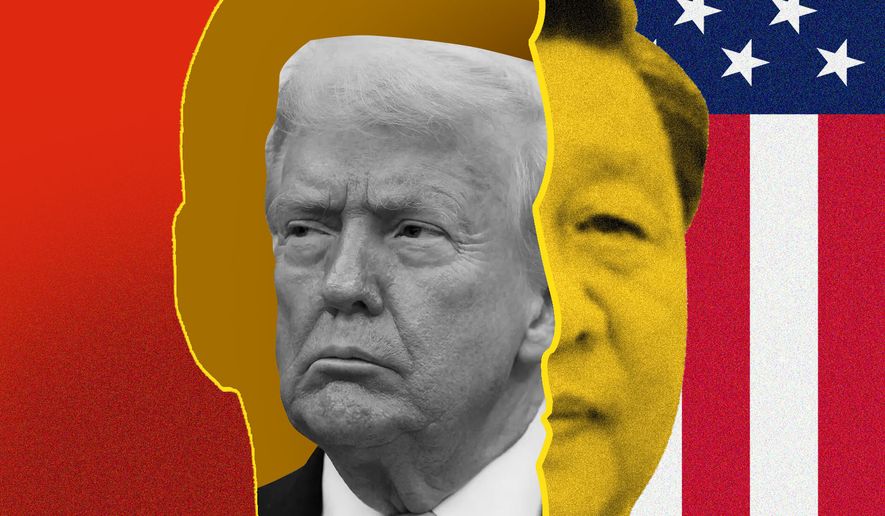

A version of this story appeared in the daily Threat Status newsletter from The Washington Times. Click here to receive Threat Status delivered directly to your inbox each weekday.
OPINION:
The more U.S.-China relations change, the more they remain the same.
Xi Jinping came to Washington amid extraordinary pageantry, presidential compliments and talk of “strategic stability.” Yet beneath the ceremony lies an iron reality: The United States and communist China remain formidable strategic adversaries because their visions of world order remain fundamentally incompatible.
The Chinese Communist Party continues to portray American power as “hegemonism,” obstructing China’s rise and its preferred Sino-centric order. Mr. Xi used precisely that language weeks before arriving in Washington.
People were interested in these podcasts
The U.S., meanwhile, continues to strengthen alliances, military deterrence and economic security measures designed, in significant part, to counter China’s global power. (The court trial of Huawei, charged by the Justice Department as a criminal organization, started in New York just days before Mr. Xi landed at Joint Base Andrews.)
That is why Mr. Trump’s spectacular welcome for Mr. Xi should not be mistaken for strategic softness.
At Joint Base Andrews on Wednesday, two B-1B bombers roared overhead as the national anthem played during Mr. Xi’s arrival ceremony. The next day at the White House, a B-2 Spirit — the same type of strategic bomber employed against Iran’s nuclear facilities — flew over, accompanied by four F-22 Raptors. Nearly 480 American military personnel participated in the welcome ceremony.
It was hospitality, certainly — but hospitality staged against an unmistakable backdrop of American military, economic and technological power.
The cultural symbolism was equally remarkable.
The state dinner included music from “Les Miserables,” whose revolutionary anthem “Do You Hear the People Sing?” became the street anthem of Hong Kong’s 2019-2020 protest movement. It also featured “The Moon Represents My Heart,” immortalized by Taiwan’s Teresa Teng.
Teng was far more than a pop singer. Her music, once condemned as “spiritual pollution” in communist China, was broadcast from Taiwan toward the mainland and became a Cold War cultural symbol of a Chinese world beyond Beijing’s rule. Teng rejected invitations to perform in communist China and publicly supported the 1989 Tiananmen protesters.
Few musical choices could have carried more historical irony at a White House dinner honoring the CCP’s supreme leader.
Even “Jasmine Flower,” performed during the state visit, was no communist anthem. It is an old Chinese folk melody, predating communist rule by centuries and famously incorporated into Puccini’s “Turandot.”
The distinction matters: China is older and greater than the CCP.
The symbolism continued at the National Archives. Mr. Trump took the ruler of a Leninist party to see America’s Declaration of Independence, Constitution and Bill of Rights — the documentary foundations of limited government, individual liberty and popular sovereignty.
Then there is the 1951 San Francisco Peace Treaty, a document Beijing would prefer the world to remember differently. Japan renounced “all right, title and claim” to Taiwan and the Pescadores without transferring sovereignty over them to China.
Beijing has long rejected the treaty’s legitimacy. Whatever one’s interpretation of Taiwan’s ultimate legal status, the treaty complicates the CCP’s insistence that Chinese sovereignty over Taiwan is an internationally settled historical fact. It is not.
Taiwan itself produced another revealing contrast. Mr. Xi pressed Mr. Trump to go beyond America’s traditional formulation of “not supporting” Taiwan independence and explicitly oppose it. Mr. Trump offered no publicly announced concession.
Then there was the radically different language used by the two sides.
Mr. Xi offered the usual abstractions: peaceful coexistence and the perennial disingenuous promise of “win-win” relations. Washington increasingly spoke the language of numbers, deadlines and implementation: an extension of the trade truce to Jan. 10, 2027; at least $17 billion annually in American agricultural purchases; restored market access for American beef and poultry; 10 million metric tons of American coal in both 2027 and 2028; tariff treatment for $30 billion in goods in each direction; and concrete delivery of rare earths and critical minerals.
Still, Washington should never confuse promises with performance. Earlier commitments remain incomplete, including Chinese purchases of Boeing aircraft and American agricultural products.
No grand strategic bargain emerged from the Washington summit. The two leaders essentially agreed to keep talking.
There was another important message that week, and it was directed toward Japan.
While U.S.-China relations provided the diplomatic theater, Mr. Trump conspicuously reinforced America’s treaty alliance with Tokyo. Two days before meeting Mr. Xi, the American president held a highly visible meeting with Prime Minister Sanae Takaichi at the United Nations. They discussed China, cooperation on artificial intelligence, semiconductors and critical minerals, deterrence, the Quad and a free and open Indo-Pacific.
No sooner had Mr. Xi departed for home than Ms. Takaichi received a detailed briefing on the summit directly from “Dear Donald.”
The larger picture could hardly have been lost on Mr. Xi: China gets presidential pageantry, and Japan remains America’s principal Indo-Pacific ally and the cornerstone of America’s power and influence in the region.
Strategic stability requires strategic patience — and wiles. Mr. Trump has spent a lifetime bargaining in hard-edged worlds, from New York real estate to casinos and entertainment. He understands that cordiality and displays of power and strength are not synonymous.
America now needs both carrot and stick.
Mr. Trump can play diplomatic good cop, keeping leader-to-leader communication open and offering rewards for measurable Chinese compliance. Yet his administration also contains officials — such as Marco Rubio and Pete Hegseth — who can play the harder role when Beijing fails to deliver.
China has leverage, especially in rare earths and critical minerals, but dependence runs both ways and asymmetrically. China remains enormously dependent on American consumers, advanced technologies, financial power and a global economic and alliance system in which the U.S. still exercises extraordinary influence.
Washington has far more leverage than its habitual pessimists imagine. The question is whether it is willing to use it.
The summit’s message was not going soft on China. Nor was it friendship. It was something subtler and potentially more effective: Smile at Mr. Xi. Show him the Constitution. Play Teresa Teng and Puccini. Fly the B-1Bs and B-2s overhead. Demand dates, quantities and compliance. And keep the stick within reach.
• Miles Yu is the director of the China Center at the Hudson Institute. His “Red Horizon” column appears every other Tuesday in The Washington Times. He can be reached at mmilesyu@gmail.com.
Please read our comment policy before commenting.