



A version of this story appeared in the daily Threat Status newsletter from The Washington Times. Click here to receive Threat Status delivered directly to your inbox each weekday.
ISTANBUL — The ramped-up ballistic missile and drone barrage targeting sites, including the holy city of Mecca, across Saudi Arabia in recent days is providing an eye-opening test of the mutual defense pact the kingdom signed last month with Turkey and Pakistan. So far, the Saudis’ new partners have shown little appetite for joining the widening Middle East war against Iran and its Houthi proxies.
Pakistan, a key Saudi ally since the 1960s, has had troops — at least 8,000, by most estimates — stationed in the kingdom for years, along with fighter squadrons, drone units and air defense operations. Still, Islamabad this week was quiet about committing more forces to the Middle East as the Yemen-based Houthis dramatically escalated their attacks on the Saudis.
The other leg of the new security triad, Turkey, was similarly noncommittal, offering “technical” assistance to the Saudis.
People were interested in these podcasts
The Mecca Agreement, signed Aug. 7, declares an armed attack on any of the three members an attack on all, but because its supporting structure is still being built, analysts said the “trigger” and “threshold” for activating it have not been set.
Pakistani Prime Minister Shehbaz Sharif, in a statement Wednesday, called Islamabad’s relationship with Riyadh “even stronger,” but he announced no new deployments and did not say whether the kingdom had asked for military help.
Turkish Foreign Minister Hakan Fidan told Turkish broadcaster NTV on Saturday that Saudi Arabia “may have some military needs, especially on some technical issues. We would have no issues in meeting these.” Under the alliance, “we stand by our word,” he said, adding that the three nations were holding consultations they had not disclosed.
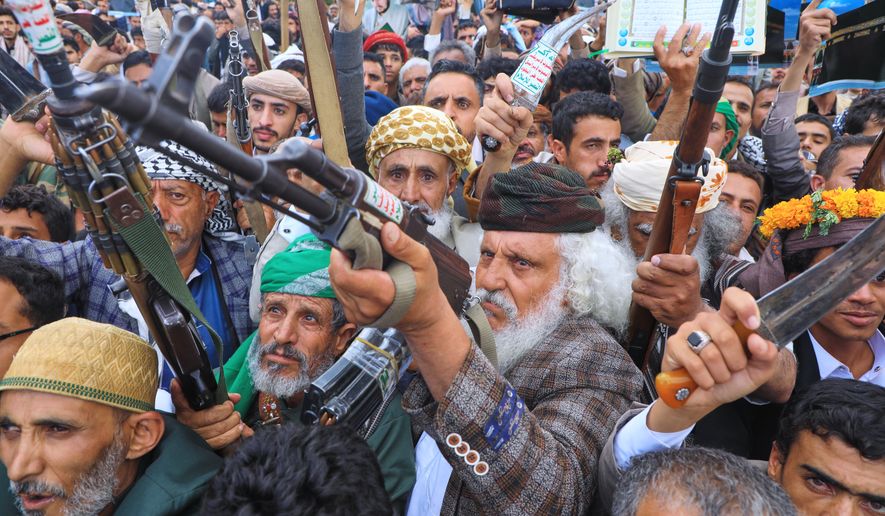
The Iran-backed Houthis are warning both the Turks and the Pakistanis to stay clear of the fighting.
Yahya Ali al-Ra’i, speaker of the Houthi parliament, wrote Wednesday to his Pakistani and Turkish counterparts, urging them to keep their countries clear of Saudi policy and to press Riyadh to end its war and blockade on Yemen, according to Saba, the Houthi-controlled news agency, which published the letters.
Saudi air defenses intercepted six ballistic missiles Thursday aimed at the Red Sea port of Yanbu and Khamis Mushait in the southwest, The Associated Press reported. The Houthis later said they had fired dozens of missiles and drones at Jazan province, on the Saudi border.
The fighting near the Red Sea shipping corridor has unsettled global markets as the Houthis press a blockade of the world’s top oil exporter. Saudi Arabia has been routing about 4 million barrels a day around the Strait of Hormuz through its east-west pipeline to Yanbu. Drone attacks that Riyadh blames on Iraqi militias struck the pipeline on Sept. 10, prompting a shutdown on Sept. 11 before operations restarted at a low rate on Tuesday.
If Pakistan is stepping up its support for the Saudis, that effort is likely happening with little or no fanfare.
“In all likelihood, the kind of operational support will be kept confidential,” said Masood Khan, a former Pakistani ambassador to the United States who advises the Saudi government on security. He brushed aside skepticism about the Mecca Agreement, telling The Washington Times that the mutual defense treaty is fully operational.
“The moment it was inked, it became operative,” he said.
“We can, upon request, increase our military presence within and outside the framework of the [Mecca Agreement],” Mr. Khan said.
The Saudis have turned to regional allies after the Trump administration, which has been in contact with the Houthis, indicated the United States was sitting out this fight.
“This just confirms that America is not here to defend us,” said Abdulkhaleq Abdulla, a retired professor of political science in the United Arab Emirates. “We have no solid agreement that America sends 100,000 of its soldiers, as it did in 1991 during Saddam’s invasion. That is gone. We need to be on our own.”
Riyadh has asked France, Britain, Pakistan and Egypt for air-defense help as months of war with Iran have strained American interceptor stocks, regional officials told the AP.
“There is no other alternative to the American security guarantee,” Mr. Abdulla said. “Most of that has to do with getting the best weapons money can buy. Nobody has them except America.”
Zahid Mahmood, a retired Pakistani major general, said the potential $24.3 billion sale of 48 F-35 fighters conditionally approved by Washington last week “does not solve today’s immediate problem.” What Riyadh needs now, he added, is “sensors, interceptors, counter-UAV capabilities, and integrated air and missile defense.”
Pakistan could supply those systems, he said, in the form of the HQ-9/P and LY-80 air-defense systems, both Chinese designs, along with counter-drone weapons, radars and early-warning tools, to “complement, rather than merely duplicate, Saudi Patriot capabilities.”
Chinese hardware already sits inside Saudi defenses: The kingdom has deployed China’s Silent Hunter laser as part of a counter-drone system protecting key sites and Patriot batteries, and has bought Chinese armed drones. The Emirates, by contrast, fields Israeli systems; Riyadh has declined to do so because of a lack of diplomatic ties with Israel.
Pakistan is fighting militants in Khyber Pakhtunkhwa and Balochistan, Mr. Mahmood said, and would have to weigh carefully how much it could spare.
Some Pakistani officials have argued that, because the fighting in Yemen predates the pact, it may fall outside it, according to the Soufan Center, a New York-based international security research organization.
Mr. Khan rejected that. “The fresh Houthi attacks have intensified after the signing of the Makkah Agreement,” he said. “If formally asked, Pakistan is obligated to side with Saudi Arabia.”
Turkish analysts say Ankara’s caution is by design. Sinem Cengiz, a researcher at Qatar University’s Gulf Studies Center, said the pact should not be pulled into every flare-up.
“It is not appropriate to bring the Mecca Agreement into the agenda of every escalation,” she told The Times. “It is a long-term framework, and its institutional and technical dimensions still need to be carefully defined and developed.” Turkey can strengthen Saudi defenses through its existing agreements, she said, “while leaving the political and operational responsibility for Yemen with Riyadh.”
Egypt, which Riyadh has also asked for air-defense help, is further from joining. Foreign Minister Badr Abdelatty said in August that Egyptian institutions were studying the pact. Hany El-Aasar, executive director of Cairo’s National Center for Studies, told The Times that Egypt would not want to join but “may be forced into it at some stage.” Cairo could offer military support if certain red lines were crossed, he said, “among them the targeting of the holy sites.”
The Houthis have named their price. Mohammed al-Bukhaiti, a member of the group’s political bureau, said attacks would continue until Riyadh lifts its decadelong blockade of Houthi-held areas, after which the group would negotiate. Saudi Arabia, he said, “lost its most critical card: the west coast.” He told an Iraqi television channel that Turkey and Pakistan would face an “iron fist” if they entered the war.
“Pakistan is battle-hardened and is not cowed by such warnings,” Mr. Khan said. Islamabad is working another channel instead: “Even as we speak, a Pakistani envoy is in Tehran to persuade the Iranian leadership to ask the Houthis to stop their attack.”
“Saudi Arabia’s options have gone from bad to worse,” said April Longley Alley, a senior fellow at The Washington Institute who served as senior political adviser to the U.N. Special Envoy for Yemen. Riyadh is caught in a double chokehold, she said at an International Crisis Group panel Tuesday, with Iran at Hormuz, the Houthis at Bab al-Mandab and Iraqi militias to the north. “Over the long term, this is just existential for the Saudis.”
The Houthis have also managed “to drive a wedge between the U.S. and Saudi Arabia,” she said, by assuring Washington that its ships are safe while pressing the kingdom alone.
Speaking Sunday in New York at the Qatar Economic Forum on the sidelines of the U.N. General Assembly, Qatar’s prime minister, Sheikh Mohammed bin Abdulrahman Al Thani, called for a regional security framework linking Iran and the Gulf states. “Iran is our neighbor,” he said. “Without a security framework that brings us all together as Gulf countries with Iran, ensuring that none of us is posing a threat on the other, this region will not just be continuing in the same way as it used to be.”
King Salman accused the Houthis on Tuesday of trying again to strike Mecca, telling a Cabinet meeting in Jeddah that the attempt violated Islam’s holiest sites and offended Muslims everywhere. The Houthis deny targeting the city. Beyond that, Saudi officials have given no details of a military response. Coalition spokesman Maj. Gen. Turki al-Maliki has said only that the coalition reserves the right to act to deter the Houthis.
Mr. Abdulla said Washington’s most useful step lies outside Yemen.
“The best thing the Americans can do is get the Strait of Hormuz open,” he said. “They got us into this mess. So if there is anything America can do for the region, for us, for its friends — besides giving us the best weapons money can buy — please get the Strait of Hormuz open.”
Please read our comment policy before commenting.