


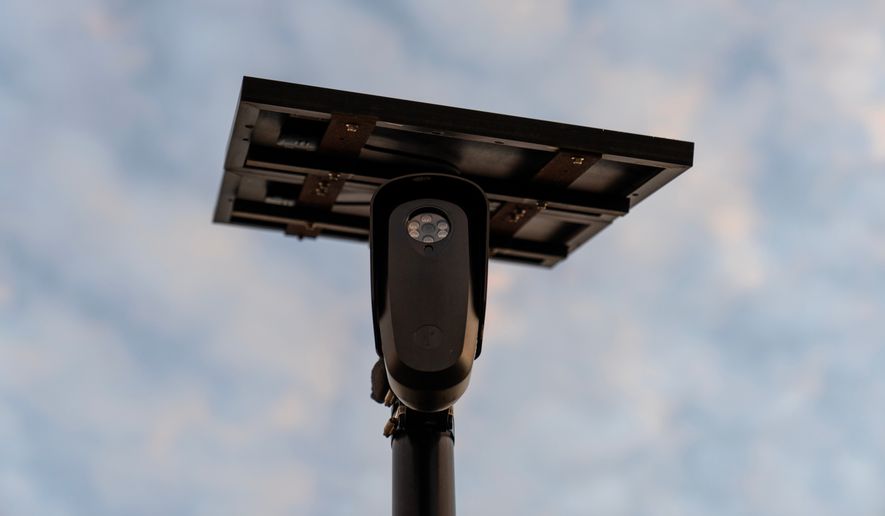

It turns out Uncle Sam is part of the Flock family.
A Trump administration agency is paying Flock Group $231,600 a year to host license plate reader cameras on roads around the Washington area, according to government contracting data.
The U.S. Park Police, an agency within the Interior Department, renewed its contract Friday, even amid a growing national backlash against the cameras as a step toward a surveillance state.
People were interested in these podcasts
The contracting documents are slim on details, saying only that the department “has a requirement to acquire and deploy a Flock Safety automated license plate reader (ALPR) system in the greater Washington, D.C., metropolitan area.”
They do not say where the cameras are located, and department officials, like most police agencies, declined to specify any locations to The Washington Times. Officials cited the need for secrecy of law enforcement operations and security.
DeFlock.org, a website that maps cameras reported by the community, shows dozens of cameras on lands controlled by the National Park Service and patrolled by U.S. Park Police. That includes at least 15 cameras on the George Washington Memorial Parkway, which runs along the Potomac River to the south and west of Washington, and the Baltimore-Washington Parkway, which runs northeast from the city.
The DeFlock map also shows cameras on Rock Creek Parkway and on parkland near several bridges linking Virginia to the District.
DeFlock.org mapping records and site observations confirm a camera just north of the Ellipse is pointed toward the White House’s south facade.
Park Police, in a statement to The Washington Times, defended the contract.
The department stated that data is retained “for a certain number of days” and is accessible only to “trained personnel” conducting “legitimate and documented law enforcement activity.”
The department said the data is retained “for a certain number of days,” and accessing it is limited to “trained personnel” engaged in “legitimate and documented law enforcement activity.”
The department added that system usage “is subject to audits,” which may eventually be automated.
“Keep in mind that the running of plates is done regularly without these cameras — the cameras just process more plates faster,” the department said.
Flock is the biggest player in the license plate reader industry.
The cameras are trained on roadways and use artificial intelligence to catalog license plate numbers as vehicles drive by. The data gives an unprecedented look at Americans’ travel patterns, a fact that has spurred a massive popular resistance.
Arlington County, traversed by the George Washington Memorial Parkway, voted Sept. 15 to remove its 41 Flock cameras. The same day, neighboring Fairfax County’s Board of Supervisors voted to freeze its program and halt new camera installations pending a policy review.
Park Police, though, told The Times it has no plans to give up its contract.
One of the cameras stands on the George Washington Parkway just south of the Alexandria boundary.
“People in the D.C. area can’t even enjoy going to the beautiful parks along the GW Parkway without our constitutional rights being violated,” DeFlock Alexandria, a local advocacy group, told The Washington Times. “We all deserve freedom of movement without constant surveillance.”
The group acknowledged that local governments cannot control what Park Police do but said Alexandria and Fairfax County could end their contracts.
The total contract is worth $433,600 across two years, with $231,600 allocated for the first year, according to government records.
Federal taxpayer money going to Flock Group may not sit well with some members of Congress who are crafting legislation to restrict public spending for license plate readers.
However, any legislative effort could face resistance from the White House.
The Atlantic reported in July that a list of must-have items the Trump administration requested for the Interior Department budget included dedicated funding for Flock license plate readers.
The Interior Department, which oversees the Park Police, did not respond to an inquiry for this report.
FBI Director Kash Patel told the Senate Judiciary Committee during an oversight hearing on Sept. 16 that the cameras keep children safe.
He explained that agents obtain photos of vehicles suspected in child kidnappings and share them with license plate reader firms to track down the cars.
“We have saved children over and over again from these child predators,” Mr. Patel said.
Other federal agencies have also explored the use of license plate readers.
Customs and Border Protection has been using them for years, including at border crossings and along roads near the border. The cameras help track suspicious behavior.
Contracting documents show some military bases also use the technology at their entrance gates.
Contact the author

Please read our comment policy before commenting.