


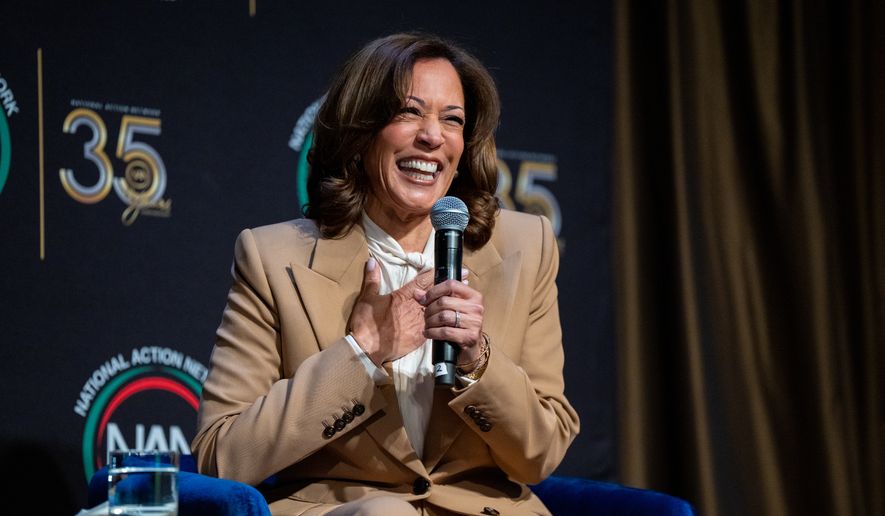

Former Vice President Kamala Harris on Tuesday made her first major midterm foray, traveling to Michigan to boost Democrat Abdul El‑Sayed’s Senate bid — a high‑profile stop that doubled as a test of her standing as a potential 2028 contender.
Ms. Harris joined Mr. El‑Sayed at a Detroit birth center for a roundtable on Black maternal health, where participants highlighted Black women dying at three to four times the rate of White women in connection with childbirth — and how the Senate race between Mr. El‑Sayed and Republican Mike Rogers could shape Medicaid funding, Planned Parenthood access and federal research dollars.
“I’m here to support Dr. El-Sayed because on this subject I know he will be a champion, and I have a right to say that,” Ms. Harris said.
People were interested in these podcasts
Mr. El‑Sayed, who previously led the Detroit Health Department and later the Wayne County Department of Health, said the issue is personal.
“Babies shouldn’t die. Full stop,” he said, recalling the deaths of two of his grandmother’s eight children before their first birthdays.
Ms. Harris, who replaced Joseph R. Biden as the Democrats’ 2024 presidential nominee, also planned a private reception with Michigan Democratic leaders and to meet with local faith leaders focused on voter turnout.
Her visit was designed to pull the party together behind Mr. El‑Sayed — particularly Black voters, many of whom had backed his primary rival, Rep. Haley Stevens, in a competitive and often bitter contest.
Mr. El-Sayed’s rival, Republican Mike Rogers, launched a preemptive strike ahead of the visit.
“It’s no surprise El‑Sayed is campaigning alongside Kamala Harris,” he said. “In the White House, her administration oversaw inflation above 9% as gas and grocery costs soared. Now they’re in lockstep on an agenda of higher costs, higher taxes and emptying prisons. Michiganders won’t fall for it.”
At a press conference earlier in the day, Mr. El‑Sayed faced questions about his role in the “uncommitted” movement, which some Democrats have blamed for helping President Trump carry Michigan over Ms. Harris in 2024.
He didn’t retreat from his criticism of the Biden administration’s handling of the war in Gaza or his support for an embargo on Israel, saying the party should look ahead rather than relitigate the past.
“My positions on Gaza, on the genocide, on funding, on foreign military aid, on weapon sales — none of those positions have changed at all. I’m not going to change them,” he said. “They’re based in principle, and I believe that they are the right thing to do.”
He emphasized unity heading into the Harris visit.
“In our party, we can have some disagreements, but the things that unite us are so much bigger than the things that divide us,” he said. “We understand we’ve got to hold Trump accountable.”
Michigan is one of the marquee contests on a Senate map. Democrats are fighting to hold the seat and take control of the chamber, but even keeping Michigan would leave them needing to flip four more GOP‑held seats to secure a majority. The seat is open because Democratic Sen. Gary Peters is retiring.
Michigan is also part of a broader midterm push for Ms. Harris, who plans to campaign with Democrats in Nevada and Georgia — two other states central to the battle for Senate control. And with Michigan set to be an early state on the Democratic presidential primary calendar, her visit further heightened expectations of a 2028 run.
Please read our comment policy before commenting.