


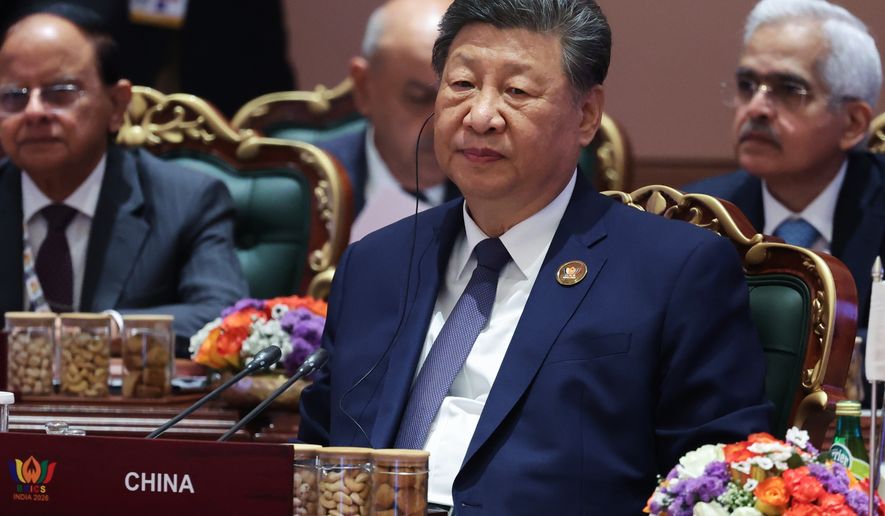

Beijing’s strategy for the upcoming summit between President Trump includes an effort to overcome a questionable theory that the two nations are headed for war, according to the Chinese Communist Party’s flagship newspaper.
The People’s Daily stated in a front-page report on President Xi Jinping’s visit this week that U.S.-China relations remain “bumpy,” quoting Mr. Xi from May as asking Mr. Trump in Beijing whether China and the U.S. can overcome the “Thucydides trap” and create a new model for relations.
The theory of that “trap” dates to the ancient Greek historian but was given new life in a 2017 book by political scientist Graham Allison. The book stated, by analogy with Thucydides’ account of the ruinous war between Athens and Sparta, that war is likely between a rising China and a declining United States.
People were interested in these podcasts
The trap idea is a central feature of aggressive Chinese international propaganda and cognitive warfare promoting its communist system as the replacement for what China alleges is a waning U.S. and America-led democratic world order.
Critics dismissed the Thucydides trap as an outdated and inaccurate effort to reduce complex geopolitical and economic ideas to a single notion of “rising versus ruling powers,” and as a call for the U.S. to appease China to prevent war.
Mr. Trump pushed back strongly on the idea of a declining U.S. during his United Nations General Assembly speech Tuesday, telling world leaders now is the “golden age of America.”
“America is blessed with the strongest economy, the strongest borders, the strongest military, the strongest friendships, and the strongest spirit of any nation on the face of the earth,” he said.
Other goals disclosed in the People’s Daily Report were that Mr. Xi’s visit will seek to improve handling global challenges together and provide for greater world stability.
China has called for a ceasefire in the Iran conflict but has reportedly covertly supplied targeting information for Iranian missile and drone strikes against U.S. bases.
For China, the summit also hopes to lower “turbulence” in relations and resolve trade disputes and U.S. technology restrictions, the report said.
Under Mr. Xi’s tight control, such state-media outlets as the People’s Daily report are often used to explain official policy, and the report reflects what analysts say are key priorities for the summit.
Beijing is seeking to loosen U.S. controls on the export of advanced semiconductors needed for developing artificial intelligence. For its part, China has curbed exports of vital rare earth elements needed by U.S. industry.
Both leaders agreed at the May summit in Beijing to pursue what the Chinese call a constructive relationship of strategic stability for the next three years and beyond, the report said.
“While President Trump hopes to make America great again, I am dedicated to leading the Chinese people toward national rejuvenation,” Mr. Xi was quoted as saying in the report in May.
Chinese Foreign Minister Wang Yi told Secretary of State Marco Rubio last week in a preparatory phone call that China regards “head-of-state diplomacy as the anchor of U.S.-China relations, the report said.
Economic and trade relations are viewed by Beijing as “ballast” for overall U.S.-China relations and should be a driving force rather than a stumbling block, the report said.
Beijing’s retaliation for heavy U.S. tariffs while continuing trade talks is an attempt to manage differences, the report said.
Topics to be raised by the Chinese leader include artificial intelligence, climate-change mitigation, public health and counternarcotics, the report said.
Echoing Mr. Trump’s emphasis on personal relations with foreign leaders, Mr. Xi also has said “friendship” between people is key to sound bilateral relations.
During times of tension in U.S.-China relations, Mr. Xi “cast his eyes” toward influencing young Americans to improve relations in the future, the report said, offering to allow 50,000 students to study in China.
The report made no mention of Taiwan, which many analysts say will be a central security issue between Washington and Beijing at the summit.
China has been conducting aggressive and provocative military operations around Taiwan that have upset the fragile status quo between the island and the mainland.
The Trump administration is holding up a $14 billion arms sale package to Taiwan that is key to the democratic state’s efforts to deter a Chinese blockade or invasion.
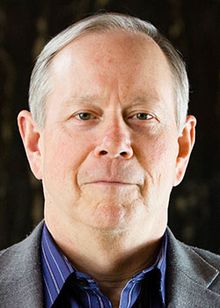
On the Thucydides trap, China expert Arthur Waldron said the Allison book fails to account for China’s major economic problems that are critical to gauging its future and also is historically inaccurate regarding the war between the two Greek city-states.
“The whole Thucydides Trap — not clear who coined this false phrase — does not exist, even in its prime example,” Mr. Waldron, emeritus professor at the University of Pennsylvania, wrote in an online review in 2017.
“The problem is the pervasive lack of knowledge of China — a country which is, after all, run by the Communist Party, the police, and the army, and thus difficult to get to know. This black hole of information has perversely created an overabundance of fantasies, some very pessimistic, some as absurdly bright as a foreigner on the payroll can make them,” he said.
Contact the author
Please read our comment policy before commenting.